
Guide
Pesticide application record keeping: what to write down, and for how long.
The record is the part of the job the inspector reads. Federal law sets a floor for restricted-use products; every state sets its own rules for commercial applicators, and nearly all of them want a record of every application, written within a day or two, kept for two to three years. Here is the field list that satisfies the common requirements, what a few states add, and how to keep it without a binder in the truck.
Key takeaways
- Record every application, not just restricted-use products. State commercial rules require it almost everywhere.
- Write it the same day. Most states allow a day or two; an inspector reads a late record as a reconstructed one.
- The core fields: date, site and customer, target pest, product and EPA registration number, rate and total amount, method, applicator and license number. Several states add weather.
- Keep records two years at minimum, three in a number of states. Keep them where you can produce them on request.
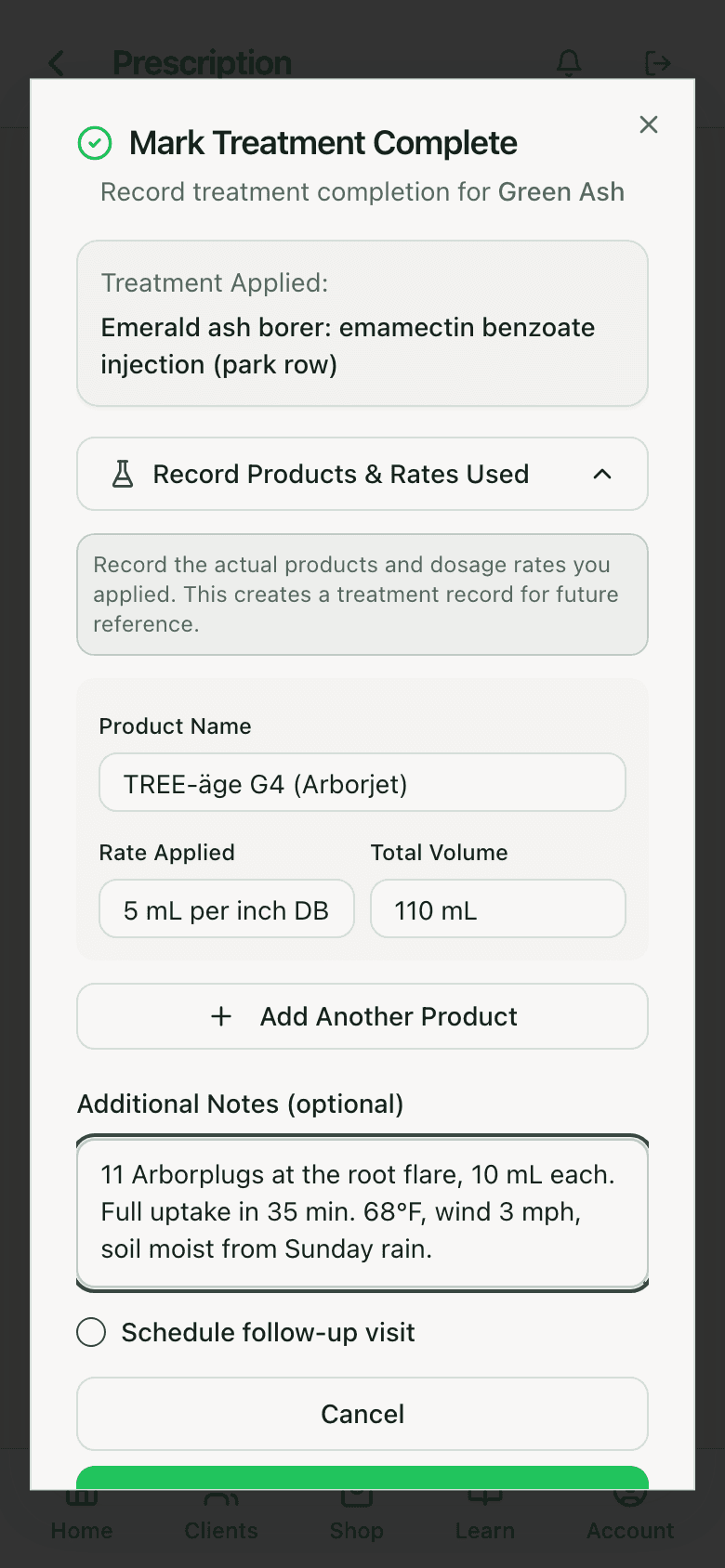
- The best record is the one written when the treatment is marked complete, on the tree it went into.
The federal floor
Under FIFRA and the USDA record-keeping rule, certified private applicators must keep records of restricted-use pesticide applications for two years, recorded within 14 days, with the product name and EPA registration number, total amount, size of the treated area, crop or site, location, date, and the applicator's name and certification number. Commercial applicators must keep the same RUP records and provide a copy to the customer within 30 days. That is the floor. Almost nobody in tree care operates at the floor, because the states built on it.
What the states add
Most states require commercial applicators to record every application, restricted or general use. Most set a deadline of the same day or within a day or two, and a retention period of two or three years. Many add fields: the customer's name and address, the target pest, wind speed and direction, temperature, the application equipment, the start and end time, and the re-entry interval if the label has one. A few require the record to be given to the customer at the time of service, and several require specific posting or notification for applications on school, daycare, and public property. The state licensing page lists the agency that publishes each state's rule.
The field list
A record with these fields satisfies the federal rule and the common state requirements. Add the state-specific ones for where you work.
Application record fields
Date and time
- What to write
- Date of application; start and end time where required
- Where PHC Rx gets it
- Completion timestamp on the treatment
Customer and site
- What to write
- Name, address, and the specific tree or area treated
- Where PHC Rx gets it
- Client and plant record on the prescription
Target pest or disease
- What to write
- What the application was for
- Where PHC Rx gets it
- Target on the prescription
Product
- What to write
- Brand name as on the label
- Where PHC Rx gets it
- Product on the completion record
EPA registration number
- What to write
- From the label
- Where PHC Rx gets it
- Product entry in the label library
Rate and total amount
- What to write
- Rate per inch or per gallon, and the total applied
- Where PHC Rx gets it
- Rate applied and total volume on the completion record
Method and equipment
- What to write
- Trunk injection, soil injection, drench, basal bark, foliar; the equipment used
- Where PHC Rx gets it
- Treatment type on the prescription; equipment in notes
Applicator
- What to write
- Name and license number; supervisor if a technician applied
- Where PHC Rx gets it
- Account that completed it; license on the profile
Weather
- What to write
- Wind speed and direction, temperature, where required
- Where PHC Rx gets it
- Notes on the completion record
REI and posting
- What to write
- Re-entry interval if the label has one; posting done
- Where PHC Rx gets it
- Product REI in the calculator; posting in notes
Writing it the same day
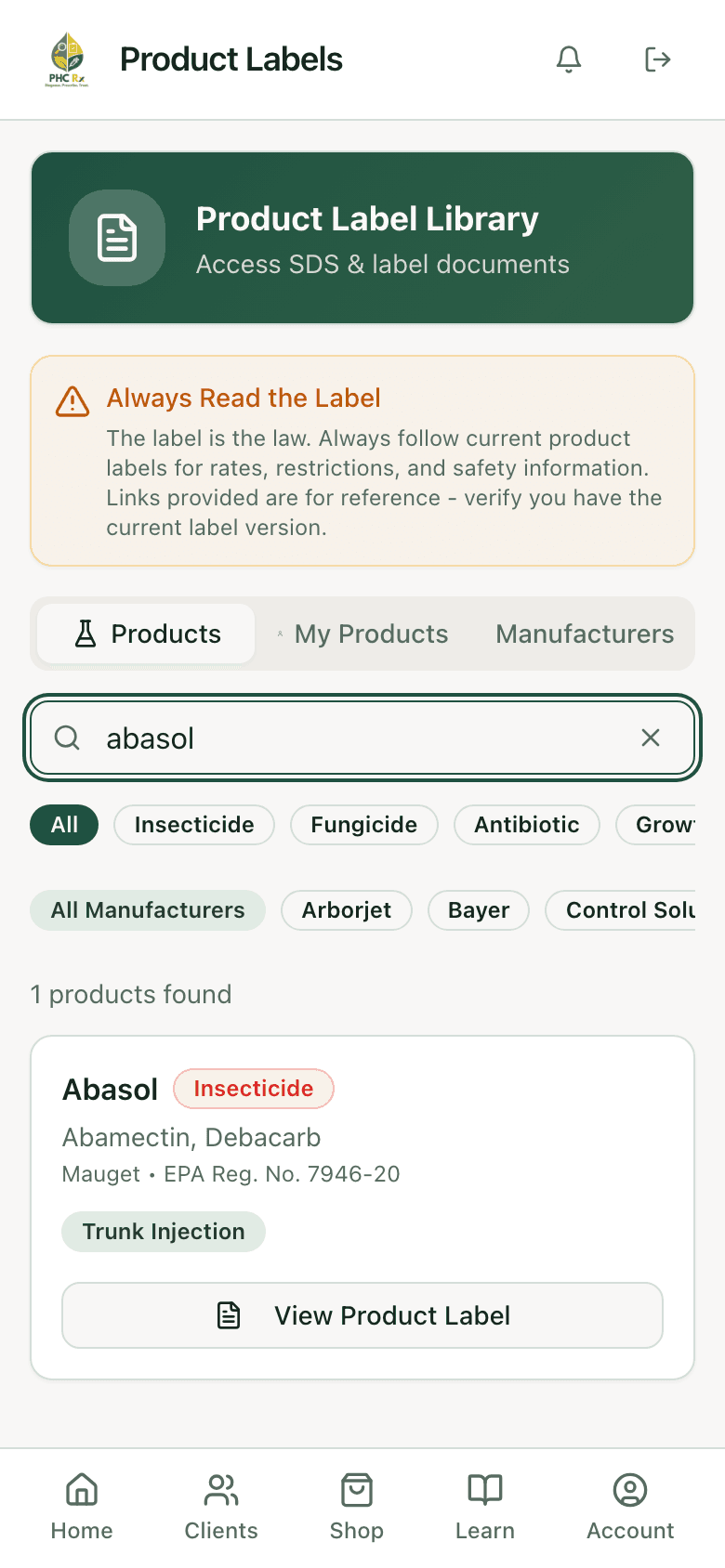
A record written Friday for Tuesday's work is reconstructed from memory, and the inspector reads it that way. The rule in most states is same day or within a day or two, and the practical rule is: the record is written when the product goes in, on site, by the person who applied it. That means the record has to be easy to write. A form in the truck works if the truck is where the tech is. A prescription on the phone that asks for the product, the rate, the volume, and the conditions when the tech taps Mark Complete works because the tech is already holding the phone.
Keeping it
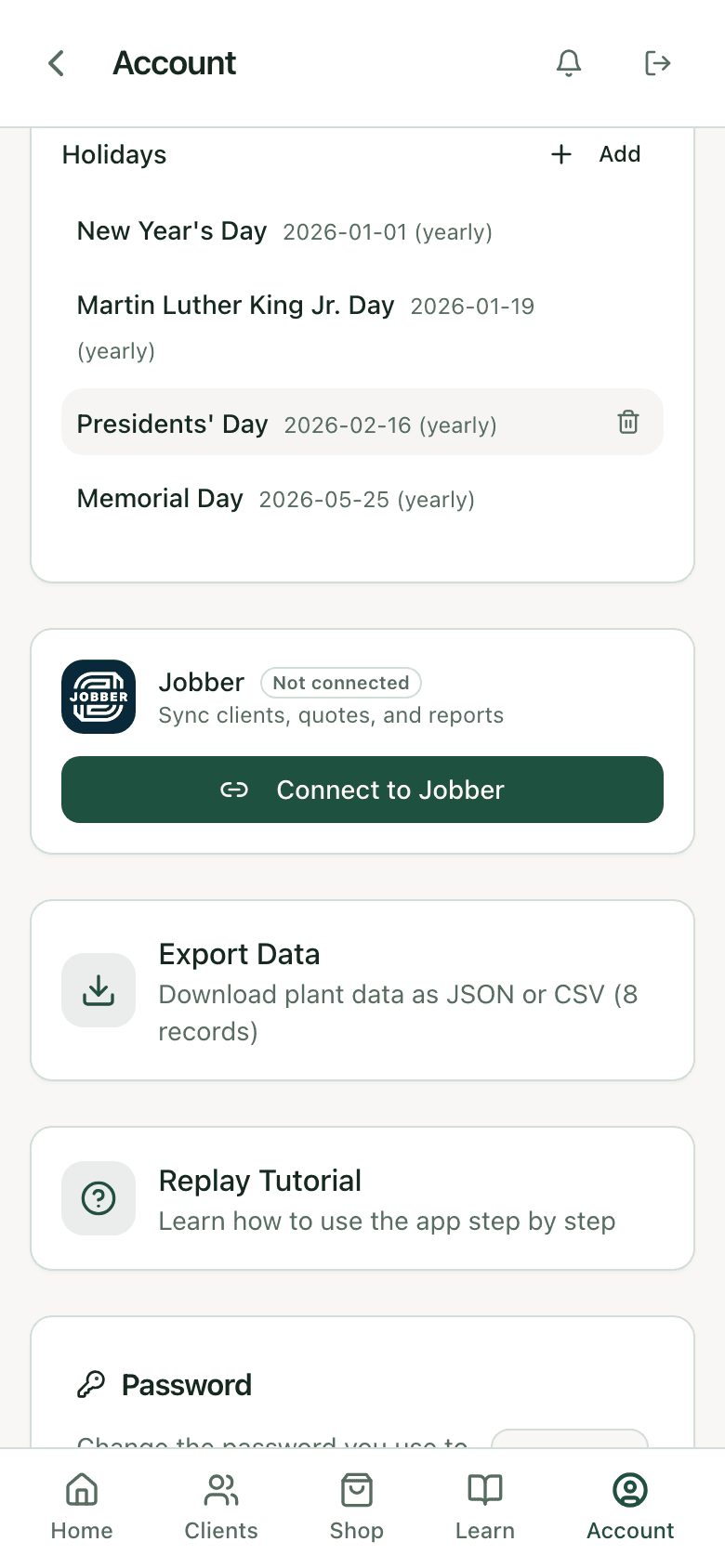
Two years is the federal minimum and the shortest state period; three years is common. Keep records where you can produce them for an inspector on request, which in most states means within a few days. Paper in a filing cabinet works until the cabinet is in a truck that was sold. A record on the tree, in a database, exported to CSV once a season into the compliance folder, is the version that survives staff turnover. In PHC Rx the record stays on the plant and exports as JSON or CSV from settings.
Records the client keeps
Several states require the applicator to give the customer a copy of the record or a summary at the time of service: product, rate, target, REI, precautions. The prescription the client accepted already carries the product, the rate, and the target, and the completion adds the date and the applied amount, so the client-facing document is the record. Send it as a link from the report and it is on their phone and in your send history.
The record you will be asked for
- A state inspection: every application for the period, usually pulled by date range or by product.
- A complaint: every application at one address, with the products, rates, and weather.
- A tree that died: everything ever applied to that tree, with dates, which is why the record lives on the tree.
- A restricted-use audit: purchase records against application records for the RUP.
- An insurance claim: the label check that was run before the application, and the applicator's license.
Written and reviewed by
ISA Board Certified Master Arborist MA-5832B · ISA TRAQ · Maryland Licensed Tree Expert #2168
Alex Shy is an ISA Board Certified Master Arborist, TRAQ-qualified tree risk assessor, and Maryland Licensed Tree Expert. He holds a B.S. in Forest Resource Management from West Virginia University. Alex is the founder and president of Mobile Tree Spa LLC, founder and co-owner of the PHC Rx diagnostic app, and a member of the ATCP board, where he oversees the education committee. His work focuses on making science-based plant health care practical, profitable, and easy for tree care companies to adopt.
ISA Certified Arborist MA-7027A · VNLA Certified Horticulturist · Virginia Commercial Pesticide Applicator
Jordan Thompson is an ISA Certified Arborist, VNLA Certified Horticulturist, Virginia Commercial Pesticide Applicator, and co-owner of J.J. Mauget Co. and TIPCO. She holds an M.S. in Entomology and a B.S. in Environmental Horticulture from Virginia Tech. Her work bridges arboriculture, plant health care, and applied research, with a particular focus on tree injection, invasive species, tree disease management, and translating university research into practical tools for professional arborists.
FAQ
Questions arborists ask
What records are required for pesticide applications?
Federally, restricted-use applications: date, product and EPA number, amount, site and location, crop or site, applicator name and certification number, kept two years. State commercial rules extend that to every application, add fields such as customer, target pest, method, and weather, and set the deadline at the same day or within a day or two.
How long do I have to keep pesticide application records?
Two years federally and in the shortest states; three years in a number of states. Keep them where you can produce them within a few days of a request.
Do I need to record general-use pesticide applications?
As a commercial applicator, in nearly every state, yes. The federal RUP rule is the floor; state rules cover every application for hire.
Do I need to record weather?
Several states require wind speed and direction and temperature for outdoor applications. Recording it everywhere costs nothing and answers the drift complaint before it is filed.
Can I keep the records electronically?
Yes, in every state, provided you can produce them on request. Export a copy each season to a compliance folder so the records exist outside any one app or account.
Where is the template?
A printable record sheet is on the record template page. The app writes the same fields when a treatment is marked complete.
Related