
Free download
Pesticide application record template, one sheet, every field a state asks for.
The federal rule sets eight fields for restricted-use products. Most states add start and end time, wind, temperature, REI posting, and the supervising licensee, and they want them for every application, not just the restricted ones. This is one sheet per applicator per day with all of it, a printable version, and the same fields the app writes when a treatment is marked complete.
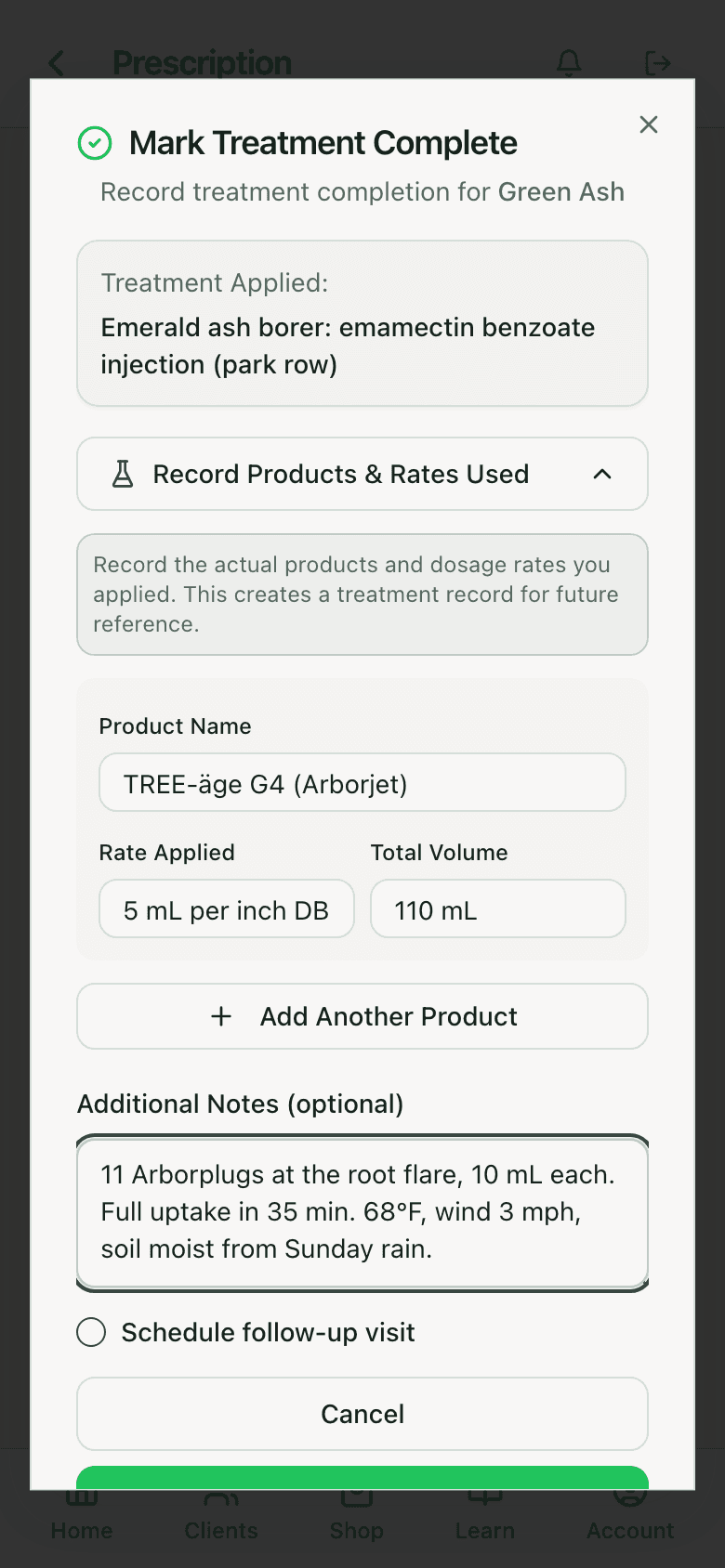
Download the blank version, or skip the paper and fill it in the app.
Field by field
What goes in each box, and why
Applicator and day
Date, applicator name, license number and category, state, company, supervising licensee if a technician applied, vehicle or rig.
One sheet per applicator per day is the unit an inspector asks for. The supervising licensee line is the one technicians forget and the one that turns a routine records check into a violation.
Start and end time
Clock time the application started and finished, per application.
Required by many states for all applications and by the label for some products. It is also the number that settles a drift complaint from the neighbor.
Client and site address
The property, and enough of the location to find the tree: front yard, rear, tree number.
The federal rule calls this "location"; state rules say address. Either way it must be findable by someone who was not there.
Trees or host and DBH
Species and DBH of each tree treated, or the count and size band for a spray across many.
DBH is what the rate was calculated from. A record with a rate per inch and no DBH cannot be checked.
Target pest or disease
What the application was for.
The label lists pests; the record ties the product to one of them. It also lets you look up next year whether the treatment worked.
Product and EPA registration number
Brand name as it appears on the label and the EPA registration number, per product.
The two fields every rule agrees on. The registration number is the product's identity; the brand name alone is not enough when a manufacturer sells three concentrations under similar names.
Rate and total applied
The rate (per inch of DBH, per gallon, per 1,000 square feet) and the total amount of product used.
Total is product, not finished spray. Write the mix ratio in notes for sprays. The total across the day is what reconciles against inventory and against the label's maximum per acre or per year.
Method
Trunk injection, soil drench, soil injection, foliar spray, bark spray, basal.
The method changes what else is required: injection has no drift or REI posting; spray needs wind, temperature, and posting.
Wind, temperature, REI, posting
Wind speed and direction, temperature, the product's restricted entry interval in hours, and whether the site was posted.
Where the state requires weather it is usually for sprays only, and the label's wind limit is a legal maximum. REI and posting are what protect the client's family and your crew on the next visit.
Restricted-use products
The federal record for any restricted-use product: product and EPA number, total amount, size of area treated, crop or site, location, date, certified applicator name and certification number.
Federal rule 7 CFR Part 110 for certified commercial applicators. Kept for two years and available to the state agency on request. The main log covers most of it; this block makes sure nothing is missing on the applications that get audited.
Notes and client copy
Sensitive sites nearby (bees, water, school, organic neighbor), how the client was notified, signature.
Several states require notification and some require a written copy to the customer. The signature is what makes the sheet a record instead of a note.
How to complete it
Step by step
1
Fill the header at the truck in the morning
Date, applicator, license, supervisor, rig. Thirty seconds, once, and every row on the sheet inherits it.
2
Write each application when the product goes in
Not at the end of the day. The rate and the total are on the calculator screen or the injection rig; the wind and temperature are on the phone. Ten seconds per row at the tree is accurate; ten rows at the desk at 6 pm is a guess.
3
Restricted-use block for anything on the RUP list
Most trunk injection products are general use; some sprays are not. Check the label's first page. If it says restricted use, fill the federal block as well as the log row.
4
Notes, notification, signature
Sensitive sites, how the client was told, and a signature. If the state wants a customer copy, this sheet is it.
5
File it and export it
Two years minimum, three in some states, and the state agency can ask for it. In PHC Rx the record is written when the treatment is marked complete and exports by season as a spreadsheet.
About the download
One page: applicator header, a twelve-row application log with the fields above, the federal restricted-use block, and notes with a signature. It is a PHC Rx layout built to satisfy the common state requirements on top of the federal rule; it does not replace a state's own form where one is mandated. The record keeping guide walks the federal floor, what the states add, and how long to keep it.
The record the app writes for you
When a treatment is marked complete in PHC Rx, the record is written against the tree: product from the label library with its EPA number, rate and total volume from the calculator, method, applicator from the account, REI from the product, completion timestamp, and notes. Wind and temperature go in the notes where the state wants them. The season's records export as a spreadsheet from settings, sorted by applicator, product, or client, which is the format an inspector actually reads.
FAQ
Questions arborists ask
What has to be on a pesticide application record?
Federally, for restricted-use products: product name and EPA registration number, total amount, size of area treated, crop or site, location, date, and the certified applicator's name and number. Most states add start and end time, wind and temperature for sprays, target pest, rate, REI posting, and the supervising licensee, and apply it to every application. The sheet has all of them.
How long do I keep pesticide records?
Two years under the federal rule; several states require three, and some longer for certain products. Keep them in a form the state agency can read on request, which in practice means a folder of sheets or an export from the app.
Do I need to record weather for a trunk injection?
Usually not. Weather fields exist for drift, and an injection does not drift. Record the temperature anyway if the label sets a minimum for uptake, and leave wind blank.
Is a spray log the same thing?
A spray log is the same record for foliar and bark applications, where wind, temperature, and posting matter most. This sheet covers sprays and injections on the same page; the method column tells them apart.
Where is the state list?
The record keeping guide covers what the states add on top of the federal fields, and the applicator license page lists the agency for each state. Confirm with your state's agency before an audit, not after.
Related