
Treatment guide
Bacterial leaf scorch treatment: what oxytetracycline can and cannot do
There is no cure. There is a spring oxytetracycline injection that holds the symptoms back for a season, sometimes two, and buys a pin oak another decade of shade. Rates per inch, the window, how to tell it from drought scorch, and the conversation to have with the client before the first capsule goes in.
disease
Bacterial leaf scorchXylella fastidiosa
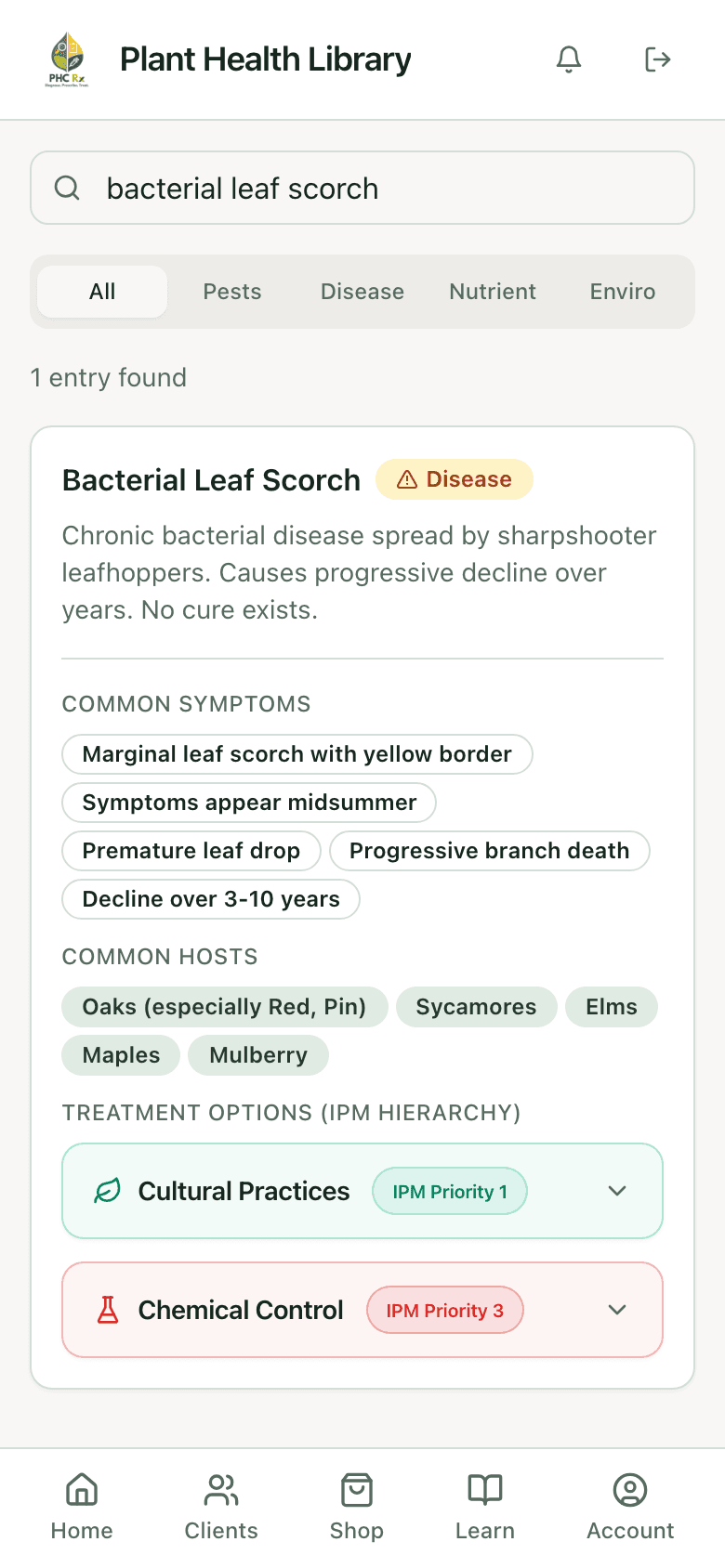
A xylem-limited bacterium spread by leafhoppers and spittlebugs. It multiplies in the water-conducting tissue, plugs it, and the leaves farthest from the roots dry out from the edge inward in late summer. The tree leafs out normally every spring and scorches every August, a little worse each year, until whole limbs stop leafing out. Decline takes five to ten years on an oak. The bacterium is in the tree for good; every treatment is management.
Symptoms (the tree's response)
- Marginal leaf browning with a yellow or reddish band between dead and green tissue, starting in July or August
- Symptoms on the oldest leaves and outer canopy first, spreading inward over years
- Early leaf drop on affected limbs
- Branch dieback and thinning canopy after several seasons
- Same limbs worse each year, in the same order
Signs (the organism itself)
- No fungal fruiting bodies and no cankers; the scorch has no organism you can see
- Lab confirmation by ELISA or PCR on a petiole sample in August, which is the only way to be sure
- Leafhoppers on the property, though they are everywhere
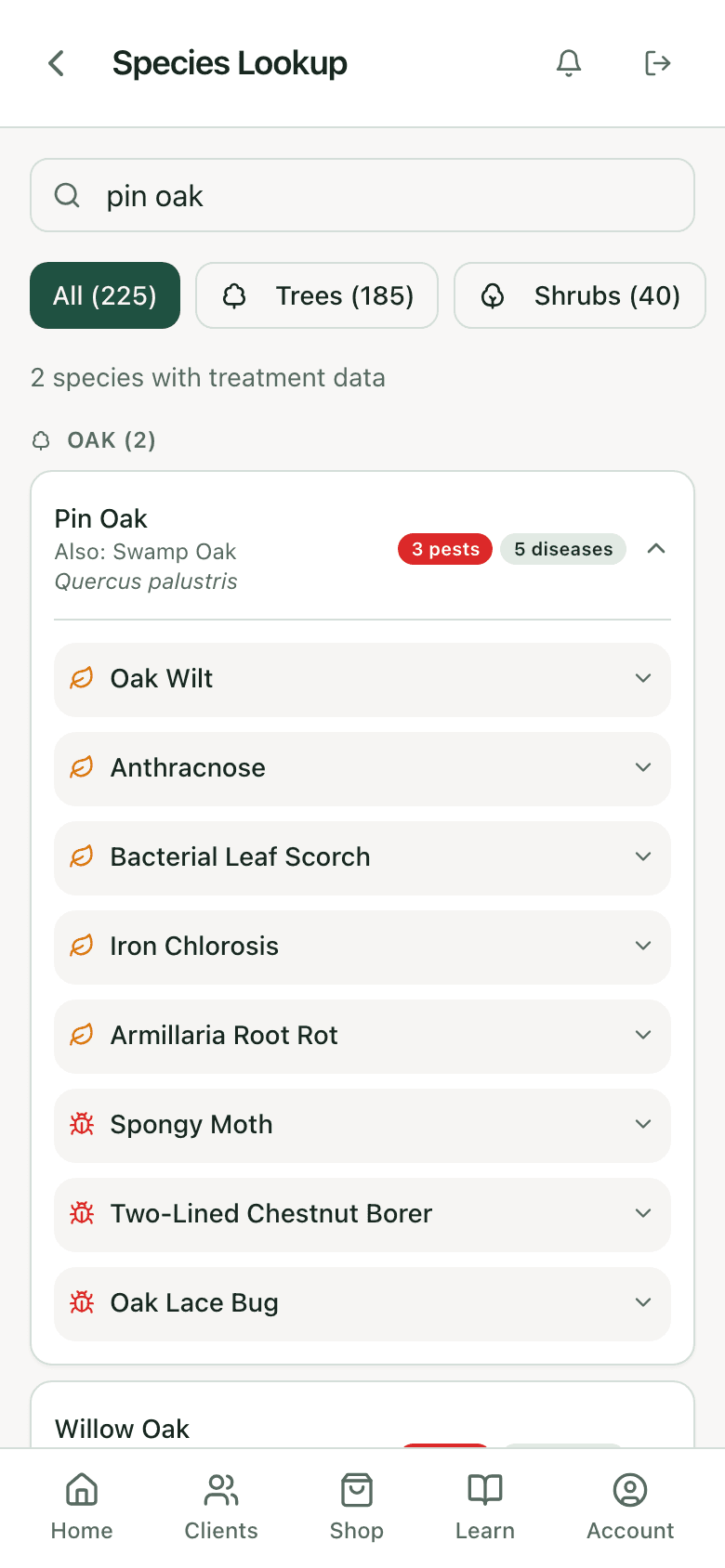
Common hosts: Pin oak, red oak, and the rest of the red oak group, Sycamore and London plane, American elm, Red and sugar maple, Mulberry, Sweetgum, Oleander in the South and West
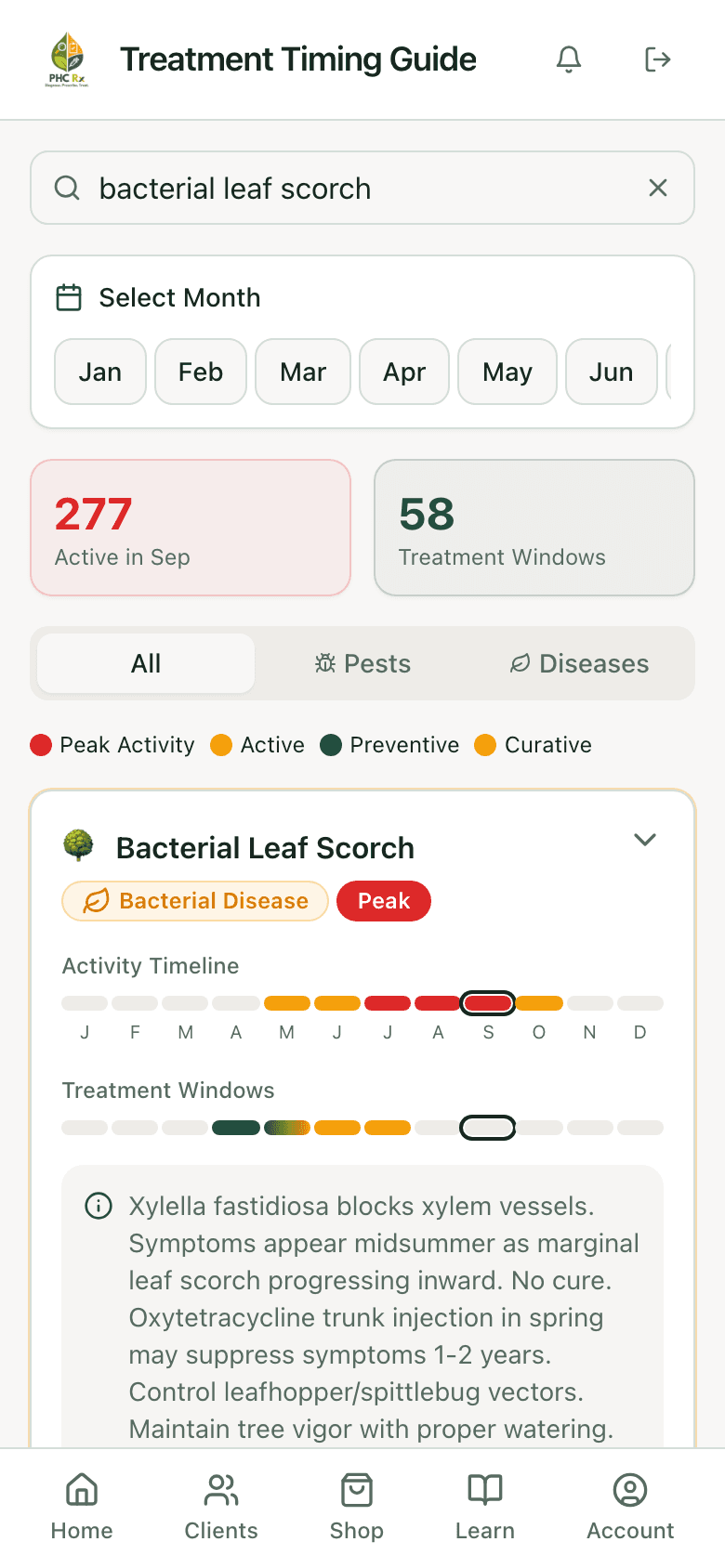
Timing window
6 active monthsOrganism active
Preventive treatment
Curative treatment
Inject in spring after full leaf expansion, May into early June in most of the range, when the tree is moving water hard and the antibiotic distributes. A single application suppresses scorch for that season; some trees hold for two. Sample for lab confirmation in August when the bacterial load is highest. Do not inject in the heat of late summer or when the tree is drought stressed, because uptake is poor.
Treatment options
Product, rate, delivery, timing
Rates below are per inch of trunk diameter at breast height unless the row says otherwise. The registered label wins over anything on this page.
Arbor-OTC (Mauget)
- Active ingredient
- Oxytetracycline Hydrochloride
- Rate
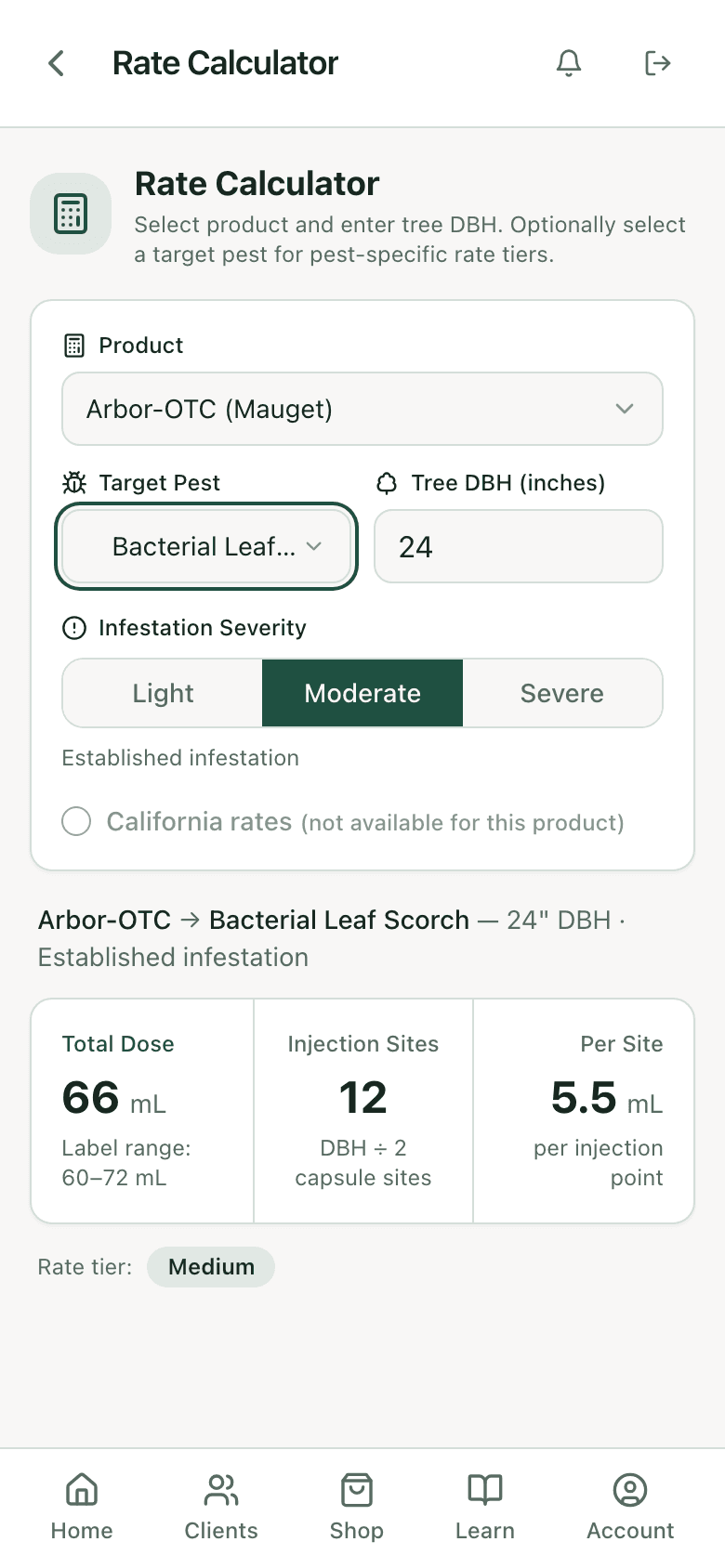
- Capsule micro-injection by DBH band. A 24 inch pin oak is 60 to 72 mL low, 60 to 72 mL medium, 60 to 72 mL high (label band 20 to 24 in); a 30 inch sycamore is 72 to 90 mL low, 72 to 90 mL medium, 72 to 90 mL high (label band 25 to 30 in)
- Delivery
- Mauget capsule micro-injection at the root flare, capsules spaced around the trunk
- Timing
- Late spring after full leaf-out, when the tree is transpiring
- Frequency
- Annually; some trees hold two seasons
MYCOJECT® ULTRA (Mauget)
- Active ingredient
- Oxytetracycline Hydrochloride
- Rate
- Capsule micro-injection by DBH band; a 24 inch tree is 60 to 72 mL low, 60 to 72 mL medium, 60 to 72 mL high (label band 20 to 24 in)
- Delivery
- Mauget capsule micro-injection
- Timing
- Late spring after full leaf-out
- Frequency
- Every 3 to 4 months for severe infections; typically annual.
Cultural: water, mulch, and pruning
- Active ingredient
- none
- Rate
- Deep irrigation through July and August droughts; 2 to 4 inches of mulch out to the dripline where possible
- Delivery
- Client instructions on the prescription, with the irrigation schedule written out
- Timing
- Every summer, starting the year of diagnosis
- Frequency
- Ongoing
- Arbor-OTC (Mauget): Oxytetracycline, the only chemistry with a label and data for this disease. It does not kill the bacterium. It knocks the population down enough that the xylem keeps moving water through August, and the tree keeps its leaves. Response is judged next August, not next month.
- MYCOJECT® ULTRA (Mauget): Oxytetracycline at a higher concentration, the choice on a large oak or a tree that scorched hard last year. Same rules: spring, moving water, annual.
- Cultural: water, mulch, and pruning: Water stress and xylem plugging add up. A scorching oak in a wet August looks fine; the same tree in a dry August loses limbs. Prune out dead wood in winter. Do not fertilize with nitrogen to push growth, which makes more leaves the plugged xylem cannot supply.
Worked examples
Dose per tree
Arbor-OTC, capsule micro-injection
24″ DBH
60 to 72 mL low, 60 to 72 mL medium, 60 to 72 mL high (label band 20 to 24 in)
Arbor-OTC, capsule micro-injection
30″ DBH
72 to 90 mL low, 72 to 90 mL medium, 72 to 90 mL high (label band 25 to 30 in)
MYCOJECT® ULTRA, capsule micro-injection
24″ DBH
60 to 72 mL low, 60 to 72 mL medium, 60 to 72 mL high (label band 20 to 24 in)
MYCOJECT® ULTRA, capsule micro-injection
36″ DBH
90 to 108 mL low, 90 to 108 mL medium, 90 to 108 mL high (label band 31 to 36 in)
Want the number for the tree in front of you? Use the tree injection rate calculator.
Scorch or scorch
Drought scorch, root damage from a driveway cut, and bacterial leaf scorch all brown a leaf from the margin in August. The tells for Xylella are the colored band between brown and green, symptoms that come back in the same limbs a little worse every year, and a tree that looked fine in June. Drought scorch hits the whole canopy at once and clears up in a wet year. Root damage follows the side of the tree that was cut.
The diagnosis in the app weighs those findings and gives you a confidence number. Below about 70 percent, send a petiole sample to a lab in August before you sell a treatment program the client will be paying for every spring for the rest of the tree's life.
The conversation
The client needs to hear three things before the first injection: the tree has a disease it will not recover from, the treatment slows it down and does not stop it, and the program is annual. Framed that way, a $400 spring injection on a 24 inch pin oak that shades the house is an easy yes for as long as the tree holds its canopy. Skipped, the same client is angry in year three when the tree is still declining and they thought they had paid to fix it. Put the prognosis on the prescription in plain words and let them approve it from the link.
What the label check will catch
Oxytetracycline is labeled for bacterial leaf scorch on the hosts above, so the disease check passes. The label check flags an application scheduled after mid-July when uptake drops, a second application inside the label's minimum interval, and a DBH under the table minimum. It also flags the thing crews do most often on this disease, which is inject a propiconazole because the leaves look like anthracnose. Propiconazole does nothing to a bacterium.
Label check
1 warningLast application was 14 days ago. Proceed with a documented override, or reschedule.
Pricing the job
Per inch of DBH, annually, sold as a multi-year program. A 24 inch oak at $16 per inch is $384 a year; a 30 inch sycamore is $480. Add the irrigation and mulch line as a separate service or a written instruction. Put next May on the calendar the day you finish this one, with the product and capsule count on the event, so the record is there when the client asks whether it worked.
Products on this page
FAQ
Questions arborists ask
Can bacterial leaf scorch be cured?
No. Xylella fastidiosa stays in the tree. Oxytetracycline trunk injections in spring suppress the symptoms for a season and slow the decline, and good watering through summer droughts helps the tree cope. The program is annual for the life of the tree.
How do you treat bacterial leaf scorch on an oak?
Inject oxytetracycline at the root flare in late spring after the leaves are fully out. A 24 inch pin oak takes 60 to 72 mL low, 60 to 72 mL medium, 60 to 72 mL high (label band 20 to 24 in) from the Arbor-OTC rate table. Water deeply in July and August, mulch, and prune dead wood in winter.
When is the best time to inject for bacterial leaf scorch?
May into early June, when the canopy is full and the tree is moving water. Late summer injections take up poorly. Judge the result the following August by comparing scorch to the year before.
How do I know it is bacterial and not drought?
Bacterial scorch shows a yellow or reddish band between the brown margin and the green center, returns to the same limbs a little worse each year, and shows up in a tree that looked normal in June. A lab test on petioles collected in August confirms it.
How long will the tree live?
Five to ten years untreated on most oaks, sometimes longer on a well-watered tree. Annual injections plus irrigation can stretch that considerably. Plan for removal eventually and say so.
Where do these rates come from?
The PHC Rx product catalog, built from the Arbor-OTC and MYCOJECT ULTRA labels, and the app's timing guide for the injection window.
Related