
Guide
DBH calculator: circumference to diameter, and where to measure.
DBH is the diameter of the trunk at 4.5 feet above the ground, in inches. Every injection dose, most PHC prices, and every risk assessment form starts with it. Measure the circumference with any tape and divide by 3.14, or read it straight off a diameter tape. The table below does the division. The rest of the page is the rules for slopes, leaners, forks, and trees that bulge at exactly 4.5 feet.
Key takeaways
- DBH is diameter at breast height: 4.5 feet (1.37 m) above the ground on the uphill side of the tree.
- Circumference divided by pi (3.1416) is the diameter. A 63 inch circumference is a 20 inch DBH.
- Multi-stem trees: measure each stem at 4.5 feet and follow the label's method for combining them.
- A bulge, wound, or branch at 4.5 feet: measure the narrowest point below it, and note it.
- Record DBH on the plant record once, with the date. Retreat doses two years later use the same number.
Circumference to DBH
Wrap a flexible tape around the trunk at 4.5 feet, keeping it level and snug, and read the circumference. Divide by 3.1416 for the diameter. A diameter tape (D-tape) has the division printed on it and reads DBH directly; a logger's tape or a cloth tape needs the table.
Circumference in inches to DBH in inches (circumference divided by pi)
12.6
- DBH
- 4
- Circumference
- 75.4
- DBH
- 24
18.8
- DBH
- 6
- Circumference
- 81.7
- DBH
- 26
25.1
- DBH
- 8
- Circumference
- 88.0
- DBH
- 28
31.4
- DBH
- 10
- Circumference
- 94.2
- DBH
- 30
37.7
- DBH
- 12
- Circumference
- 100.5
- DBH
- 32
44.0
- DBH
- 14
- Circumference
- 113.1
- DBH
- 36
50.3
- DBH
- 16
- Circumference
- 125.7
- DBH
- 40
56.5
- DBH
- 18
- Circumference
- 141.4
- DBH
- 45
62.8
- DBH
- 20
- Circumference
- 157.1
- DBH
- 50
69.1
- DBH
- 22
- Circumference
- 188.5
- DBH
- 60
Where 4.5 feet is
On level ground, 4.5 feet up the trunk from the soil surface, not from the top of the mulch. On a slope, measure from the ground on the uphill side. On a leaning tree, measure 4.5 feet along the trunk on the underside of the lean, and hold the tape perpendicular to the trunk, not level with the ground. A trunk that forks above 4.5 feet is one tree with one DBH; a fork below it is two stems.
Mark the height once with a stick cut to 4.5 feet or a mark on your tape handle. Eyeballing it drifts, and on a tree with taper a few inches of height is an inch of diameter.
Bulges, wounds, and branches at breast height
If 4.5 feet lands on a swelling, a burl, a wound, a branch collar, or a graft union, the measurement will overstate the tree. Measure at the narrowest point below the abnormality and record where you measured. For dosing, a smaller honest number beats a larger inflated one; the label is written for the wood that will carry the product, not the burl.
Multi-stem trees and clumps
Measure each stem that reaches 4.5 feet, at 4.5 feet, and record them individually. What you do next depends on the label and the purpose. For injection dosing, most labels have you dose each stem as its own tree and inject each one; a stem too small to inject gets no product. For a single "equivalent DBH" for a risk form or a price, the forestry convention is the square root of the sum of the squared diameters: three 8 inch stems are the square root of 192, about 13.9 inches equivalent, not 24. For pricing, plenty of companies sum the stems because the time and ports sum too. Pick one, write it on the record.
Three-stem clump, 8, 8, and 8 inches
Each stem separately
- Result
- 8, 8, 8
- Used for
- Injection dosing and port count
Sum of stems
- Result
- 24
- Used for
- Pricing on many companies' sheets; some soil labels
Equivalent DBH (root of sum of squares)
- Result
- 13.9
- Used for
- Risk assessment forms, inventories
How DBH drives the dose
Every systemic label doses by DBH, as a rate per inch or a table by band. The band matters: on the Propizol table a 20 inch oak is 190 to 210 mL low, 380 to 420 mL high (label band 19 to 21 in), while a 22 inch oak is 220 to 240 mL low, 440 to 480 mL high (label band 22 to 24 in). On TREE-äge G4 a 12 inch birch is 30 to 35 mL low, 35 to 90 mL medium, 90 to 120 mL high (label band 10 to 12 in) and a 16 inch birch is 42 to 55 mL low, 55 to 135 mL medium, 135 to 180 mL high (label band 16 to 18 in). Two inches of measurement error moves a tree across a band. The rate calculator takes the DBH and returns the dose, the port count, and the per-port volume; the number it starts from is yours.
Recording it
DBH goes on the plant record with the date it was measured. Trees grow: a 20 inch oak adds a quarter inch to a half inch a year, so a two-year retreat on the same number is close enough, and a ten-year-old record is not. In PHC Rx the DBH on the plant record feeds the calculator, the prescription price, and the risk assessment form, so it is measured once per visit and typed once.
Metric
Diameter at breast height in centimeters is measured at 1.3 meters in most of the world and 1.37 meters (4.5 feet) in the United States. Circumference in centimeters divided by 3.1416 gives DBH in centimeters; divide by 2.54 for inches. A 100 cm circumference is 31.8 cm DBH, or 12.5 inches. Labels sold in the United States dose in inches.
FAQ
Questions arborists ask
How do I calculate DBH from circumference?
Divide the circumference by pi, 3.1416. A 63 inch circumference is a 20 inch DBH. A diameter tape does the division for you.
What height is DBH measured at?
4.5 feet (1.37 meters) above the ground in the United States, on the uphill side on a slope, along the trunk on a leaning tree.
How do I measure DBH on a multi-stem tree?
Measure each stem at 4.5 feet. Dose each stem separately for injection. For a single equivalent number use the square root of the sum of the squared diameters, or sum them for pricing if that is your company's convention. Record which you did.
What if there is a branch or bulge at 4.5 feet?
Measure at the narrowest point below the abnormality and note it on the record.
Why does DBH matter so much for treatment?
Every systemic label doses by trunk diameter, most PHC prices are per inch, and the risk assessment form asks for it. A 2 inch error is roughly 10 percent of the dose and the price on a 20 inch tree.
Is there a DBH calculator in the app?
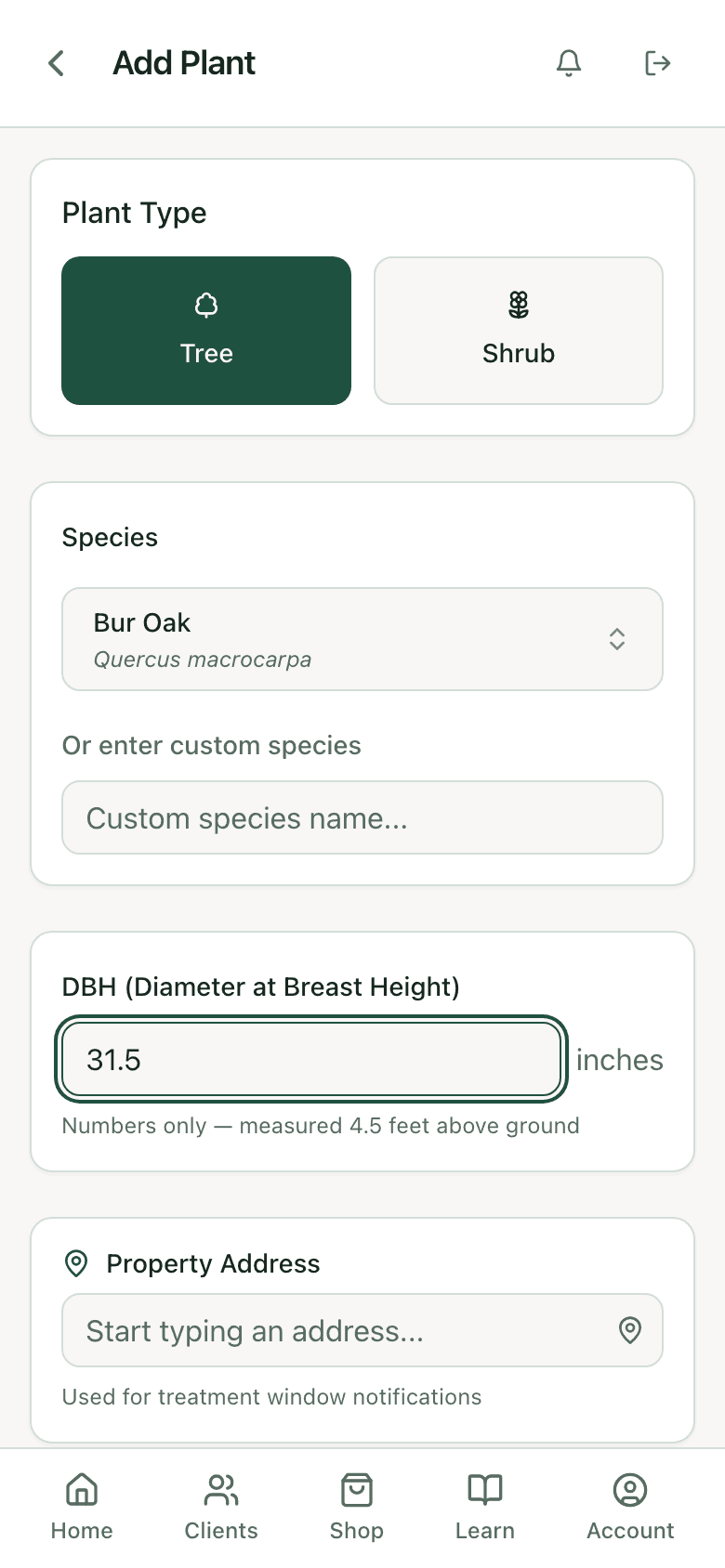
The plant record takes DBH in inches and the rate calculator turns it into a dose, port count, and per-port volume for the product you choose. The calculator.
Related