
Treatment guide
Hemlock woolly adelgid treatment: imidacloprid and dinotefuran rates
Two systemics do this job. Imidacloprid is slow to arrive and lasts for years. Dinotefuran is in the needles in two to three weeks and lasts one season. Most programs use both on a declining tree and imidacloprid alone on a healthy one. Rates per inch, the fall and spring windows, and the trees near water where only trunk injection is allowed.
pest
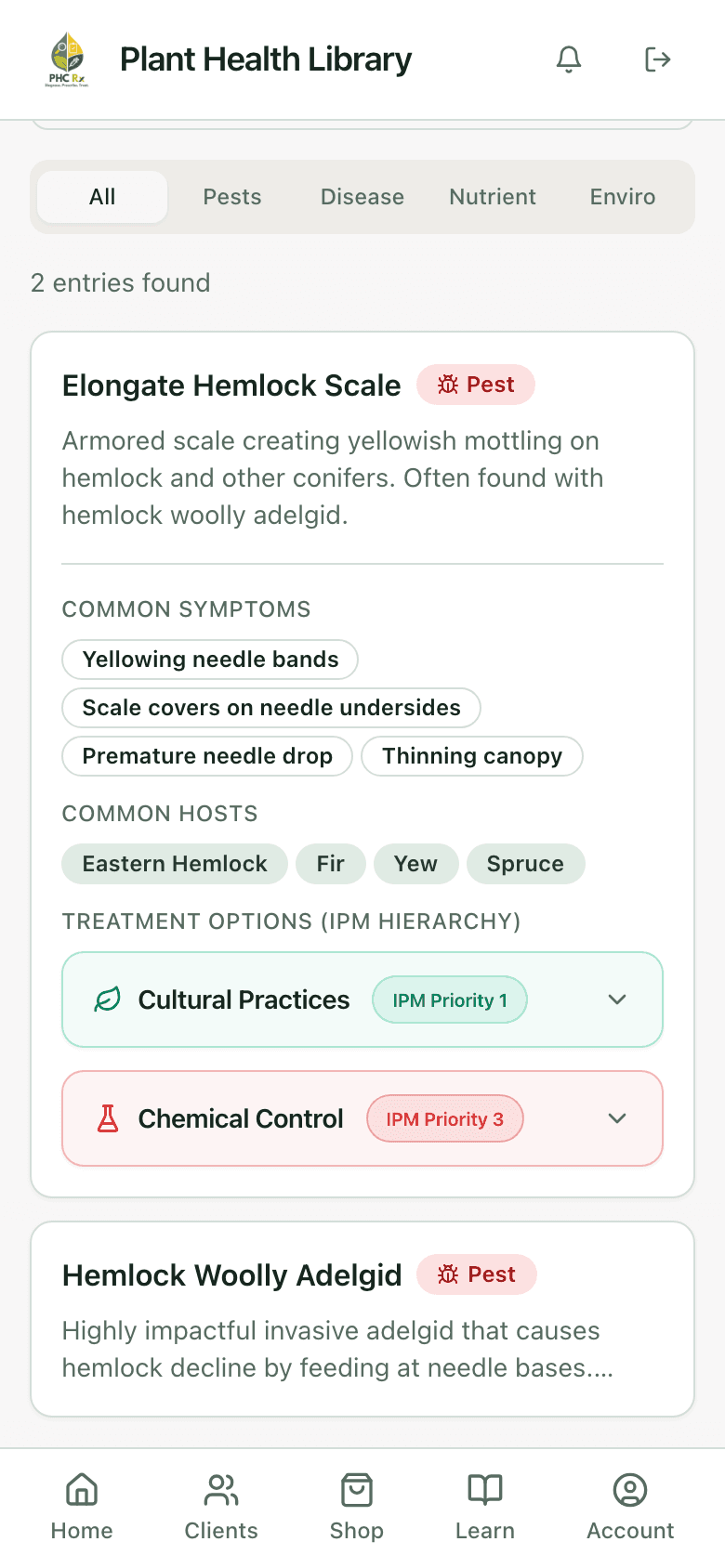
Hemlock woolly adelgidAdelges tsugae
A sap-feeding adelgid from Japan that settles at the base of the needles and feeds on stored starch in the twig. Two generations a year, both parthenogenetic, so one insect founds a colony. Untreated eastern hemlocks in the southern Appalachians die in four to ten years; further north it is slower. Biocontrol beetles (Laricobius, Sasajiscymnus) are established in places and help at the forest scale, not on the single tree by the porch.
Symptoms (the tree's response)
- Grayish-green needles instead of dark green
- Premature needle drop, starting on the lower and inner branches
- Crown thinning from the bottom up
- Little or no new growth on infested twigs
- Dieback and death
Signs (the organism itself)
- White cottony egg masses at the needle bases on the underside of twigs, most visible November through May
- Crawlers on new growth in early summer
Common hosts: Eastern hemlock (Tsuga canadensis), Carolina hemlock (Tsuga caroliniana)
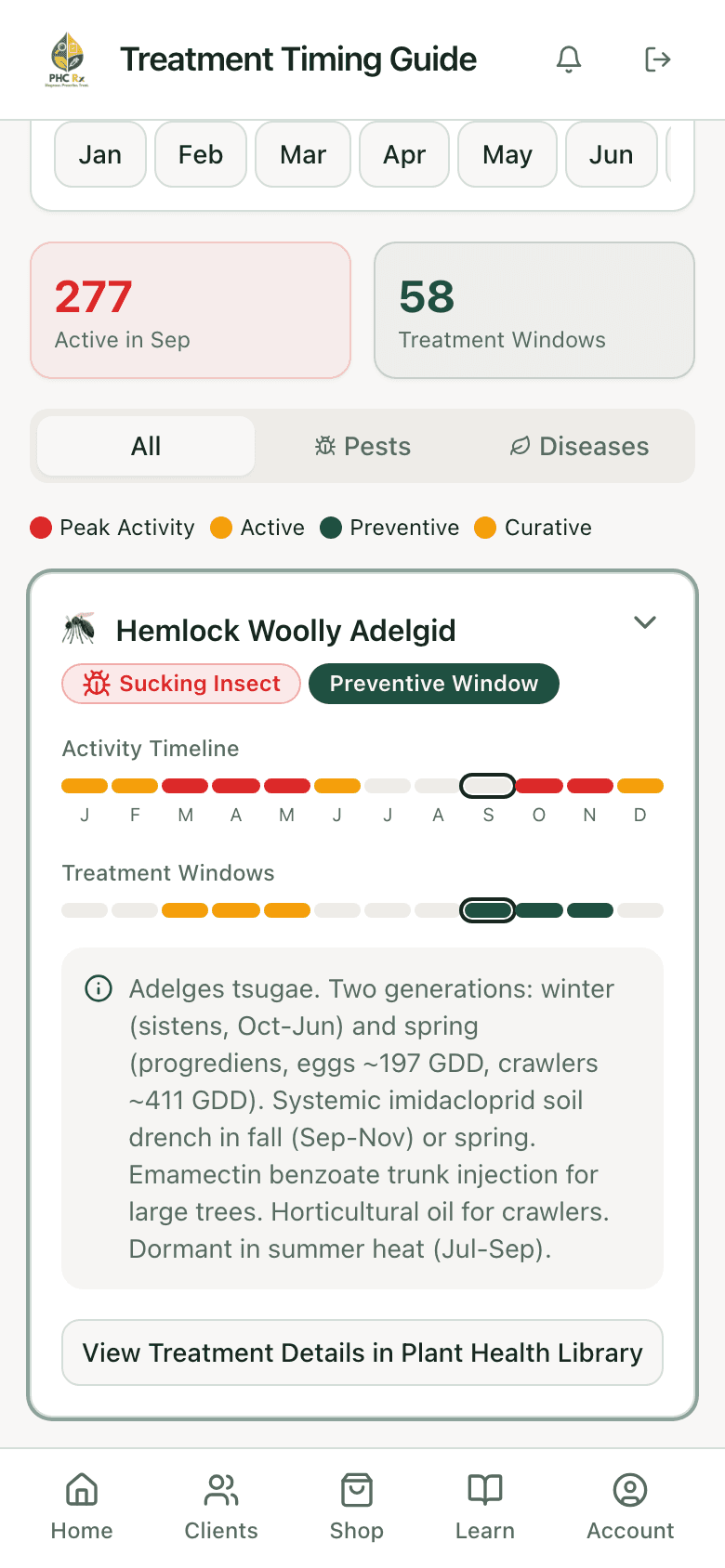
Timing window
8 active monthsOrganism active
Preventive treatment
Curative treatment
The adelgid feeds through the cool months and goes dormant in summer, so the treatment windows are fall (September through November) and spring (March through May). Soil applications need unfrozen, unsaturated soil and time to move: imidacloprid takes 90 days or more in a hemlock, dinotefuran two to three weeks. Trunk injection works any time the tree is moving water.
Treatment options
Product, rate, delivery, timing
Rates below are per inch of trunk diameter at breast height unless the row says otherwise. The registered label wins over anything on this page.
IMA-jet (Arborjet)
- Active ingredient
- Imidacloprid 5%
- Rate
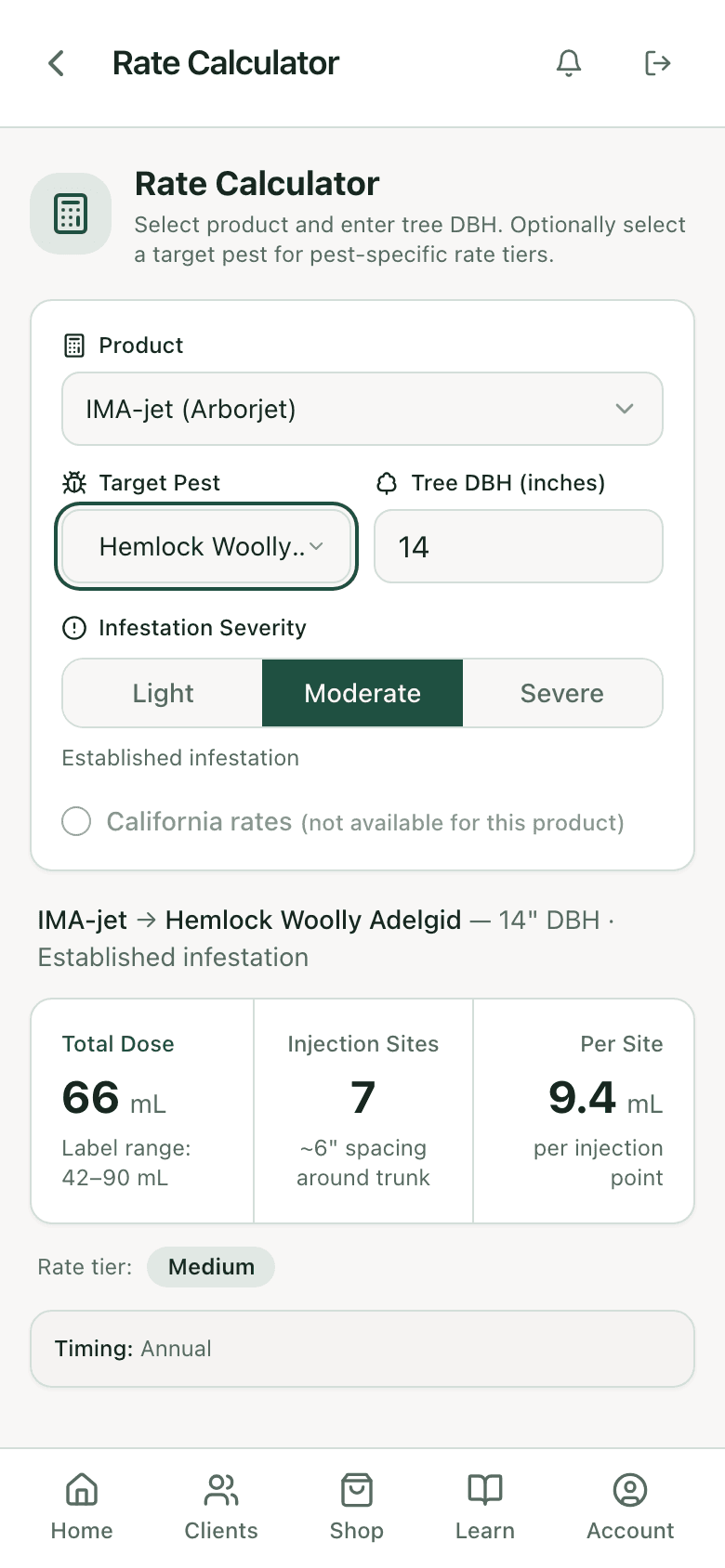
- Label table by DBH band with low, medium, and high tiers. A 14 inch hemlock is 26 to 60 mL low, 42 to 90 mL medium, 52 to 120 mL high (label band 13 to 15 in); a 20 inch tree is 38 to 84 mL low, 60 to 126 mL medium, 76 to 168 mL high (label band 19 to 21 in)
- Delivery
- Trunk injection, ports at DBH divided by 2
- Timing
- Fall or spring while the tree is transpiring
- Frequency
- Annually per label; Benton and colleagues at the USDA Forest Service (2015) measured imidacloprid still active in hemlock foliage seven years after a soil treatment, so many programs stretch it on healthy trees
Merit 2F (Bayer)
- Active ingredient
- Imidacloprid 21.4%
- Rate
- Per label, by DBH or by trunk circumference for soil injection and drench; the label steps the rate for larger trees
- Delivery
- Soil injection or soil drench in the root zone, within 18 inches of the trunk
- Timing
- Fall (September to November) or spring (March to May), soil above 40 F and not saturated
- Frequency
- Every 1 to 2 years depending on population
Safari 20 SG (Valent)
- Active ingredient
- Dinotefuran
- Rate
- Per label, by DBH for soil injection and drench, or by trunk area for basal bark spray
- Delivery
- Soil injection, soil drench, or basal bark spray on the lower trunk
- Timing
- Spring or fall, any time the soil is workable; the bark spray can go on in summer
- Frequency
- Annually
Dinocide (Mauget)
- Active ingredient
- Dinotefuran
- Rate
- Capsule micro-injection by DBH band; a 20 inch hemlock is 30 to 33 mL low, 40 to 44 mL high (label band 20 to 22 in)
- Delivery
- Mauget capsule micro-injection
- Timing
- When the tree is actively transpiring, spring through fall
- Frequency
- Annually, within the label's maximum annual rate
Horticultural Oil (Southern Ag)
- Active ingredient
- Mineral Oil 98%
- Rate
- Per label; 2 percent for a dormant application, 1 to 2 percent in season
- Delivery
- Foliar spray to drip, covering the undersides of the twigs
- Timing
- Dormant season or when crawlers are active in early summer
- Frequency
- As needed, with the label's minimum interval
- IMA-jet (Arborjet): The imidacloprid trunk injection in the PHC Rx library. Use it for hemlocks within 30 feet of water or on rock where a soil application is not allowed or will not work. IMA-jet 10 is the 10% version at half the volume.
- Merit 2F (Bayer): The long-residual option. Slow to arrive (90 days or more) and slow to fade. On a healthy hemlock this is the whole program. On a declining one, pair it with dinotefuran for the first year.
- Safari 20 SG (Valent): Dinotefuran. In the canopy in two to three weeks, which is why it goes on the tree that is already thin. One season of control. Also takes out elongate hemlock scale, which is usually on the same tree.
- Dinocide (Mauget): Dinotefuran by trunk injection, for the riparian hemlock that needs fast knockdown and cannot take a soil application.
- Horticultural Oil (Southern Ag): Contact only. Works on small trees you can cover completely and nothing else. A hedge, not a 60 foot hemlock.
Worked examples
Dose per tree
IMA-jet, from the label table
14″ DBH
26 to 60 mL low, 42 to 90 mL medium, 52 to 120 mL high (label band 13 to 15 in)
IMA-jet, from the label table
20″ DBH
38 to 84 mL low, 60 to 126 mL medium, 76 to 168 mL high (label band 19 to 21 in)
Dinocide, capsule micro-injection
20″ DBH
30 to 33 mL low, 40 to 44 mL high (label band 20 to 22 in)
Merit 2F, soil injection
24″ DBH
Per label by DBH; the label steps the rate up for larger trees. Add the water the label calls for and inject within 18 inches of the trunk
Want the number for the tree in front of you? Use the tree injection rate calculator.
Imidacloprid or dinotefuran, or both
The choice is about speed and residual. Imidacloprid moves slowly into a hemlock, three months or more from a soil application, and then stays effective for years; the Forest Service work in the Appalachians found it still controlling adelgid five to seven years after a single soil injection on some trees. Dinotefuran is water soluble and moves in weeks, then is gone by the next season.
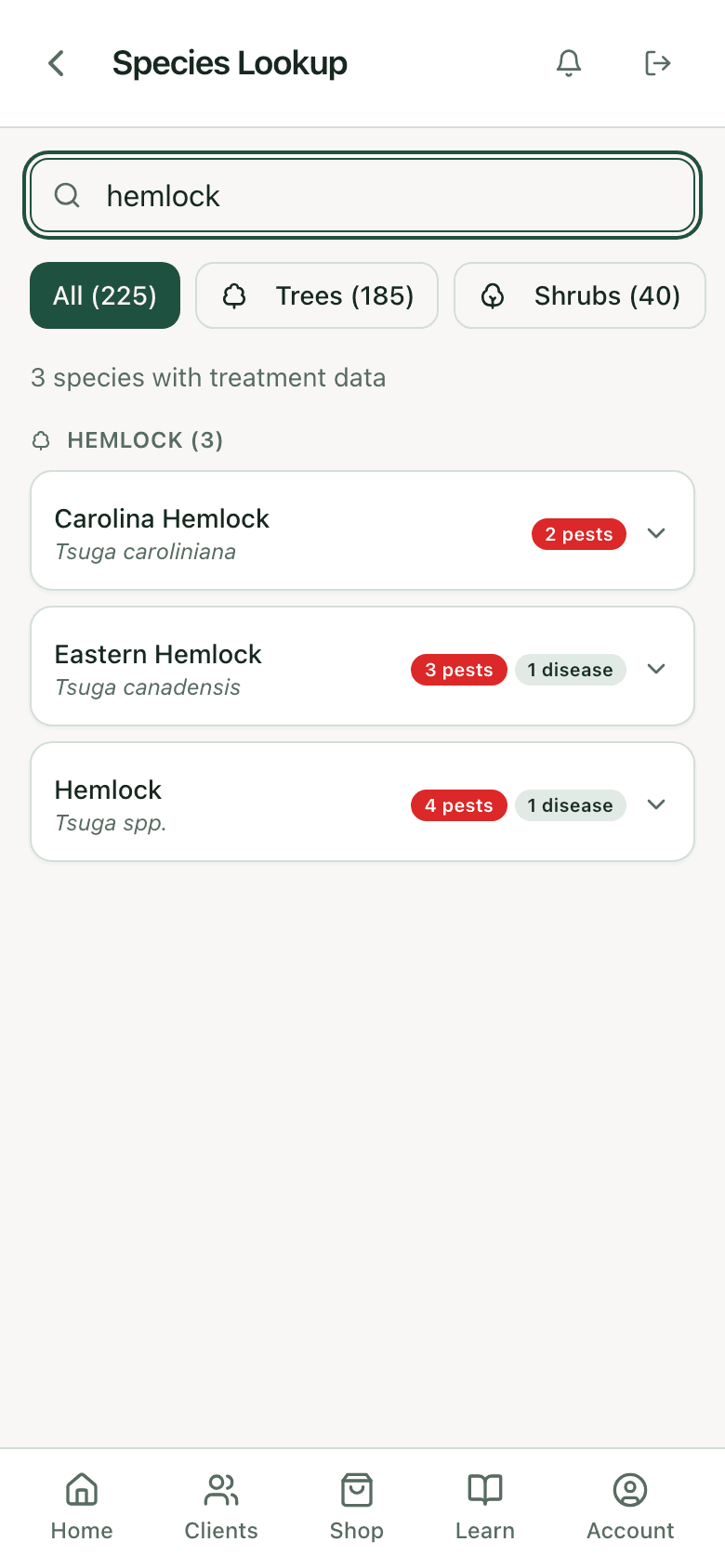
So: a healthy hemlock with a light infestation gets imidacloprid in the soil and nothing else. A hemlock that is already gray and thinning gets dinotefuran now, for the knockdown, and imidacloprid in the same visit for the years after. A hemlock on a streambank or a rock ledge gets trunk injection of one or the other because the soil route is off the table. The species lookup in PHC Rx carries these as separate treatment lines so the prescription says which one and why.
Trees near water
Neonicotinoid soil labels carry setbacks from water, and hemlocks grow on streambanks. Inside the setback the only lawful route is trunk injection, which is why IMA-jet and Dinocide are on this page at all. Read the label's water language before writing the prescription; the label check in PHC Rx flags the delivery method against the label but does not know where the creek is. You do.
What the label check will catch
Hemlock woolly adelgid is on every label here. Where prescriptions get flagged in the app is timing, most often a soil application scheduled for July when the adelgid is dormant and the soil is dry, and the reapplication interval, when a client wants the imidacloprid repeated after one year on a tree that does not need it. Both show as warnings before the client sees the plan.
Label check
1 warningLast application was 14 days ago. Proceed with a documented override, or reschedule.
When not to treat
- A hemlock that has lost most of its needles and shows no new growth. The systemic has nowhere to go. Say so in writing and offer removal or a replacement species.
- A forest edge with hundreds of hemlocks and a client who wants them all saved for one price. Pick the specimen trees, treat them, and be honest about the rest.
- Soil frozen, saturated, or bone dry. Wait for the window; the product will not move.
Pricing the job
Soil-applied imidacloprid on a hemlock is one of the cheapest PHC services to deliver and one of the most valuable to the client, because the tree is usually a screen or a specimen they cannot replace at size. Price it per inch with a minimum, and sell the return visit for dinotefuran on declining trees as a separate line. The retreat interval goes on the calendar when the application is recorded.
FAQ
Questions arborists ask
What is the imidacloprid rate for hemlock woolly adelgid?
Soil products like Merit 2F dose by DBH or trunk circumference per the label, stepping up for larger trees. For trunk injection, IMA-jet's table puts a 14 inch hemlock at 26 to 60 mL low, 42 to 90 mL medium, 52 to 120 mL high (label band 13 to 15 in) and a 20 inch tree at 38 to 84 mL low, 60 to 126 mL medium, 76 to 168 mL high (label band 19 to 21 in). The label in hand is the reference.
How fast does dinotefuran work on hemlocks?
Two to three weeks from a soil or basal bark application, faster by trunk injection. It gives one season of control, which is why it is paired with imidacloprid rather than used alone on a tree you want to keep.
When is the best time to treat?
Fall, September through November, or spring, March through May. The adelgid feeds in the cool months and the tree is moving water. Summer soil applications on dry ground do little.
How long does imidacloprid last in a hemlock?
Research on treated eastern hemlocks has found control persisting for several years from a single soil application, longer on smaller trees. The label frequency is annual; record the interval you choose and check the tree each spring for new woolly masses.
Can I treat a hemlock next to a stream?
Only by trunk injection inside the label's water setback. IMA-jet and Dinocide are the injectable options in the PHC Rx catalog.
Where do these rates come from?
The PHC Rx product catalog, built from the IMA-jet, Merit 2F, Safari 20 SG, Dinocide, and horticultural oil labels, and the app's species library for hosts and timing.
Related