
Treatment guide
Bronze birch borer treatment: rates per inch and the spring window
The same family of beetle as emerald ash borer, with the same D-shaped hole and the same top-down dieback, on a tree that is usually already stressed. Emamectin benzoate by trunk injection every two years, or a soil neonicotinoid every spring, on birches worth keeping. Rates per inch, the April window, and the canopy cutoff past which you are selling a removal.
pest
Bronze birch borerAgrilus anxius
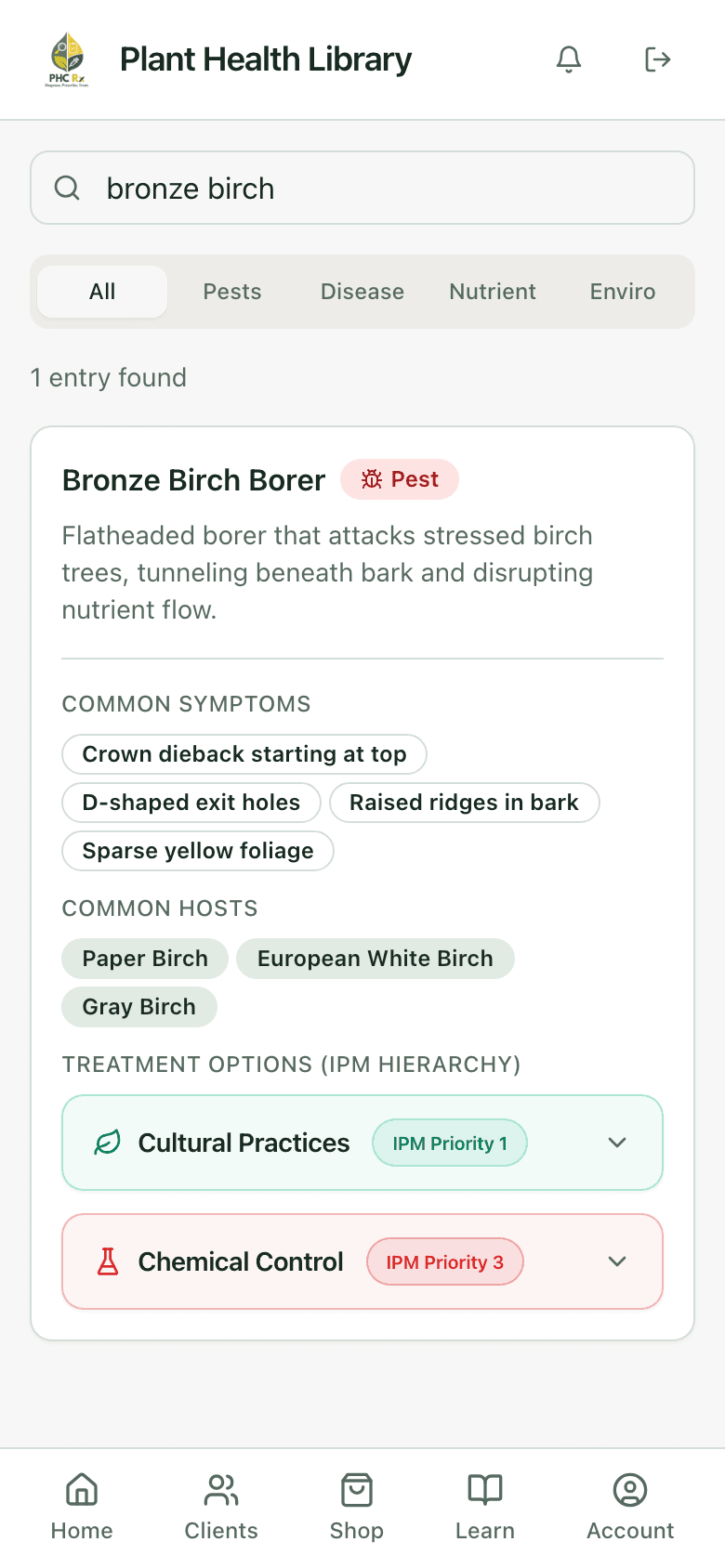
A native flatheaded borer whose larvae tunnel in the phloem and outer sapwood, girdling branches from the top of the tree down. It attacks birches under stress, which in a landscape means most of them: white-barked species planted in full sun on compacted soil with no mulch. Adults emerge late May through early July and lay eggs in bark crevices on the upper trunk and limbs. A tree with more than about a third of its crown dead is usually past saving.
Symptoms (the tree's response)
- Dieback starting at the top of the crown and moving down
- Sparse, yellow, undersized leaves on affected limbs
- Raised, winding ridges in the bark where the tree has grown over galleries
- Rusty stains on the bark below galleries
Signs (the organism itself)
- D-shaped exit holes about 1/8 inch, on the upper trunk and limbs
- Winding, frass-packed galleries under the bark, criss-crossing
- Bronze-black adults on the foliage, late May to July
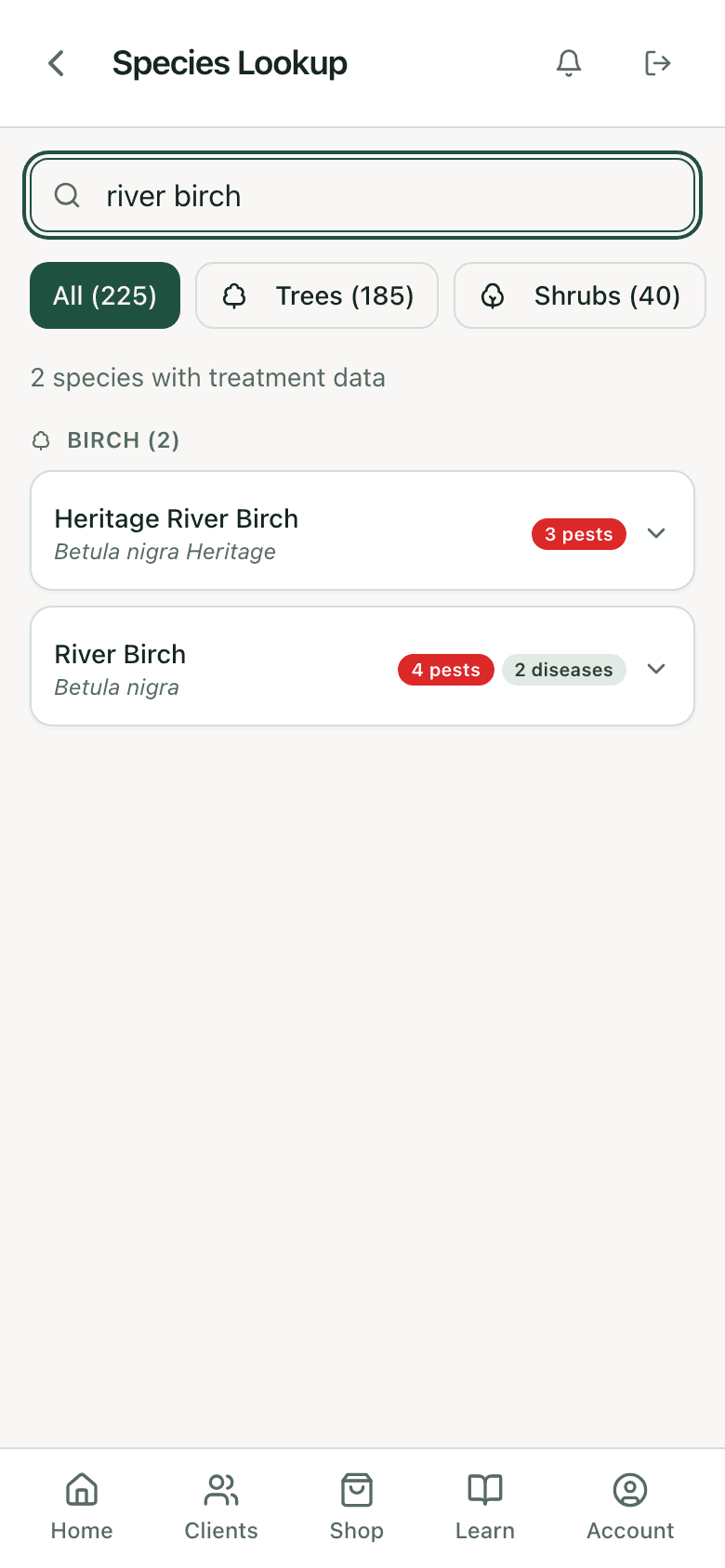
Common hosts: Paper birch (Betula papyrifera), highly susceptible, European white birch (Betula pendula), highly susceptible, Gray birch, River birch (Betula nigra), resistant unless stressed; Heritage more so
Timing window
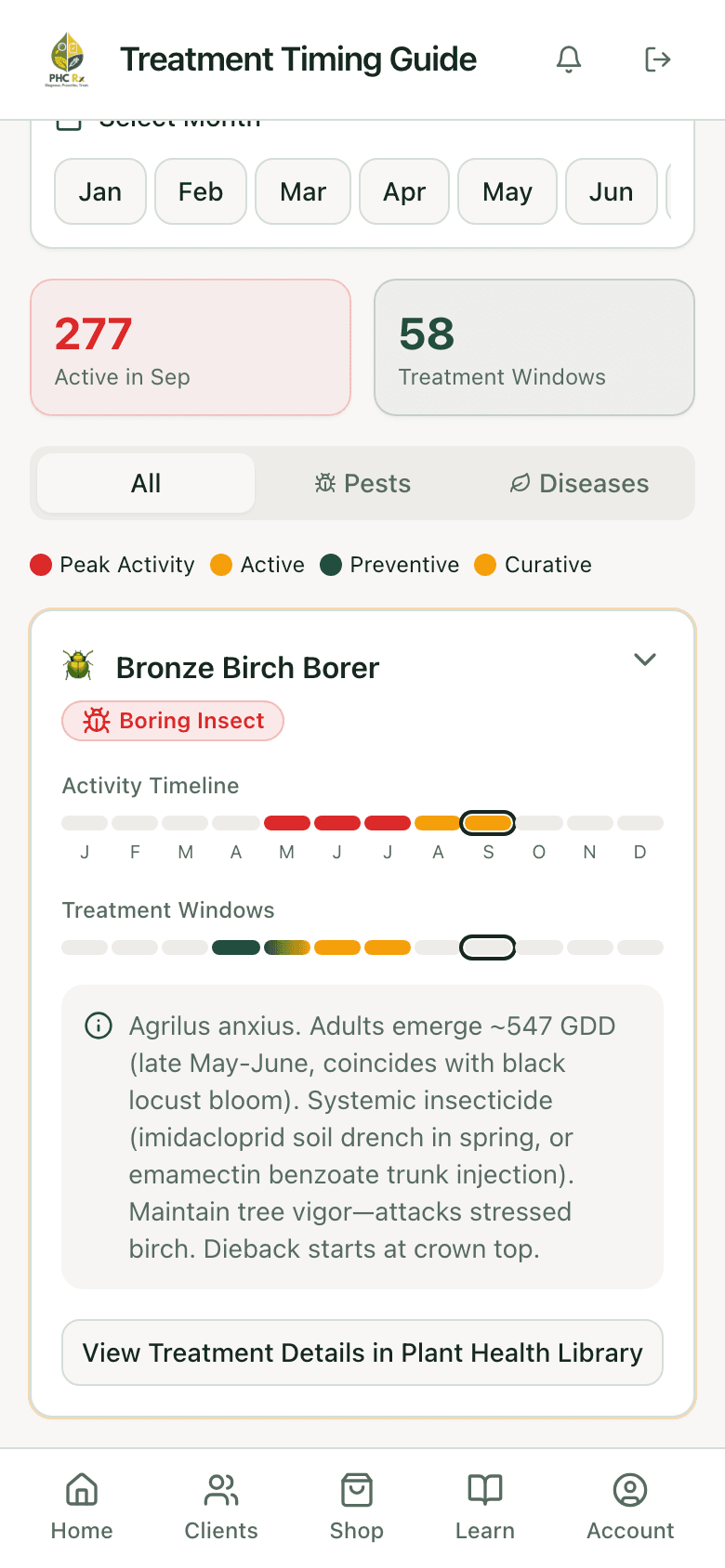
4 active monthsOrganism active
Preventive treatment
Curative treatment
Adults emerge late May to early July, depending on latitude. Systemics go in ahead of that: trunk injections in April and May while the tree is leafing out, soil applications by the first week of May so imidacloprid has time to move, or dinotefuran a little later because it is faster. Fall soil applications also work for next season. Nothing applied in August helps this year.
Treatment options
Product, rate, delivery, timing
Rates below are per inch of trunk diameter at breast height unless the row says otherwise. The registered label wins over anything on this page.
TREE-äge G4 (Arborjet)
- Active ingredient
- Emamectin benzoate 4%
- Rate
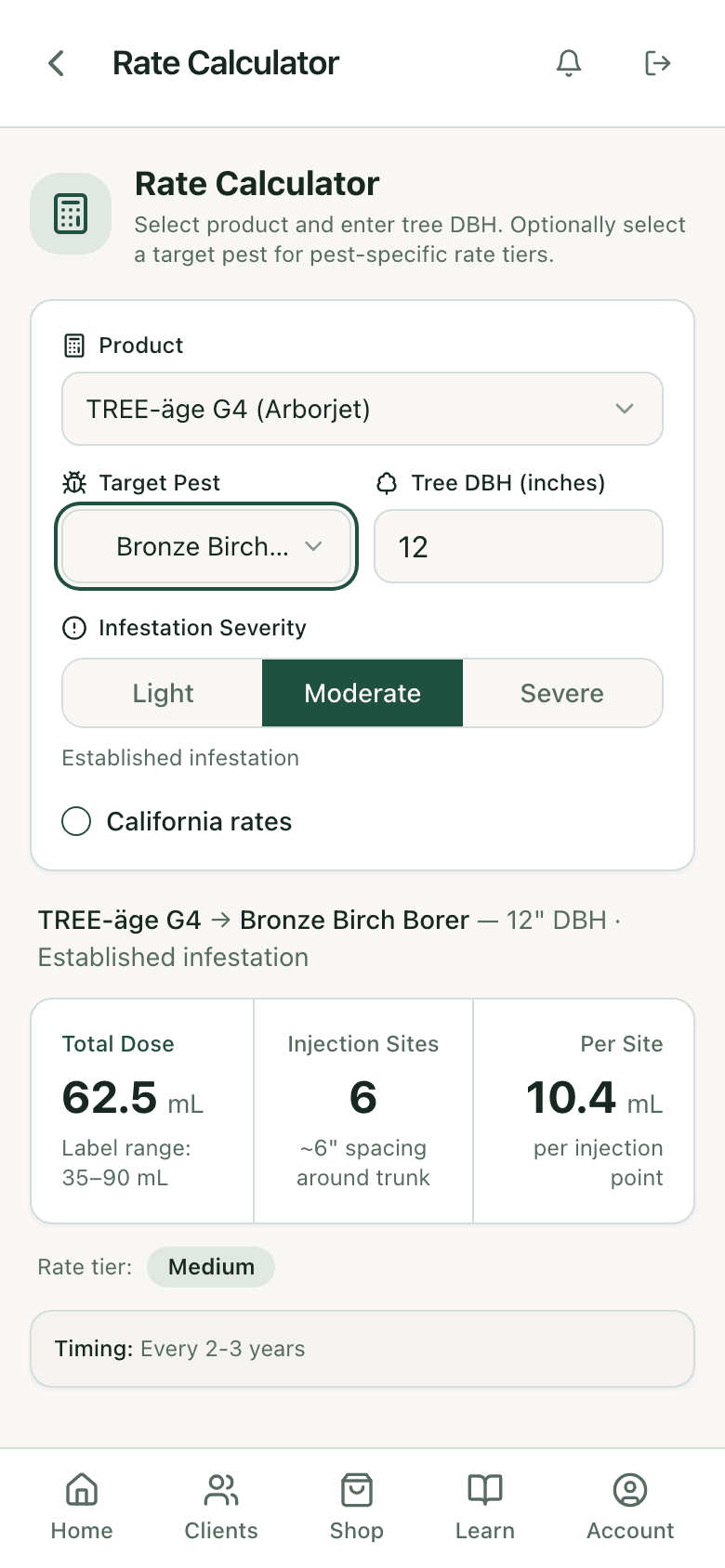
- Label table by DBH band with low, medium, and high tiers. A 12 inch birch is 30 to 35 mL low, 35 to 90 mL medium, 90 to 120 mL high (label band 10 to 12 in); a 16 inch birch is 42 to 55 mL low, 55 to 135 mL medium, 135 to 180 mL high (label band 16 to 18 in). Medium to high for borers
- Delivery
- Trunk injection at the flare; birch compartmentalizes wounds slowly, so fewer, smaller ports and no injection in drought
- Timing
- April into May, tree actively transpiring, before adult emergence
- Frequency
- Every 2 years per label
Agrilicide (Mauget)
- Active ingredient
- Emamectin benzoate 4%
- Rate
- Label table by DBH band; a 12 inch birch is 30 mL low, 55 to 110 mL medium, 110 to 165 mL high (label band 10 to 12 in)
- Delivery
- Trunk micro-injection with loadable injectors
- Timing
- Early spring, 30 days ahead of adult flight
- Frequency
- Up to 2 years of control per label
IMA-jet (Arborjet)
- Active ingredient
- Imidacloprid 5%
- Rate
- Label table by DBH band; a 12 inch birch is 20 to 48 mL low, 33 to 72 mL medium, 40 to 96 mL high (label band 10 to 12 in)
- Delivery
- Trunk injection
- Timing
- April into May
- Frequency
- Annually
Merit 2F (Bayer)
- Active ingredient
- Imidacloprid 21.4%
- Rate
- Per label by DBH for soil drench or injection; the label steps the rate for larger trees
- Delivery
- Soil drench or soil injection in the root zone
- Timing
- Early spring by the first week of May, or late summer into fall for next season
- Frequency
- Annually
Safari 20 SG (Valent)
- Active ingredient
- Dinotefuran
- Rate
- Per label by DBH for soil application, or by trunk area for a basal bark spray
- Delivery
- Soil injection, soil drench, or basal bark spray
- Timing
- Spring to early summer, actively growing
- Frequency
- Annually
- TREE-äge G4 (Arborjet): Emamectin benzoate, labeled for bronze birch borer. The choice for a birch that already shows early symptoms or a high-value specimen: two years of control from one visit. Agrilicide is the same active and concentration from Mauget.
- Agrilicide (Mauget): The emamectin benzoate in the PHC Rx shop. Labeled for bronze birch borer, two-lined chestnut borer, and the other Agrilus species.
- IMA-jet (Arborjet): Imidacloprid by injection. One season, cheaper per visit, and the right call where a soil application is not possible.
- Merit 2F (Bayer): Imidacloprid. Preventive on healthy birches; needs 30 to 60 days to reach the crown. The standard annual program on a paper birch in a bed the client waters.
- Safari 20 SG (Valent): Dinotefuran. In the tree in two to three weeks, so it is the pick when the client calls in late May. The bark spray goes on the smooth lower trunk and moves through the bark.
Worked examples
Dose per tree
TREE-äge G4, from the label table
12″ DBH
30 to 35 mL low, 35 to 90 mL medium, 90 to 120 mL high (label band 10 to 12 in)
TREE-äge G4, from the label table
16″ DBH
42 to 55 mL low, 55 to 135 mL medium, 135 to 180 mL high (label band 16 to 18 in)
Agrilicide, from the label table
12″ DBH
30 mL low, 55 to 110 mL medium, 110 to 165 mL high (label band 10 to 12 in)
IMA-jet, from the label table
12″ DBH
20 to 48 mL low, 33 to 72 mL medium, 40 to 96 mL high (label band 10 to 12 in)
Want the number for the tree in front of you? Use the tree injection rate calculator.
Stress first, then the beetle
Bronze birch borer finds the stressed tree. Paper and European white birch want cool, moist, shaded roots and get planted in the hottest spot in the yard. Before the injection, or with it, the prescription should carry the fixes: a wide mulch ring, irrigation through summer drought, no grade change, no trenching through the roots. A birch treated with emamectin and left to bake will be back on the list in two years with the same dieback.
River birch is the exception on both counts. It resists the borer unless it is badly stressed, and the Heritage cultivar more so. If a client is replacing a dead paper birch, that is the tree.
The canopy cutoff
The species notes in the PHC Rx library put the line at about 30 percent: a birch with more than a third of its crown dead has too little live phloem to carry the product and too much of its structure already girdled. Below that, emamectin by injection has a real chance, and the top can be pruned back to live wood after the first season. Write the canopy estimate on the diagnosis record. It is the number the client asks about when the tree does not recover.
What the label check will catch
Bronze birch borer is on the emamectin, imidacloprid, and dinotefuran labels, so the pest check passes. Where the app flags a plan is timing (a soil drench scheduled for June, after the beetles have emerged and too late to move) and the two-year interval on emamectin when a nervous client wants a second injection at twelve months. The label check shows both before the client sees the plan.
Label check
1 warningLast application was 14 days ago. Proceed with a documented override, or reschedule.
Pricing the job
Per inch with a minimum, like every injection. A 12 inch paper birch at $18 per inch is $216 every two years on emamectin, or a smaller annual charge on a soil program. Clump birches are three or four stems; dose each stem large enough to inject, sum them for the price, and say so on the prescription. The mulch and irrigation lines are what keep the tree off the removal list.
FAQ
Questions arborists ask
What is the emamectin benzoate rate for bronze birch borer?
A label table by DBH band. In the PHC Rx calculator a 12 inch birch on TREE-äge G4 is 30 to 35 mL low, 35 to 90 mL medium, 90 to 120 mL high (label band 10 to 12 in); a 16 inch tree is 42 to 55 mL low, 55 to 135 mL medium, 135 to 180 mL high (label band 16 to 18 in). Borers take the medium to high tier. The label in hand is the reference.
When should birches be treated for bronze birch borer?
April into May for trunk injection, before adults emerge in late May. Soil imidacloprid by the first week of May or in fall for next season. Dinotefuran a bit later because it moves faster.
Can a birch with dieback be saved?
If less than about a third of the crown is dead, usually yes, with emamectin by injection and the stress fixed: mulch, water, no root disturbance. Past that the odds drop fast, and the honest recommendation is removal and a river birch.
How often is the treatment repeated?
Every two years on emamectin benzoate. Annually on imidacloprid or dinotefuran. The PHC Rx calendar schedules the retreat from the product interval when the application is recorded.
Is river birch affected?
It is resistant and rarely attacked unless badly stressed. Heritage river birch more so. It is the replacement to recommend.
Where do these rates come from?
The PHC Rx product catalog, built from the TREE-äge G4, Agrilicide, IMA-jet, Merit 2F, and Safari 20 SG labels, and the app's species library for hosts and timing.
Related