
Treatment guide
Emerald ash borer treatment: rates per inch of DBH
What to inject or drench, how much per inch of trunk, when in the year it works, and how often you come back. Agrilicide and the other emamectin benzoate products, imidacloprid, and dinotefuran, with worked doses for the tree sizes you actually see.
Emerald ash borer treatment at a glance
- Typical cost
- $300–$750 per tree
- How often
- Every 2 years
- When to treat
- April–May, or October
EAB injection is usually priced per inch of trunk diameter. At $25 per inch, a 12-inch ash costs about $300 and a 22-inch ash about $550. Emamectin benzoate (Agrilicide, TREE-äge G4) protects for two years, so the yearly cost is half the ticket. Inject in April or May once the tree has leafed out, or in October. See how to price tree injections for the math.
pest
Emerald ash borerAgrilus planipennis
A flatheaded borer whose larvae feed in the phloem under the bark, cutting off water and nutrient transport. Untreated ash in an infested county are usually dead in three to five years. The beetle is a regulatory pest in most states; check your state's quarantine before moving ash wood.
Symptoms (the tree's response)
- Crown dieback starting at the top
- Canopy thinning
- Epicormic sprouting on the trunk and main limbs
- Bark splitting over galleries
Signs (the organism itself)
- D-shaped exit holes, about 1/8 inch
- S-shaped larval galleries under the bark
- Woodpecker flecking (blonding) on the upper trunk
- Adults on foliage, May through August
Common hosts: Green ash (Fraxinus pennsylvanica), White ash (Fraxinus americana), Black ash, Blue ash, Every other Fraxinus, White fringetree (Chionanthus virginicus), an alternate host
Timing window
4 active monthsOrganism active
Preventive treatment
Curative treatment
Trunk injections move best when the tree is transpiring and before adults emerge, so April into May. Fall soil applications (October) also work for preventive imidacloprid and dinotefuran. Do not inject a tree that has lost more than about half its canopy; there is not enough live phloem to carry the product.
Treatment options
Product, rate, delivery, timing
Rates below are per inch of trunk diameter at breast height unless the row says otherwise. The registered label wins over anything on this page.
Agrilicide (Mauget)
- Active ingredient
- Emamectin benzoate 4%
- Rate
- Label table by DBH band, not per inch. A 22 to 24 inch tree is 115 mL at the medium rate, 230 mL medium-high, 345 mL high (about 5, 10 and 15 mL per inch). Label calls for medium to high on borers and remedial work
- Delivery
- Trunk micro-injection with loadable injectors, 1 liter or 500 mL bottles. Injection sites at DBH divided by 2, about 6 inches apart in the root flare
- Timing
- Preventive: early spring before insect activity, at least 30 days ahead of egg hatch or adult flight. Remedial: spring through fall while the bark takes the injection. Post-bloom only; never a dormant or drought-stressed tree
- Frequency
- Up to 2 years of control per label
TREE-äge G4 (Arborjet)
- Active ingredient
- Emamectin benzoate 4%
- Rate
- 5 to 10 mL per inch DBH by pest pressure; the app puts a 22-inch ash at 115 to 180 mL (about 5.2 to 8.2 mL per inch)
- Delivery
- Trunk injection
- Timing
- April to June, tree actively transpiring
- Frequency
- Every 2 years
TREE-äge R10 (Arborjet)
- Active ingredient
- Emamectin benzoate 9.7%
- Rate
- Per label; at 9.7% you put in roughly 40% of the G4 volume per inch for the same amount of active
- Delivery
- Trunk injection
- Timing
- April to June
- Frequency
- Every 2 years
Mectinite (Rainbow Ecoscience)
- Active ingredient
- Emamectin benzoate 4%
- Rate
- Per label, by DBH
- Delivery
- Trunk injection
- Timing
- Spring before adult emergence, April to May
- Frequency
- Every 2 years
IMA-jet (Arborjet)
- Active ingredient
- Imidacloprid 5%
- Rate
- Per label, by DBH; injection sites at DBH divided by 2
- Delivery
- Trunk injection
- Timing
- March to May
- Frequency
- Annually
Xytect 2F (Rainbow Ecoscience)
- Active ingredient
- Imidacloprid 21.4%
- Rate
- Per label, by DBH; the label steps the rate up at 15 inches DBH
- Delivery
- Soil drench or soil injection
- Timing
- Early spring as soon as soil thaws, no later than the first week of May, or late summer into fall
- Frequency
- Annually
Transtect 70 WSP (Rainbow Ecoscience)
- Active ingredient
- Dinotefuran 70%
- Rate
- 2 to 4 g per inch DBH
- Delivery
- Soil injection, soil drench, or basal bark spray
- Timing
- Spring to mid-summer, trees actively growing
- Frequency
- Annually
- Agrilicide (Mauget): The emamectin benzoate the PHC Rx shop stocks, 1 liter bottles, ordered from inside the prescription. Same active and concentration as the original TREE-äge, so the research on two-year control applies. Also labeled for bronze birch borer, two-lined chestnut borer, bagworm, ambrosia beetles, bark beetles and pinewood nematode. Not for trees under 2 inches DBH.
- TREE-äge G4 (Arborjet): Same 4% concentration as Agrilicide, so the same volume per inch. The Arborjet option when you want the two-year interval and are already on their injection system.
- TREE-äge R10 (Arborjet): The high-concentration one. Lowest volume per tree of the emamectin options, so the quickest injection times on big trunks.
- IMA-jet (Arborjet): Budget option. One season of protection, so the client is paying for a visit every year. IMA-jet 10 is the 10% version of the same product and takes half the volume.
- Xytect 2F (Rainbow Ecoscience): Takes 30 to 60 days to move into the canopy. Preventive only, on healthy trees under 25 inches DBH.
- Transtect 70 WSP (Rainbow Ecoscience): In the tree in two to three weeks, so it is the pick when a client calls in June. Bark spray version translocates through the bark on accessible trunks.
Worked examples
Dose per tree
Agrilicide, medium rate
22″ DBH
115 mL total from the label table (230 medium-high, 345 high), 11 injection sites at DBH divided by 2, about 10.5 mL per site. About $51 of product from a $440 liter.
TREE-äge G4, moderate pressure
22″ DBH
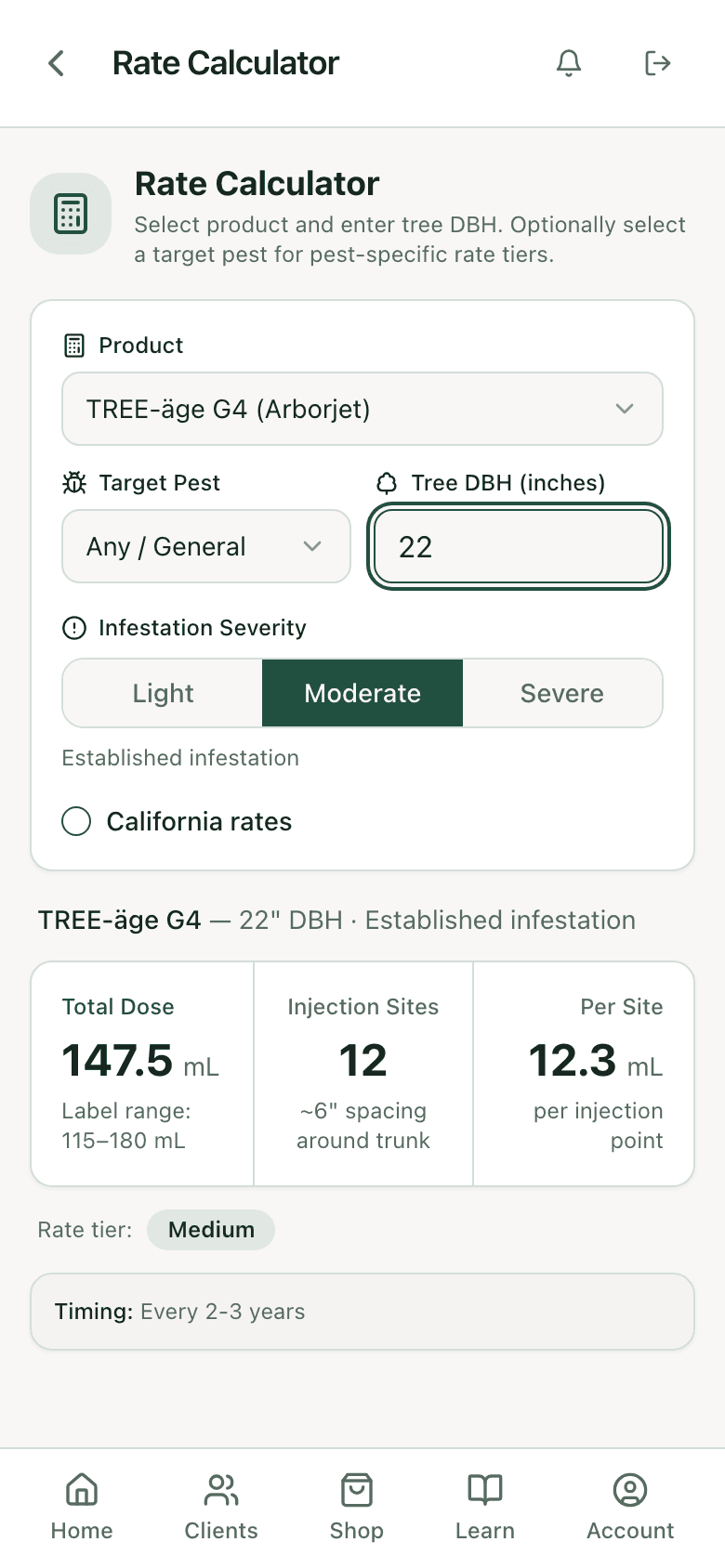
147.5 mL total, 12 injection sites at about 6 inch spacing, 12.3 mL per site (from the PHC Rx calculator)
TREE-äge G4, medium rate
18″ DBH
90 mL total at 5 mL per inch, 9 sites; the label band for a 16 to 18 inch tree at medium pressure is 55 to 135 mL
Transtect 70 WSP, soil injection
30″ DBH
60 to 120 g at 2 to 4 g per inch
Want the number for the tree in front of you? Use the tree injection rate calculator.
Which product, for which tree
Under 25 inches, healthy, preventive: imidacloprid drench in spring or fall is the cheap route, but you are back every year. Over 25 inches, or anything with visible dieback, or a county with heavy pressure: emamectin benzoate by trunk injection, every two years. Agrilicide is the one in the PHC Rx shop; TREE-äge G4 is the same 4% from Arborjet, and TREE-äge R10 (9.7%) is the higher-concentration option when you want less volume in a big tree. Client calls in June with a tree they just noticed: dinotefuran, because it is in the canopy in three weeks instead of two months.
The research behind the two-year interval is Smitley, Doccola, and Cowles in Arboriculture & Urban Forestry 36(5), 2010: a single emamectin benzoate injection at 0.2 g active ingredient per inch gave two to three years of control on street trees up to 18 inches. McCullough's group at Michigan State repeated it at larger diameters. That is why the calendar in PHC Rx puts the retreat at 24 months instead of 12.
What the label check will catch
EAB is on every one of these labels, so the pest check passes. Where a prescription fails in the app is usually timing (a soil drench scheduled for July when the label wants it in the ground by early May), reapplication interval (an annual product going in at 8 months because the client got nervous), or delivery method (dinotefuran as a bark spray on a tree the label limits to soil application at that size). Each of those shows as a warning before the client sees the prescription, and you can override with a written reason.
Label check
1 warningLast application was 14 days ago. Proceed with a documented override, or reschedule.
When not to treat
- More than 50 percent canopy loss. Injection needs live phloem to move the product. Recommend removal and say why in writing.
- A tree the client will not commit to for six or more years. One emamectin injection is a two-year decision; a program is a decade.
- Ash within a few hundred feet of untreated ash in an active infestation, if the client wants a one-time fix. It will be reinfested.
- Quarantine violations. Treating is fine; moving the firewood is not.
Pricing the job
Most companies price EAB injections per inch of DBH, with a minimum per visit. The PHC Rx default for trunk injection is in the $10 to $25 per inch range, set per company in service pricing. A 22-inch ash at $15 per inch is $330 every two years. Product cost for that tree on Agrilicide is about $48 at 5 mL per inch, roughly a seventh of the price, which is why EAB programs are the most profitable line most PHC divisions run.
Written and reviewed by
ISA Board Certified Master Arborist MA-5832B · ISA TRAQ · Maryland Licensed Tree Expert #2168
Alex Shy is an ISA Board Certified Master Arborist, TRAQ-qualified tree risk assessor, and Maryland Licensed Tree Expert. He holds a B.S. in Forest Resource Management from West Virginia University. Alex is the founder and president of Mobile Tree Spa LLC, founder and co-owner of the PHC Rx diagnostic app, and a member of the ATCP board, where he oversees the education committee. His work focuses on making science-based plant health care practical, profitable, and easy for tree care companies to adopt.
ISA Certified Arborist MA-7027A · VNLA Certified Horticulturist · Virginia Commercial Pesticide Applicator
Jordan Thompson is an ISA Certified Arborist, VNLA Certified Horticulturist, Virginia Commercial Pesticide Applicator, and co-owner of J.J. Mauget Co. and TIPCO. She holds an M.S. in Entomology and a B.S. in Environmental Horticulture from Virginia Tech. Her work bridges arboriculture, plant health care, and applied research, with a particular focus on tree injection, invasive species, tree disease management, and translating university research into practical tools for professional arborists.
FAQ
Questions arborists ask
What is the emamectin benzoate rate per inch of DBH for emerald ash borer?
Agrilicide's label is a table by DBH band rather than a per-inch figure, but its medium column works out to about 5 mL per inch of DBH, which is 0.2 g of active ingredient per inch, the figure behind the two-year interval in the research. Medium-high doubles that and high triples it. TREE-äge G4 is also 4%, so its label runs the same 5 to 10 mL per inch depending on infestation pressure; TREE-äge R10 at 9.7% needs less than half that volume. A 22-inch ash at a moderate rate works out to about 147 mL in the PHC Rx calculator. Always confirm against the label in hand.
What is the imidacloprid rate for emerald ash borer?
Imidacloprid soil products like Xytect 2F are dosed per inch of DBH with the rate stepping up for trees at or above 15 inches; the label carries the exact figures. It is preventive only, best on healthy trees under 25 inches, and it needs 30 to 60 days to reach the canopy, so it goes in by early May or in fall.
When is the best time to treat for emerald ash borer?
April into May for trunk injections, before adults emerge and while the tree is moving water. Fall works for preventive soil applications. Summer treatments are for dinotefuran, which moves fast enough to matter.
How often does an ash need to be treated?
Every two years on emamectin benzoate. Every year on imidacloprid or dinotefuran. The calendar in PHC Rx schedules the retreat visit when you record the application.
Can a tree with dieback still be saved?
Usually, if it has kept more than half its canopy. Past that, the phloem is too damaged to carry a systemic. Write down the canopy estimate at the time of the assessment; it is the number the client will ask about later.
Where do these rates come from?
The PHC Rx species library and rate calculator, which are built from the product labels for Agrilicide, TREE-äge, Mectinite, IMA-jet, Xytect, and Transtect. When you write a prescription in the app, the rate is checked against the label again. The label wins.
Related