
Treatment guide
Crape myrtle bark scale treatment: dinotefuran and imidacloprid rates
The white crust on the trunk and the black mold under it. A soil-applied systemic when crawlers are moving, a dormant oil in winter, and a scrub brush. Which neonicotinoid, how much per inch of caliper, when the crawlers are out, and the bee language on the label that decides the delivery method.
pest
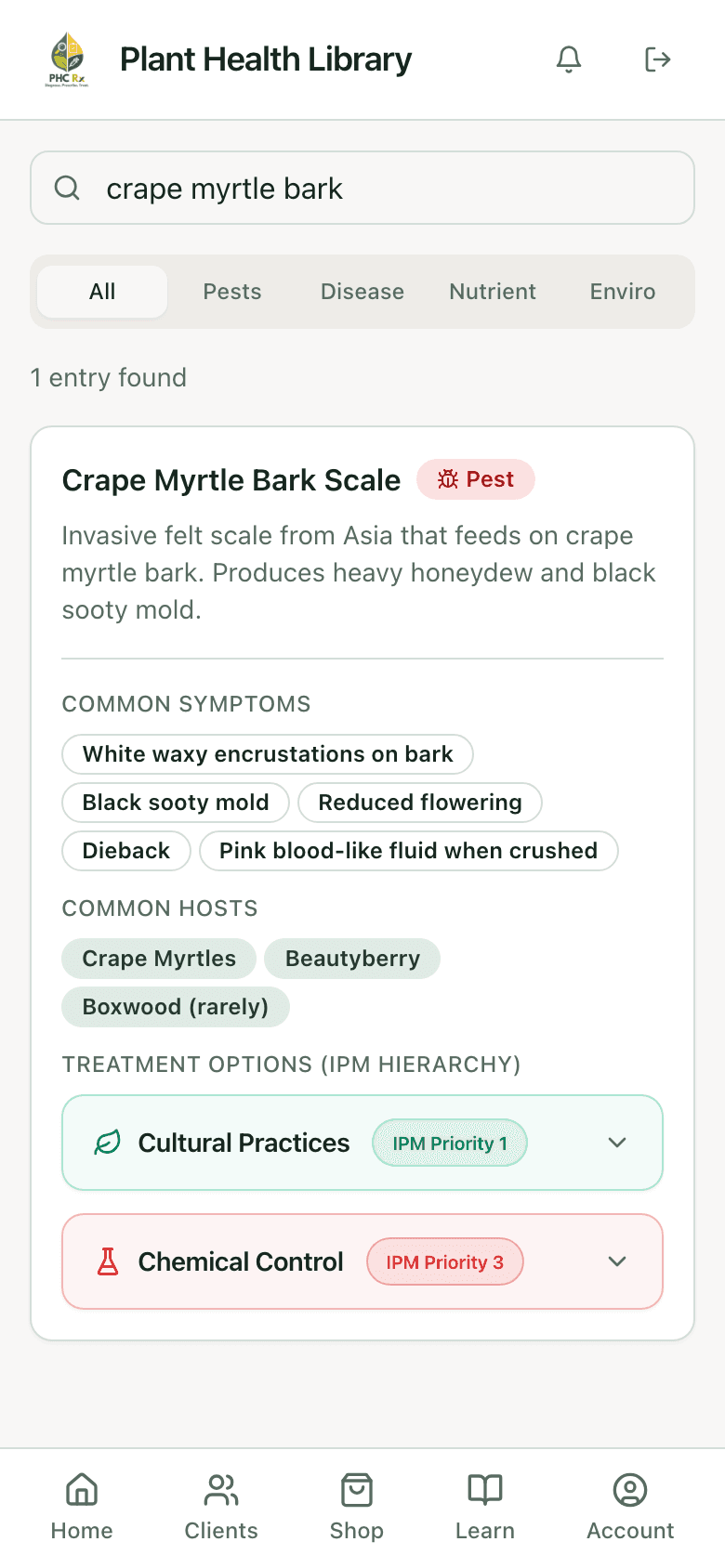
Crape myrtle bark scaleAcanthococcus lagerstroemiae
A felt scale from Asia, first found in Texas in 2004 and now across the South and into the mid-Atlantic. It feeds on the bark of the trunk and branches, not the leaves, and pumps out honeydew that grows sooty mold. Trees rarely die from it. They stop flowering well, look black, and drip on the car parked under them. Heavy populations cause dieback on small stems.
Symptoms (the tree's response)
- Black sooty mold on the trunk, branches, and everything below the tree
- Reduced or delayed flowering
- Dieback on twigs under heavy infestation
- Honeydew on leaves and on surfaces under the canopy
Signs (the organism itself)
- White to gray waxy felt sacs on the bark, clustered at branch crotches and pruning wounds
- Pink fluid when a sac is crushed
- Pink crawlers under the felt in late spring and summer
Common hosts: Crape myrtle (all Lagerstroemia), American beautyberry, Boxwood (rarely), Pomegranate and a few others in its native range
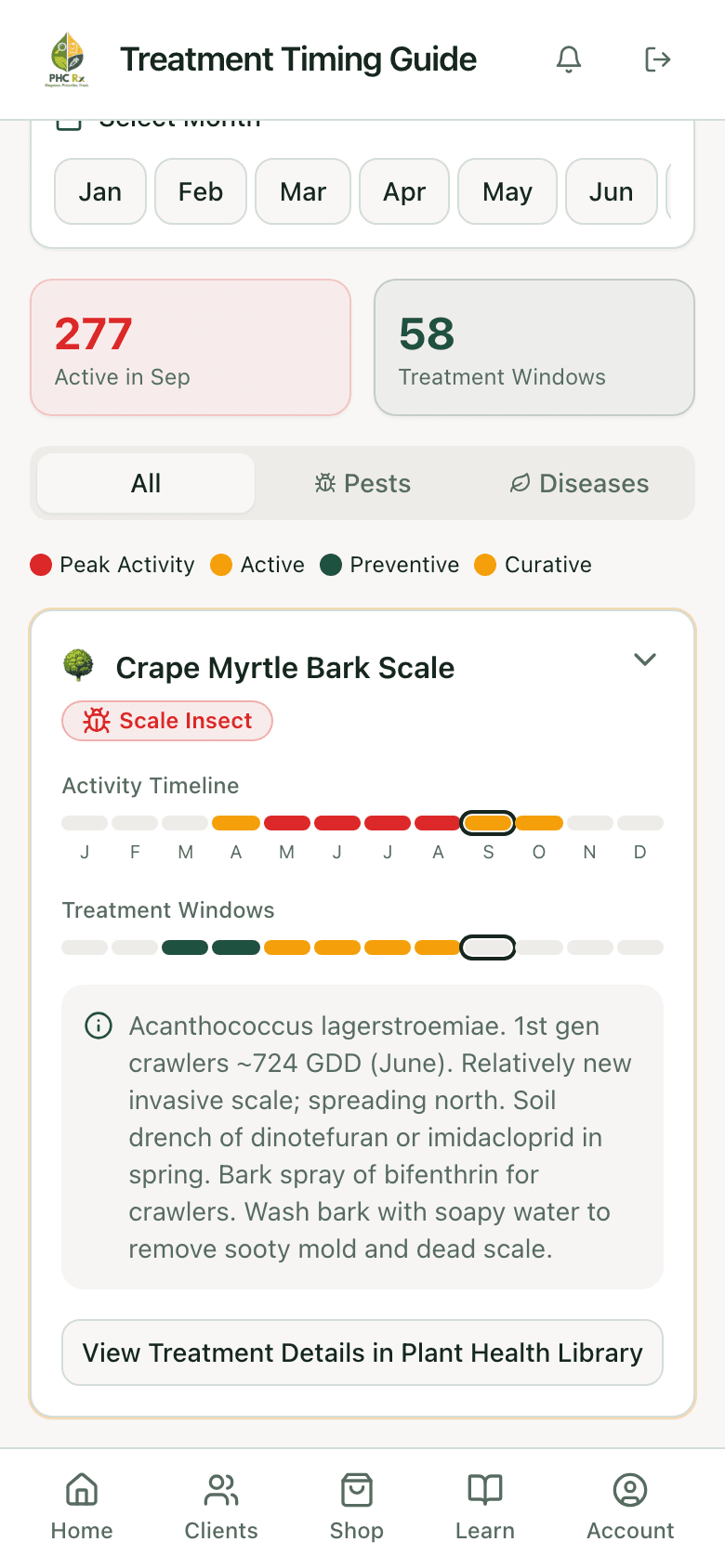
Timing window
7 active monthsOrganism active
Preventive treatment
Curative treatment
Crawlers are active from May through August, with two or more overlapping generations in the South. A soil systemic goes on in spring so it is in the bark when crawlers emerge; imidacloprid needs four to six weeks of lead, dinotefuran two to three. Dormant oil goes on in late winter to smother overwintering females and eggs. Crape myrtles flower in summer, so read the pollinator section of any neonicotinoid label before choosing a soil drench.
Treatment options
Product, rate, delivery, timing
Rates below are per inch of trunk diameter at breast height unless the row says otherwise. The registered label wins over anything on this page.
Safari 20 SG (Valent)
- Active ingredient
- Dinotefuran
- Rate
- Per label by trunk diameter for soil drench and soil injection, or by trunk area for a basal bark spray
- Delivery
- Soil drench or soil injection at the base; the label also allows a basal bark spray on the lower trunk
- Timing
- April into May, ahead of crawler emergence, on soil that is moist but not saturated
- Frequency
- Annually
Zylam Liquid (Valent)
- Active ingredient
- Dinotefuran
- Rate
- Per label by trunk diameter
- Delivery
- Soil drench, basal bark spray, or foliar
- Timing
- Spring ahead of crawlers, or summer while they are active
- Frequency
- Annually
Dinocide (Mauget)
- Active ingredient
- Dinotefuran
- Rate
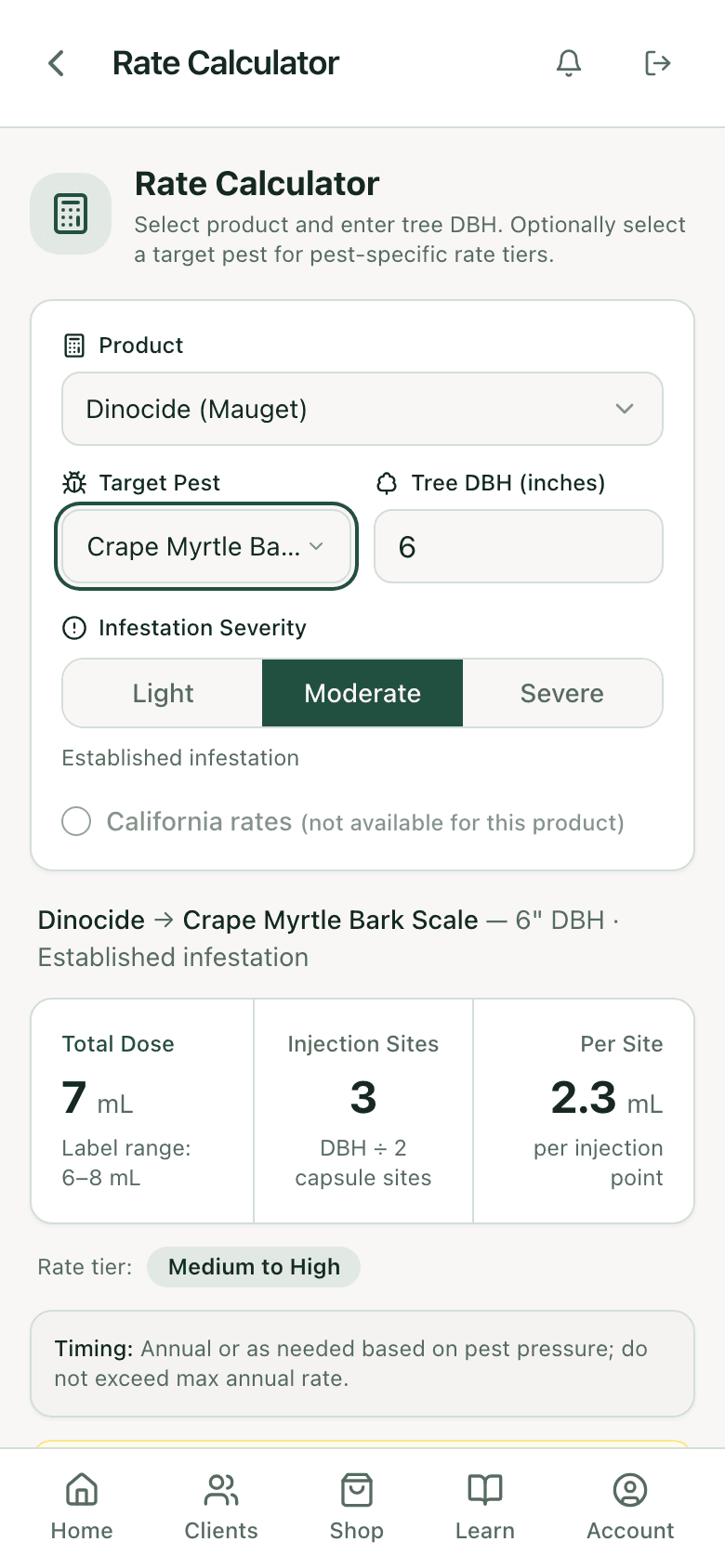
- Capsule micro-injection by DBH band; a 6 inch stem is 4 to 6 mL low, 8 to 12 mL high (label band 5 to 7 in), applied per stem on a multi-trunk tree
- Delivery
- Mauget capsule micro-injection into each trunk
- Timing
- When the tree is actively growing and scales are feeding
- Frequency
- Annually, within the label's maximum annual rate
Merit 2F (Bayer)
- Active ingredient
- Imidacloprid 21.4%
- Rate
- Per label by trunk diameter for soil drench or injection
- Delivery
- Soil drench or soil injection
- Timing
- March into April, four to six weeks before crawlers
- Frequency
- Annually
Horticultural Oil (Southern Ag)
- Active ingredient
- Mineral Oil 98%
- Rate
- Per label; 2 to 4 percent dormant, 1 to 2 percent in season
- Delivery
- Spray the trunk and branches to runoff, working it into the crotches and behind exfoliating bark
- Timing
- Late winter before bud break, and again against crawlers in summer at the lower rate
- Frequency
- As needed at the label interval
Bifen I/T (Control Solutions)
- Active ingredient
- Bifenthrin 7.9%
- Rate
- Per label, sprayed on the bark
- Delivery
- Bark spray to the trunk and branches
- Timing
- When crawlers are active, May through August
- Frequency
- At the label interval while crawlers are present
- Safari 20 SG (Valent): Dinotefuran, the product most extension programs name first for this scale. Fast uptake, one season. The bark spray option matters where a drench near paving or a bed is not practical.
- Zylam Liquid (Valent): Dinotefuran in a liquid formulation. Same active as Safari, different label; check the one you are holding.
- Dinocide (Mauget): The trunk-injected dinotefuran. The route when the client will not have a soil application near the patio, and the route that keeps the product out of the flowers' root zone. Small stems, small ports.
- Merit 2F (Bayer): Imidacloprid. Slower to arrive and longer to stay than dinotefuran. Fine on a tree you treat every year in early spring; too slow for a July call.
- Horticultural Oil (Southern Ag): Contact. Smothers overwintering females and eggs under the felt. Pairs with a scrub of the trunk with soapy water and a soft brush, which removes the mold and a lot of the scale.
- Bifen I/T (Control Solutions): Bifenthrin. Contact kill on crawlers only; adults under the felt are protected. A supplement to the systemic on a heavily crusted tree, not a program on its own.
Worked examples
Dose per tree
Dinocide, capsule micro-injection, per stem
6″ DBH
4 to 6 mL low, 8 to 12 mL high (label band 5 to 7 in)
Dinocide, capsule micro-injection, per stem
8″ DBH
8 to 10 mL low, 16 to 20 mL high (label band 8 to 10 in)
Safari 20 SG, soil drench
6″ DBH
Per label by trunk diameter, summed across the stems of a multi-trunk tree; mix in the water volume the label calls for and apply at the base
Horticultural oil, dormant
6″ DBH
2 to 4 percent solution sprayed to runoff on the trunk and branches in late winter
Want the number for the tree in front of you? Use the tree injection rate calculator.
Soil drench, bark spray, or injection
Crape myrtle bark scale lives on the bark, so a systemic that reaches the phloem of the trunk is the tool, and dinotefuran gets there fastest. The soil drench is the standard delivery and the cheapest. The complication is that crape myrtles are a summer nectar source and the neonicotinoid labels carry pollinator language about plants in bloom. Apply the soil drench in April, well before flowering, or use the basal bark spray or the trunk injection so the product goes into the trunk without a soil application at all.
The scrub is not optional. The felt and the sooty mold stay on the tree after the scale is dead, and the client judges the treatment by whether the trunk is still black. A soft brush and soapy water in the same visit as the dormant oil takes most of it off and makes the summer treatment visible.
Multi-trunk math
Most crape myrtles are three to seven stems. Soil labels dose by trunk diameter and expect you to sum the stems; injection products dose per stem and expect a port in each one big enough to take it. The calculator runs a single stem; enter each stem or the combined diameter as the label directs and record which you did. Do not inject a 2 inch stem.
What the label check will catch
The scale is on the dinotefuran and imidacloprid labels. Where the app flags a plan is timing (a soil drench scheduled for August when crawlers are done and the tree is in bloom), delivery (a foliar-only product written as a drench), and the annual maximum on dinotefuran when a tree gets a spring drench and a summer bark spray of the same active. The label check shows the flag before the client sees the plan.
Label check
1 warningLast application was 14 days ago. Proceed with a documented override, or reschedule.
Pricing the job
This is a small-tree, high-volume service. Price the systemic per tree or per stem-inch with a minimum, the dormant oil and scrub as a winter visit, and sell it as a two-visit annual program. A subdivision with crape myrtles at every driveway is a route, and the calendar in PHC Rx will put every one of them on the same spring week.
FAQ
Questions arborists ask
What is the best treatment for crape myrtle bark scale?
A soil-applied dinotefuran in April before crawlers emerge and before bloom, or dinotefuran by basal bark spray or trunk injection where a drench is not appropriate, plus a dormant oil and a trunk scrub in late winter. Imidacloprid works if it goes on early enough.
What is the dinotefuran rate for crape myrtle?
Soil products dose by trunk diameter per the label, summed across stems. By capsule micro-injection, Dinocide's table puts a 6 inch stem at 4 to 6 mL low, 8 to 12 mL high (label band 5 to 7 in). The label in hand is the reference.
When should crape myrtle bark scale be treated?
Systemics in spring, March into May, so they are in the bark when crawlers emerge in May. Dormant oil in late winter. Contact sprays only while crawlers are active, May through August.
Will the black mold go away?
Not on its own for a season or more. Scrub the trunk with soapy water and a soft brush at the winter visit. Once the scale is controlled, no new honeydew means no new mold, and rain clears the rest over time.
Is it safe to treat a flowering crape myrtle?
Read the pollinator section of the label. Soil neonicotinoids on a plant about to bloom is what that language is about. April drenches, bark sprays, and trunk injection are the ways around it.
Where do these rates come from?
The PHC Rx product catalog, built from the Safari 20 SG, Zylam, Dinocide, Merit 2F, horticultural oil, and Bifen I/T labels, and the app's species library for timing.
Related