
Treatment guide
Two-lined chestnut borer treatment: the oak borer that follows stress
An oak that dies from the top down two summers after a drought, a construction cut, or a gypsy moth year usually has two-lined chestnut borer under the bark. It is the same genus as emerald ash borer and the same chemistry stops it: an emamectin benzoate injection in spring on a tree that still has most of its canopy. Rates per inch, the window, and the trees that are past the point.
pest
Two-lined chestnut borerAgrilus bilineatus
A native flatheaded borer, a close relative of emerald ash borer, that lives at low levels in every oak woods and attacks trees that are already in trouble. Adults emerge in late May through July and lay eggs in bark crevices on stressed oaks. The larvae tunnel in the phloem and outer sapwood, girdling branches, and the tree dies from the top down over two or three years. A healthy oak drowns the larvae in sap; a drought-stressed oak cannot. The borer is the last straw, not the first, which is why the treatment is half insecticide and half fixing whatever stressed the tree.
Symptoms (the tree's response)
- Dieback starting at the top of the crown and outer branches, moving down over two or three seasons
- Leaves on affected branches wilting, browning, and staying attached in summer
- Sparse, small leaves on the surviving canopy
- Epicormic sprouts on the trunk and large limbs
Signs (the organism itself)
- D-shaped exit holes about an eighth of an inch across on dead branches and the upper trunk
- Meandering, frass-packed galleries in the phloem under loose bark on dead limbs
- Woodpecker work on the upper trunk
- A stress event in the last one to three years: drought, defoliation, grading, trenching, a new driveway
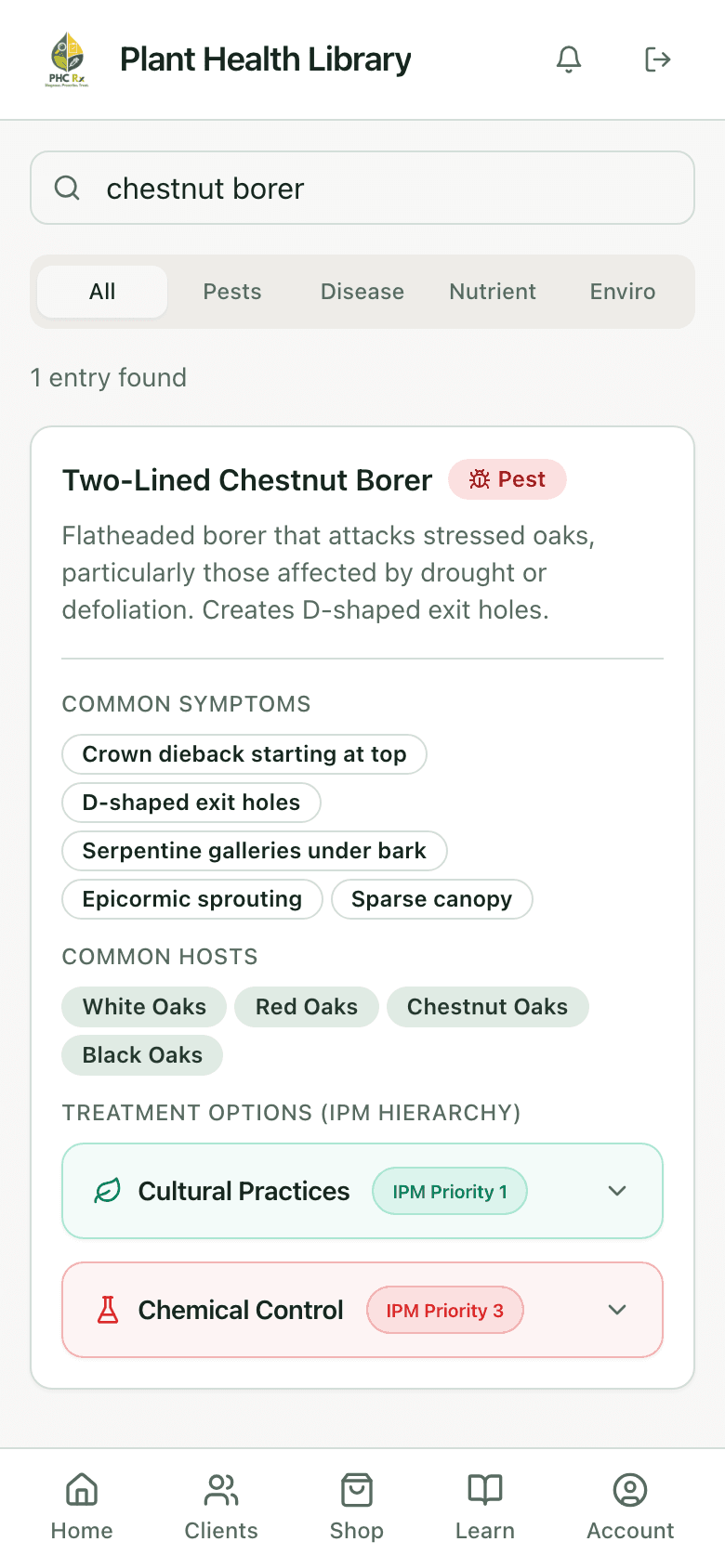
Common hosts: Red oak group: northern red, black, pin, scarlet oak, White oak group: white, bur, swamp white, chestnut oak, American chestnut, historically, Beech, occasionally, Any oak stressed by drought, defoliation, root damage, or construction
Timing window
5 active monthsOrganism active
Preventive treatment
Curative treatment
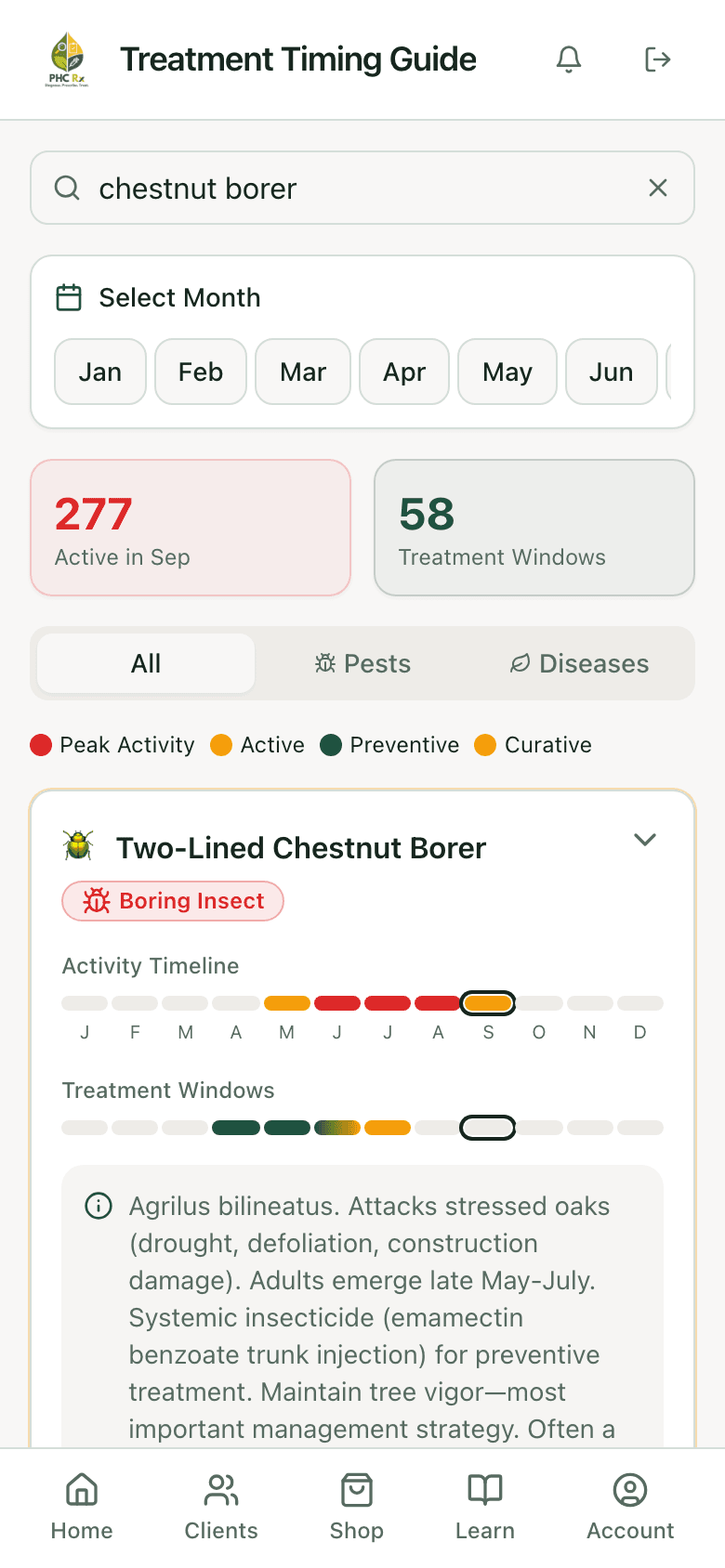
Adults emerge in late May and fly through July, laying eggs on stressed trees. A systemic injected in April through June is in the phloem when the larvae hatch and start feeding. Trees with less than a third of the crown lost respond; trees with more than half gone usually do not, and the money goes to removal. Water deeply through summer drought and stop whatever is stressing the roots.
Treatment options
Product, rate, delivery, timing
Rates below are per inch of trunk diameter at breast height unless the row says otherwise. The registered label wins over anything on this page.
Agrilicide (Mauget)
- Active ingredient
- Emamectin benzoate 4%
- Rate
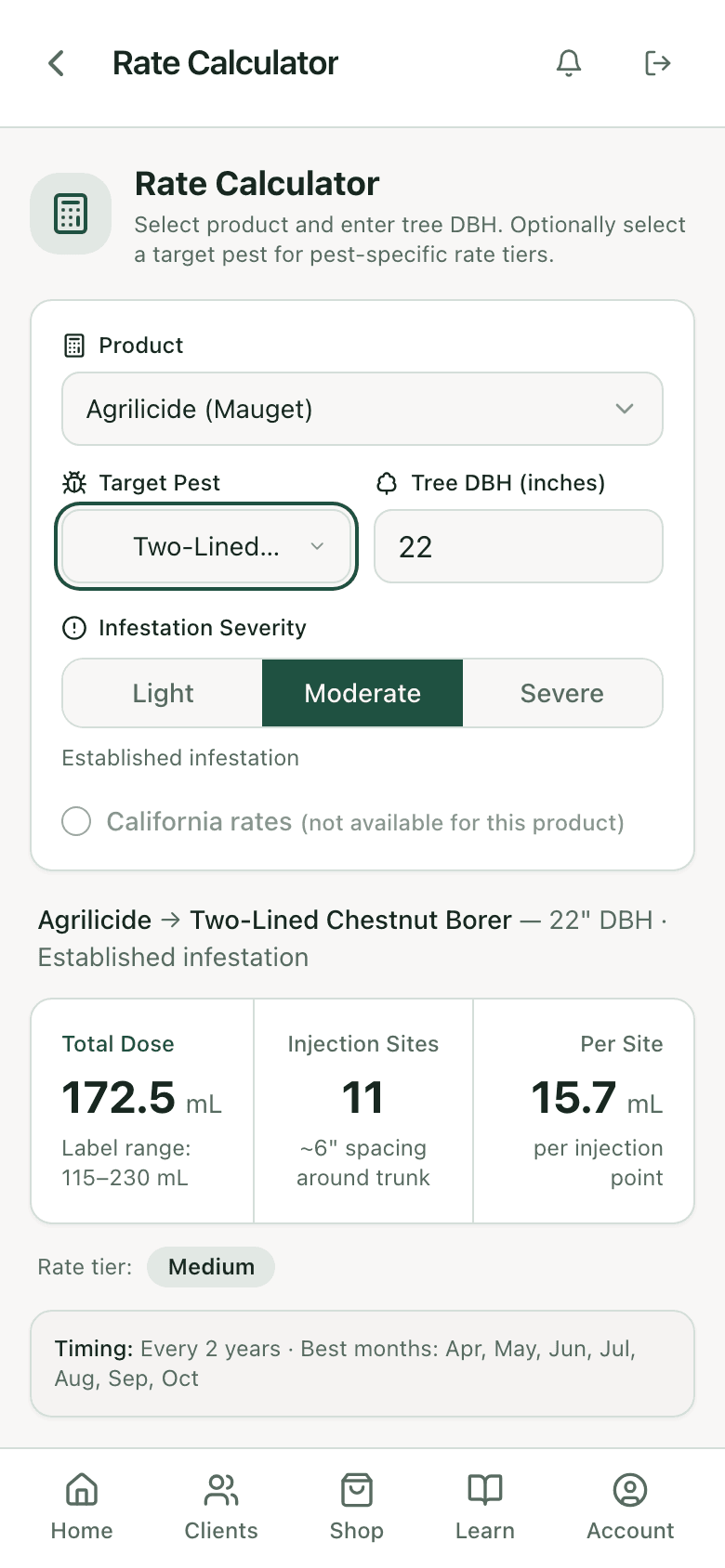
- Capsule micro-injection by DBH band. A 22 inch red oak is 115 to 230 mL medium, 230 to 345 mL high (label band 22 to 24 in); a 30 inch white oak is 145 to 290 mL medium, 290 to 435 mL high (label band 28 to 30 in)
- Delivery
- Mauget capsule micro-injection at the root flare, capsules spaced around the trunk
- Timing
- April through June, before or at adult emergence
- Frequency
- Every 2 years
Imicide (Mauget)
- Active ingredient
- Imidacloprid 10%
- Rate
- Capsule micro-injection by DBH band; a 20 inch oak is 30 to 33 mL low, 40 to 44 mL high (label band 20 to 22 in)
- Delivery
- Mauget capsule micro-injection
- Timing
- Spring, April into May
- Frequency
- Annual
Abacide 2 (Mauget)
- Active ingredient
- Abamectin 1.9%
- Rate
- Capsule micro-injection by DBH band; a 20 inch oak is 30 to 33 mL low, 40 to 44 mL high (label band 20 to 22 in)
- Delivery
- Mauget capsule micro-injection
- Timing
- Spring before adult flight
- Frequency
- Per label
TREE-äge R10 (Arborjet)
- Active ingredient
- Emamectin benzoate 9.7%
- Rate
- Label table by DBH band; a 22 inch oak is 22 mL low, 44 mL medium, 88 mL high (label band 22 to 23 in)
- Delivery
- Trunk injection with an injection rig
- Timing
- April through June
- Frequency
- Every 2 years
Cultural: water, mulch, and stop the stress
- Active ingredient
- none
- Rate
- Deep irrigation weekly through drought; mulch to the dripline where possible; no grading, trenching, or fill in the root zone
- Delivery
- Written instructions on the prescription and a conversation with the client about the driveway
- Timing
- Immediately and through the recovery
- Frequency
- Ongoing
- Agrilicide (Mauget): Emamectin benzoate, the chemistry with the strongest record on Agrilus borers. Two seasons from one injection, which is the case for it on a specimen oak that will be stressed for several years after a construction project. Kills the larvae feeding in the phloem.
- Imicide (Mauget): Imidacloprid, one season. The lower-cost option on an oak with mild dieback and a stress cause that has been fixed, where one season of protection is enough for the tree to recover on its own.
- Abacide 2 (Mauget): Abamectin, labeled for flatheaded borers. A rotation option on a tree injected in consecutive years.
- TREE-äge R10 (Arborjet): Emamectin benzoate at the higher concentration for crews running an Arborjet system. Two years per label, same window.
- Cultural: water, mulch, and stop the stress: The borer attacks stressed oaks. An injection on a tree that is still being trenched, parked on, or left dry through August buys a season and then loses the tree. Fix the cause or the treatment is a bill.
Worked examples
Dose per tree
Agrilicide, capsule micro-injection
22″ DBH
115 to 230 mL medium, 230 to 345 mL high (label band 22 to 24 in)
Agrilicide, capsule micro-injection
30″ DBH
145 to 290 mL medium, 290 to 435 mL high (label band 28 to 30 in)
Imicide, capsule micro-injection
20″ DBH
30 to 33 mL low, 40 to 44 mL high (label band 20 to 22 in)
TREE-äge R10, from the label table
22″ DBH
22 mL low, 44 mL medium, 88 mL high (label band 22 to 23 in)
Want the number for the tree in front of you? Use the tree injection rate calculator.
Treat the tree, or quote the removal
The decision is the crown. Stand back and estimate how much is dead. Under a third, with a stress cause you can fix, inject it and expect it to hold. A third to a half is a judgment call: inject if the tree matters and the client understands the odds. Over half, the borers have girdled too much of the tree to save and the injection goes into wood that is no longer moving product. Quote the removal, and if the client wants to try anyway, write the odds on the prescription before you inject.
Then find the stress. Two-lined chestnut borer does not kill healthy oaks. Walk the root zone: new hardscape, a trench for a utility line, fill dirt, a compacted lawn where the cars park, a sprinkler system that never reaches the tree. Two dry summers in a row is enough on a red oak in a lawn. Whatever it is, it goes in the plan, because the injection buys time and the fix is what the tree recovers on.
Oak wilt or borer
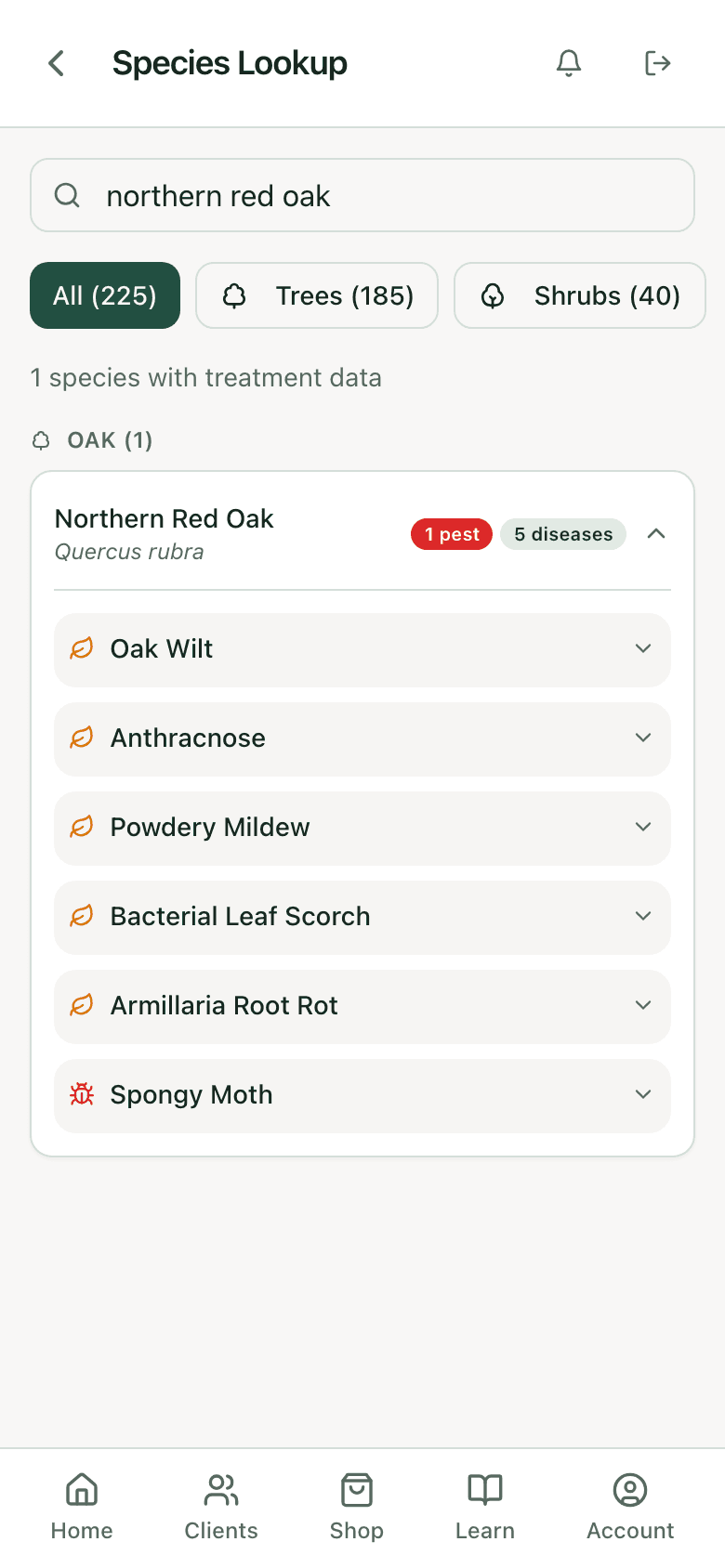
Both kill oaks from the top and both show up in the red oak group. Oak wilt in a red oak drops green leaves with browning from the tip and margin, fast, over weeks, and spreads to neighboring oaks through root grafts. Chestnut borer dieback is slower, over seasons, the dead leaves stay on the branch, and the D-shaped holes and galleries are under the bark of the dead limbs. The diagnosis in the app weighs the findings and gives a confidence, and if it comes up oak wilt the treatment is a different page and a different urgency.
What the label check will catch
Flatheaded borers are on the emamectin benzoate, imidacloprid, and abamectin labels the app carries, so the pest check passes. The label check flags an injection scheduled in August after the larvae are deep in the wood, a repeat inside the two-year interval on emamectin, and a DBH under the table minimum. On an oak with a crown-loss finding over 50 percent in the diagnosis, it flags the treatment as unlikely to succeed, which is the flag to show the client.
Label check
1 warningLast application was 14 days ago. Proceed with a documented override, or reschedule.
Pricing the job
Per inch of DBH like any injection. A 22 inch red oak at $18 per inch is $396 for two seasons on emamectin; a 30 inch white oak is $540. Add the mulch and irrigation as a service line or a written instruction. Put the re-injection two years out on the calendar with the product and rate on the event, and a crown check every summer in between so the record shows whether it is working.
FAQ
Questions arborists ask
How do you treat two-lined chestnut borer?
Inject emamectin benzoate at the root flare in April through June on an oak that has lost less than a third of its crown, and fix whatever stressed the tree: water through drought, mulch, and stop the construction damage in the root zone. Trees with more than half the crown dead are usually past saving.
Does the emerald ash borer treatment work on chestnut borer?
Yes. Two-lined chestnut borer is the same genus, Agrilus, and emamectin benzoate is the standard for both. A 22 inch red oak takes 115 to 230 mL medium, 230 to 345 mL high (label band 22 to 24 in) from the Agrilicide rate table, every two years.
Why is my oak dying from the top down?
Top-down dieback over two or three seasons on an oak that went through a drought, defoliation, or construction is the two-lined chestnut borer pattern. Look for D-shaped exit holes and galleries under the bark of the dead limbs. Fast dieback over weeks with green leaves dropping is more likely oak wilt.
When should you inject for chestnut borer?
April through June, so the systemic is in the phloem when the eggs hatch and the larvae start feeding. Adults fly from late May through July. An injection in August is too late for that year's larvae.
Will the oak recover?
If the crown loss is under a third and the stress is fixed, usually yes, over two or three seasons. The dead branches do not come back; the tree fills in around them. Over half gone, plan on removal.
Where do these rates come from?
The PHC Rx product catalog, built from the Agrilicide, Imicide, Abacide 2, and TREE-äge R10 labels, and the app's timing guide for the injection window.
Related