
Guide
Pesticide applicator license by state: what tree care needs, and who issues it.
Applying anything for hire to a client's tree needs a commercial applicator license from your state, in the category that covers ornamentals and shade trees. The federal law sets the floor; each state runs its own exams, categories, fees, and renewal cycle. This page explains the parts that are the same everywhere, then lists the agency that issues the license in every state so you call the right office.
Key takeaways
- Every state requires a commercial applicator license to apply pesticides for hire. Tree care falls under the ornamental and turf category in most states, sometimes split into an ornamental or shade tree subcategory.
- The path is a core exam plus a category exam, a fee, and in many states a supervised period as a registered technician before you can test.
- Licenses are per person. The business usually needs its own registration or license on top, and insurance proof in many states.
- Renewal runs on a cycle of one to five years with continuing education credits. Miss it and you retest.
- The agency is the state department of agriculture in most states; a handful use the environmental agency, the land-grant university, or a pesticide board.
How licensing works
The federal pesticide law (FIFRA) requires that restricted-use pesticides be applied by or under the supervision of a certified applicator, and it lets each state run its own certification program under an EPA-approved plan. States went further: nearly all of them require a license for anyone applying any pesticide for hire, restricted or not, and most require the business to be licensed too. The categories follow a federal numbering that most states adopted with local variations; ornamental and turf is category 3, and several states split it into 3A ornamental and 3B turf, or name it ornamental and shade tree.
For a tree care company that means: the person who applies the product holds a commercial applicator license in the ornamental category; anyone working under them without a license is a registered technician or trainee under direct supervision, where the state allows that; and the company holds a business license, registration, or permit with proof of insurance. Restricted-use products add a purchase record and stricter supervision rules.
The exam
Two parts almost everywhere. The core exam covers label reading, safety, calibration, drift, storage, disposal, and the law. The category exam covers the pests, diseases, and application methods for ornamentals and turf. Study material comes from the state's extension service and is usually a manual per exam; some states offer the tests online, most at a testing center or an extension office. Budget four to ten weeks from ordering the manuals to holding the license, and expect a fee for each exam and for the license itself.
Several states require a period as a registered technician or trainee, working under a licensed applicator, before you can sit for the commercial exam. Others let you test immediately. Some accept an arborist certification or a degree in place of experience. Check the specific state before planning a hire around it.
Renewal, CEUs, and reciprocity
Licenses renew on a fixed cycle, commonly two, three, or five years, and renewal requires continuing education credits in the category. Credits come from state and extension workshops, trade association meetings, and approved online courses. Let the license lapse and most states make you retest.
Reciprocity exists between some neighboring states for the core exam, less often for the category exam, and almost never for the business license. A company working across a state line needs to check both states, and often needs a licensed applicator in each.
What the license does not cover
- Record keeping. Every state requires application records; the fields and the retention period are in the record keeping guide.
- Posting and notification. Several states require signs or advance notice for commercial applications, especially on school and public property.
- Insurance. Most states require proof of liability coverage for the business license, and some general liability policies exclude pesticide application unless it is added.
- Federal WPS. The Worker Protection Standard applies to agricultural establishments, not ornamental tree care on residential property, but nurseries and tree farms fall under it.
The licensing agency in every state
Category names, fees, and exam formats change; the agency is stable. Search the agency name with "pesticide applicator" to reach the current program page, and call before you order manuals.
State lead agencies for pesticide applicator certification
Alabama
- Agency
- Department of Agriculture and Industries
Alaska
- Agency
- Department of Environmental Conservation
Arizona
- Agency
- Department of Agriculture, Pest Management Division
Arkansas
- Agency
- Arkansas State Plant Board
California
- Agency
- Department of Pesticide Regulation
Colorado
- Agency
- Department of Agriculture
Connecticut
- Agency
- Department of Energy and Environmental Protection
Delaware
- Agency
- Department of Agriculture
Florida
- Agency
- Department of Agriculture and Consumer Services
Georgia
- Agency
- Department of Agriculture
Hawaii
- Agency
- Department of Agriculture
Idaho
- Agency
- State Department of Agriculture
Illinois
- Agency
- Department of Agriculture
Indiana
- Agency
- Office of Indiana State Chemist (Purdue University)
Iowa
- Agency
- Department of Agriculture and Land Stewardship
Kansas
- Agency
- Department of Agriculture
Kentucky
- Agency
- Department of Agriculture
Louisiana
- Agency
- Department of Agriculture and Forestry
Maine
- Agency
- Board of Pesticides Control
Maryland
- Agency
- Department of Agriculture
Massachusetts
- Agency
- Department of Agricultural Resources
Michigan
- Agency
- Department of Agriculture and Rural Development
Minnesota
- Agency
- Department of Agriculture
Mississippi
- Agency
- Department of Agriculture and Commerce, Bureau of Plant Industry
Missouri
- Agency
- Department of Agriculture
Montana
- Agency
- Department of Agriculture
Nebraska
- Agency
- Department of Agriculture
Nevada
- Agency
- Department of Agriculture
New Hampshire
- Agency
- Department of Agriculture, Markets and Food
New Jersey
- Agency
- Department of Environmental Protection
New Mexico
- Agency
- Department of Agriculture
New York
- Agency
- Department of Environmental Conservation
North Carolina
- Agency
- Department of Agriculture and Consumer Services
North Dakota
- Agency
- Department of Agriculture
Ohio
- Agency
- Department of Agriculture
Oklahoma
- Agency
- Department of Agriculture, Food and Forestry
Oregon
- Agency
- Department of Agriculture
Pennsylvania
- Agency
- Department of Agriculture
Rhode Island
- Agency
- Department of Environmental Management
South Carolina
- Agency
- Clemson University, Department of Pesticide Regulation
South Dakota
- Agency
- Department of Agriculture and Natural Resources
Tennessee
- Agency
- Department of Agriculture
Texas
- Agency
- Department of Agriculture
Utah
- Agency
- Department of Agriculture and Food
Vermont
- Agency
- Agency of Agriculture, Food and Markets
Virginia
- Agency
- Department of Agriculture and Consumer Services
Washington
- Agency
- State Department of Agriculture
West Virginia
- Agency
- Department of Agriculture
Wisconsin
- Agency
- Department of Agriculture, Trade and Consumer Protection
Wyoming
- Agency
- Department of Agriculture
District of Columbia
- Agency
- Department of Energy and Environment
Putting the license on the record
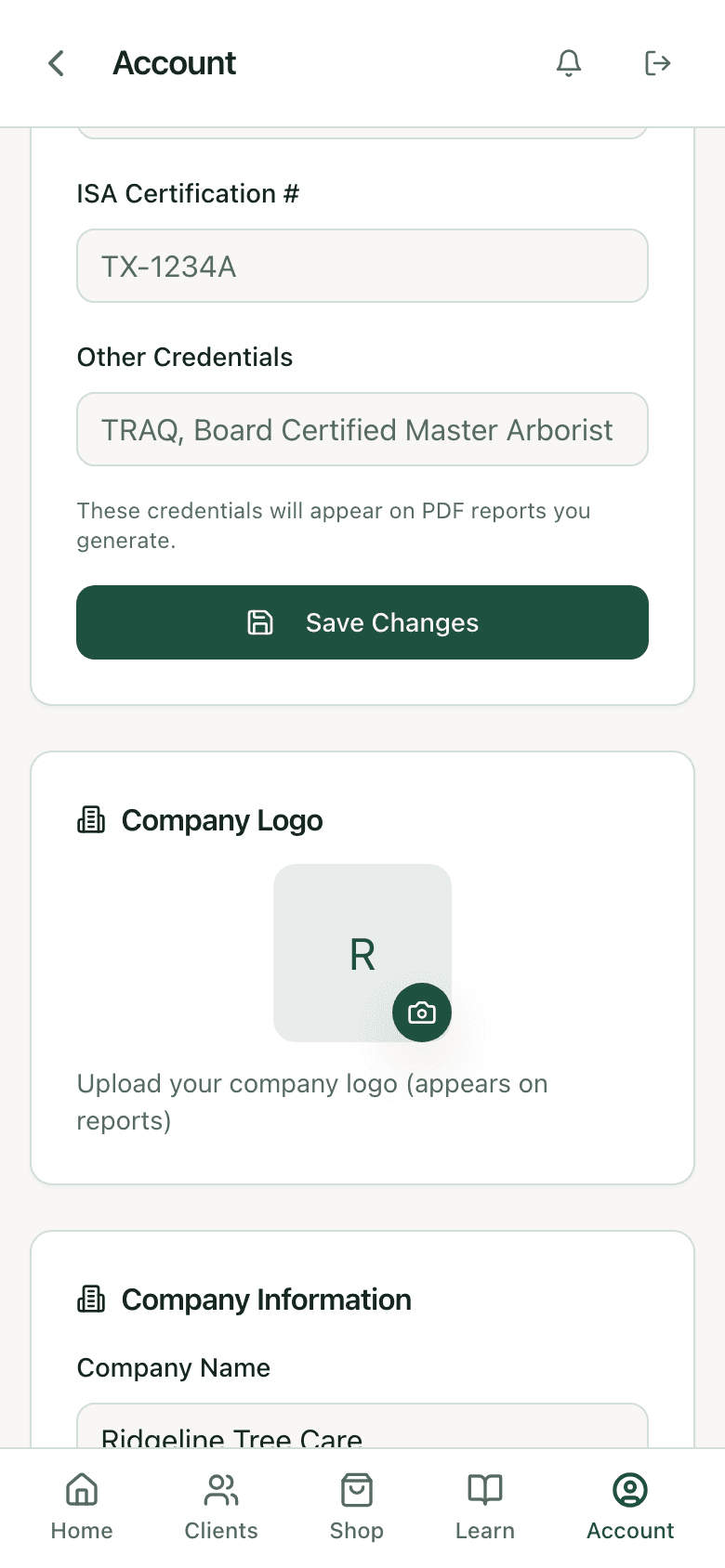
Once you have it, the license number goes on every application record and, in most states, on the client-facing paperwork. In PHC Rx the applicator license and certifications live on the profile and company branding and print on reports and prescriptions, so the number is on the document the client keeps and the record the inspector reads.
Written and reviewed by
ISA Board Certified Master Arborist MA-5832B · ISA TRAQ · Maryland Licensed Tree Expert #2168
Alex Shy is an ISA Board Certified Master Arborist, TRAQ-qualified tree risk assessor, and Maryland Licensed Tree Expert. He holds a B.S. in Forest Resource Management from West Virginia University. Alex is the founder and president of Mobile Tree Spa LLC, founder and co-owner of the PHC Rx diagnostic app, and a member of the ATCP board, where he oversees the education committee. His work focuses on making science-based plant health care practical, profitable, and easy for tree care companies to adopt.
ISA Certified Arborist MA-7027A · VNLA Certified Horticulturist · Virginia Commercial Pesticide Applicator
Jordan Thompson is an ISA Certified Arborist, VNLA Certified Horticulturist, Virginia Commercial Pesticide Applicator, and co-owner of J.J. Mauget Co. and TIPCO. She holds an M.S. in Entomology and a B.S. in Environmental Horticulture from Virginia Tech. Her work bridges arboriculture, plant health care, and applied research, with a particular focus on tree injection, invasive species, tree disease management, and translating university research into practical tools for professional arborists.
FAQ
Questions arborists ask
Do I need a pesticide license to do plant health care?
Yes. Every state requires a commercial applicator license to apply pesticides for hire, in the category that covers ornamentals and shade trees. Most states also license the business.
Which category covers tree care?
Ornamental and turf, category 3 in the federal numbering, in most states. Some split it into ornamental (3A) and turf (3B) or name it ornamental and shade tree. Right-of-way and aquatic work are separate categories.
How long does it take to get licensed?
Four to ten weeks in most states from ordering the study manuals to holding the license, longer where a supervised technician period is required first.
Does an ISA arborist certification replace the pesticide license?
No. They are separate. Some states accept an arborist credential toward the experience requirement, but the applicator license is always required to apply pesticides for hire.
Can I use my license in another state?
Sometimes for the core exam through reciprocity with neighboring states, rarely for the category exam, and almost never for the business license. Check both states.
Are the state pages coming?
This is the hub. Pages for each state with the category name, exam format, fees, renewal cycle, and record-keeping rule are planned; the agency table above is the starting point until then.
Related