
Treatment guide
Rhizosphaera needle cast treatment: two sprays in spring, two years running
The blue spruce that is thin at the bottom and green at the tips has needle cast, and the year-old needles it dropped are not coming back. What a program can do is protect this year's needles and next year's, so the tree fills in from the outside. Two protectant sprays at half-elongation, repeated two seasons, or an injection where a sprayer cannot go. Rates and the window.
disease
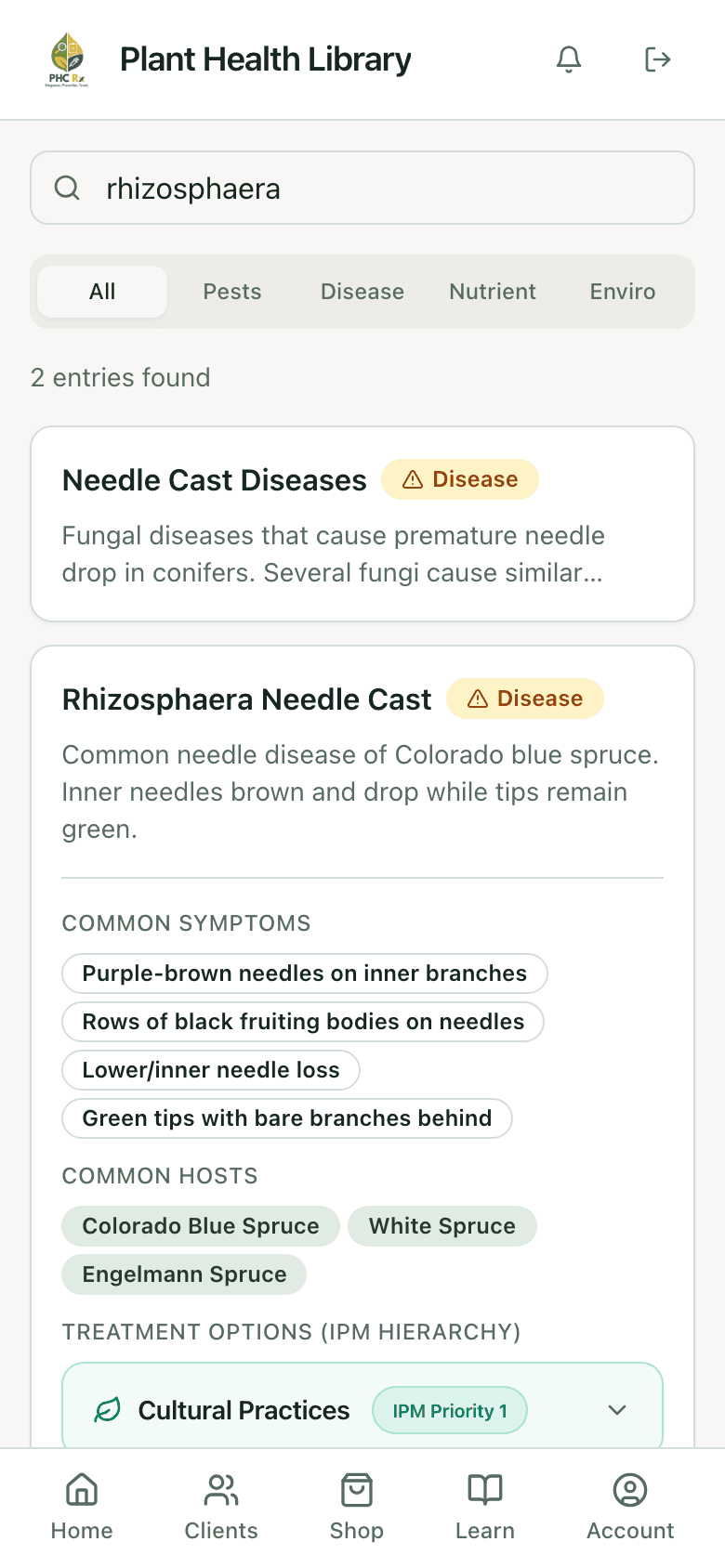
Rhizosphaera needle castRhizosphaera kalkhoffii
A fungus that infects spruce needles as they emerge in spring and shows up the following year. Infected needles turn purple-brown from the inside of the tree outward, drop in late summer and fall, and leave the current season's growth green at the branch tips. Year after year the tree loses its interior needles, the lower branches go bare, and a 30-foot blue spruce ends up a green shell around dead wood. It spreads in wet weather, so a spruce planted in a low corner or watered by a sprinkler head is the first to go.
Symptoms (the tree's response)
- Purple to brown needles on the inner part of the branch, lower branches first
- Needle drop from the inside out, leaving green tips with bare wood behind
- Lower branches dying after several seasons of needle loss
- A thin tree that looks like it has been losing needles for years, because it has
Signs (the organism itself)
- Rows of tiny black dots, the fruiting bodies, in the stomatal lines on infected needles, visible with a hand lens
- Second-year needles affected, current-year needles clean
- Worse on the north and east sides and on trees crowded together
Common hosts: Colorado blue spruce, by far the most susceptible, White spruce and Engelmann spruce, Norway spruce, usually mildly, Black Hills spruce, Occasionally pine, fir, and Douglas-fir under stress
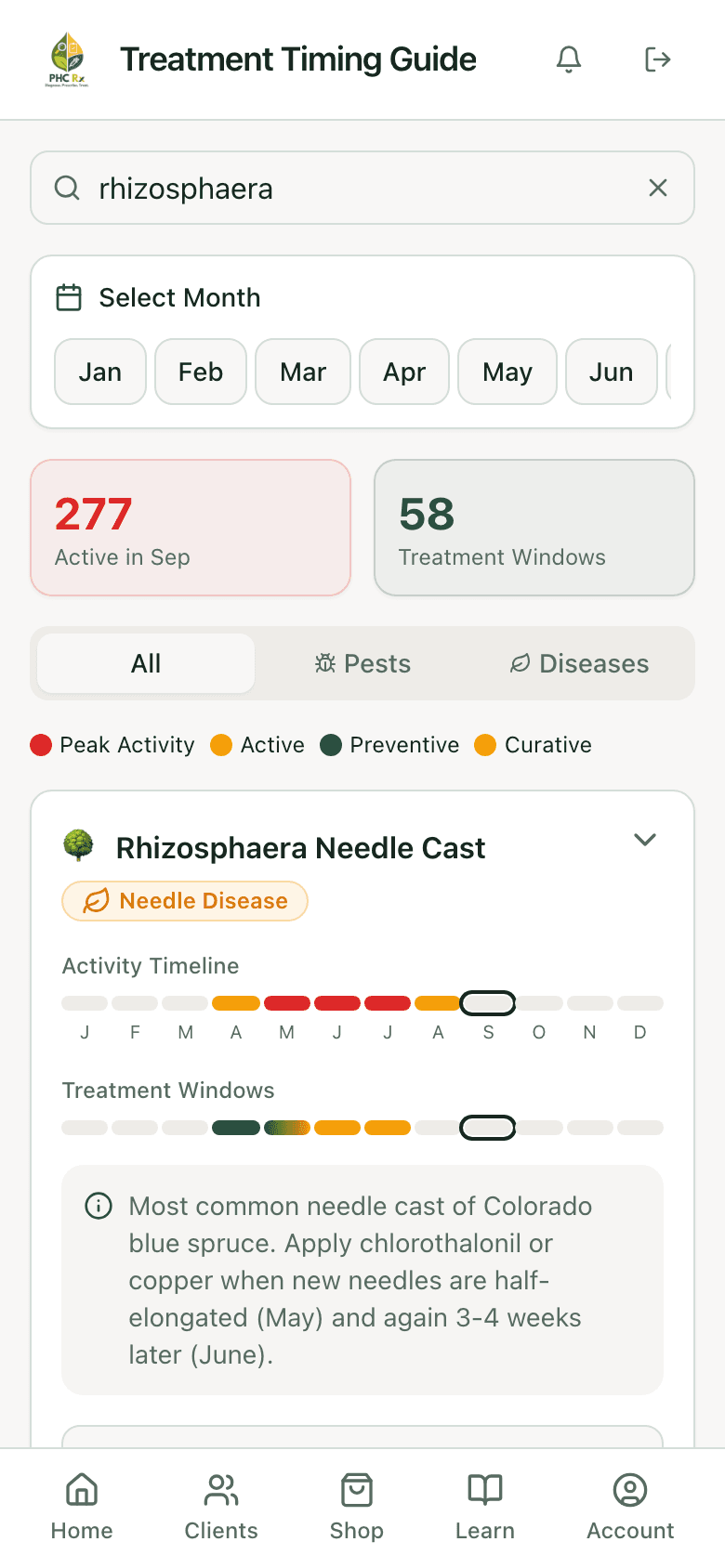
Timing window
5 active monthsOrganism active
Preventive treatment
Curative treatment
Spores infect new needles as they emerge. Spray when the new needles are about half elongated, usually mid to late May, and again three to four weeks later in June. Repeat both sprays the following spring, because the needles infected last year drop this year no matter what, and the tree needs two clean seasons to look better. A trunk injection goes in at bud break. Nothing applied after July does anything until next year.
Treatment options
Product, rate, delivery, timing
Rates below are per inch of trunk diameter at breast height unless the row says otherwise. The registered label wins over anything on this page.
FUNGISOL® (Mauget)
- Active ingredient
- Debacarb, Carbendazim
- Rate
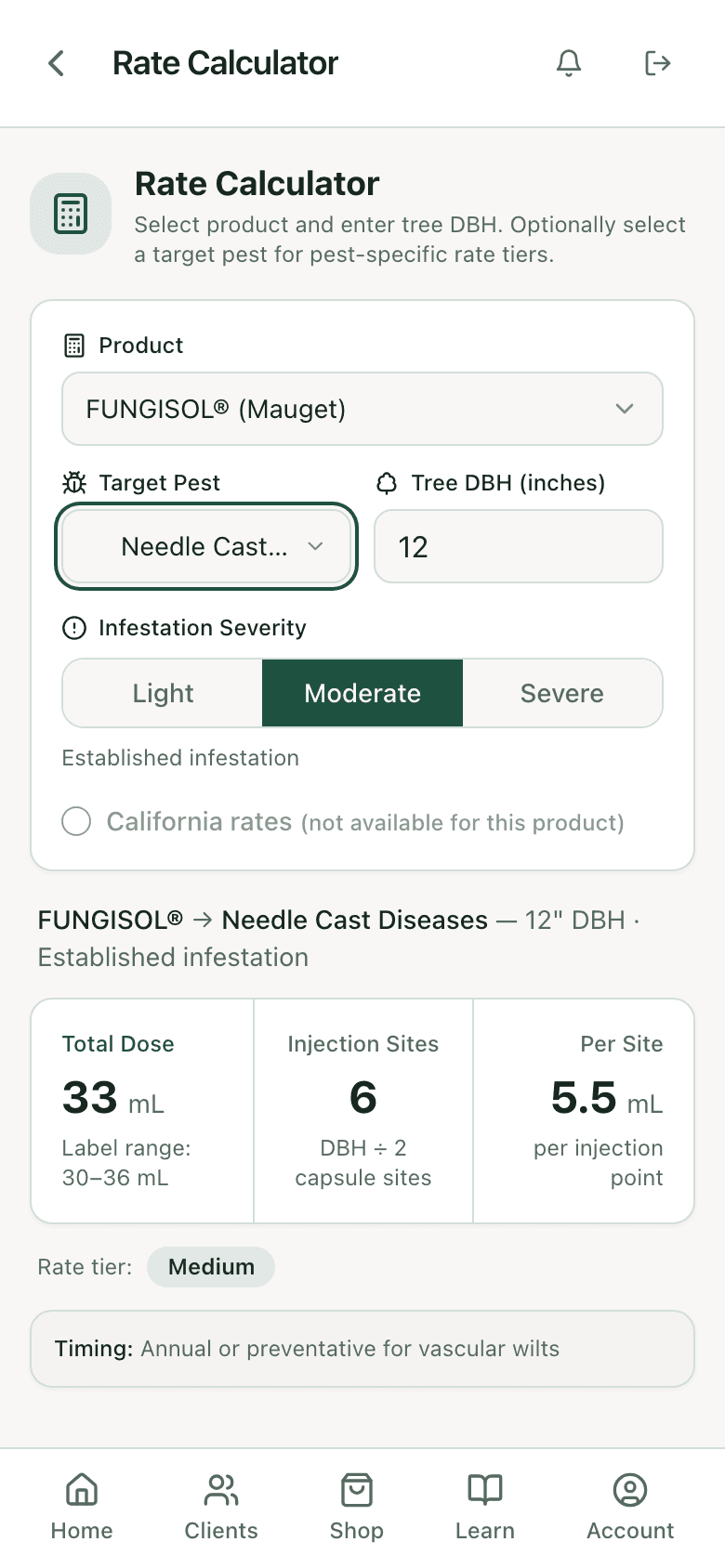
- Capsule micro-injection by DBH band. A 12 inch spruce is 30 to 36 mL low, 30 to 36 mL medium, 30 to 36 mL high (label band 11 to 13 in); an 18 inch spruce is 42 to 54 mL low, 42 to 54 mL medium, 42 to 54 mL high (label band 14 to 19 in)
- Delivery
- Mauget capsule micro-injection at the root flare, capsules spaced around the trunk
- Timing
- Bud break, before the new needles emerge
- Frequency
- Annual or preventative for vascular wilts
Tebuject 16 (Mauget)
- Active ingredient
- Tebuconazole
- Rate
- Capsule micro-injection by DBH band; a 14 inch tree is 42 to 54 mL low, 42 to 54 mL high (label band 14 to 19 in)
- Delivery
- Mauget capsule micro-injection
- Timing
- Bud break
- Frequency
- Annual application or as needed during the growing season.
Propizol (Arborjet)
- Active ingredient
- Propiconazole
- Rate
- Label table by DBH band; a 14 inch tree is 130 to 150 mL low, 260 to 300 mL high (label band 13 to 15 in)
- Delivery
- Trunk injection
- Timing
- Bud break
- Frequency
- annual
TM 4.5 (Quali-Pro)
- Active ingredient
- Thiophanate-methyl 46.2%
- Rate
- Per label, diluted, sprayed to wet all new growth to the interior of the tree
- Delivery
- Foliar spray with enough pressure to reach the inside of a dense spruce
- Timing
- New needles half elongated, then three to four weeks later
- Frequency
- Two applications per spring for two consecutive years
Chlorothalonil (several brands)
- Active ingredient
- chlorothalonil
- Rate
- Per label, sprayed to wet all new growth including the interior
- Delivery
- Foliar spray
- Timing
- Half needle elongation, then three to four weeks later
- Frequency
- Two applications per spring for two consecutive years
- FUNGISOL® (Mauget): Debacarb and carbendazim, systemic. The option on a 40-foot spruce in a back corner that no sprayer reaches, or on a property where the client will not have spray drift. One visit for the season instead of two.
- Tebuject 16 (Mauget): Tebuconazole, a triazole for rotation on a spruce that is injected every spring for several years.
- Propizol (Arborjet): Propiconazole for crews running an Arborjet system. Same window.
- TM 4.5 (Quali-Pro): Thiophanate-methyl, labeled and effective. Coverage inside the tree is the whole job; a spray that only hits the outer foliage protects the needles that were already going to be fine.
- Chlorothalonil (several brands): The protectant every extension bulletin names for this disease and the rotation partner for thiophanate-methyl. Not in the PHC Rx catalog as a specific product; write the brand you use and its rate.
Worked examples
Dose per tree
FUNGISOL, capsule micro-injection
12″ DBH
30 to 36 mL low, 30 to 36 mL medium, 30 to 36 mL high (label band 11 to 13 in)
FUNGISOL, capsule micro-injection
18″ DBH
42 to 54 mL low, 42 to 54 mL medium, 42 to 54 mL high (label band 14 to 19 in)
Tebuject 16, capsule micro-injection
14″ DBH
42 to 54 mL low, 42 to 54 mL high (label band 14 to 19 in)
Propizol, from the label table
14″ DBH
130 to 150 mL low, 260 to 300 mL high (label band 13 to 15 in)
Want the number for the tree in front of you? Use the tree injection rate calculator.
Two years, not one
A client who pays for one spring of spraying and sees a thinner tree in August the same year concludes it did not work. It did; the needles that dropped were infected the year before. Sell the program as two seasons from the start, with the expectation that the tree looks the same after year one and fuller after year two, and put that in writing on the prescription. A blue spruce that has lost its lower third is not going to regrow it, and that goes in writing too.
Fix the water while you are there. A sprinkler head that wets the lower branches every night is why the bottom of the tree went first. Move it, or set the client's expectations about the tree it is watering.
Spray or inject
A row of 15-foot spruce along a property line gets sprayed, two passes each spring with a rig that pushes into the interior, because the coverage is easy and the cost per tree is low. A single 40-foot specimen blue spruce in a courtyard, or any spruce where the drift lands on a pool or a neighbor, gets injected at bud break. Injection is one visit per season and no drift; the trade is the cost per inch on a big trunk. Both go on the calendar for two years the day the plan is approved.
What the label check will catch
Needle cast is on the debacarb, tebuconazole, propiconazole, and thiophanate-methyl labels the app carries, so the disease check passes. The label check flags a second spray scheduled outside the label interval, a fungicide injection in July after the needles have hardened, the same triazole on the same tree three years running, and a DBH under the table minimum on a young spruce that should be sprayed. It also flags horticultural oil on a blue spruce if someone adds it for mites, because oil takes the blue off.
Label check
1 warningLast application was 14 days ago. Proceed with a documented override, or reschedule.
Pricing the job
Sprays are per tree per visit with a property minimum, sold as four visits over two springs. Injection is per inch of DBH: a 12 inch spruce at $18 per inch is $216 a season, an 18 inch spruce is $324. Include the sprinkler conversation as a written instruction. Everything lands on the calendar with the product and rate on each event, and the year-two visits are scheduled before year one is done.
FAQ
Questions arborists ask
How do you treat rhizosphaera needle cast on blue spruce?
Two protectant fungicide sprays each spring, the first when the new needles are about half elongated and the second three to four weeks later, repeated for two consecutive years. Thiophanate-methyl or chlorothalonil with full interior coverage. On a large or hard-to-spray tree, a fungicide trunk injection at bud break replaces the sprays.
Will the spruce grow its needles back?
The needles that dropped are gone, and a branch that has lost all its needles is dead. What a program does is keep the new needles clean so the tree fills in from the tips over two or three seasons. A tree that has lost its lower third stays that shape.
When should you spray spruce for needle cast?
When the new growth is half elongated, usually mid to late May, and again three to four weeks later. Nothing sprayed after the needles harden in July does anything. Repeat the following spring.
Can needle cast be treated with a tree injection?
Yes. FUNGISOL or Tebuject 16 at bud break protects the season's new needles from the inside. A 12 inch spruce takes 30 to 36 mL low, 30 to 36 mL medium, 30 to 36 mL high (label band 11 to 13 in) from the FUNGISOL rate table.
Is it needle cast or spider mites?
Mites stipple needles yellow and leave webbing and the damage is worst in hot dry weather on the outer foliage. Needle cast browns second-year needles from the inside of the tree out, worst in wet years, with rows of black dots in the stomatal lines under a hand lens. A spruce can have both.
Where do these rates come from?
The PHC Rx product catalog, built from the FUNGISOL, Tebuject 16, Propizol, and TM 4.5 labels, and the app's timing guide for the spray windows.
Related