
Treatment guide
Apple scab treatment: the green-tip spray schedule and the injection option
Crabapples that are bare by August have scab. The fungus infects the first leaves as they open in a wet April, and every control is about being on the tree before that: protectant sprays from green tip through petal fall, or a systemic in the trunk in early spring for the big crabapple nobody can spray. Timing, products, rates, and the cultivar conversation that ends the problem.
disease
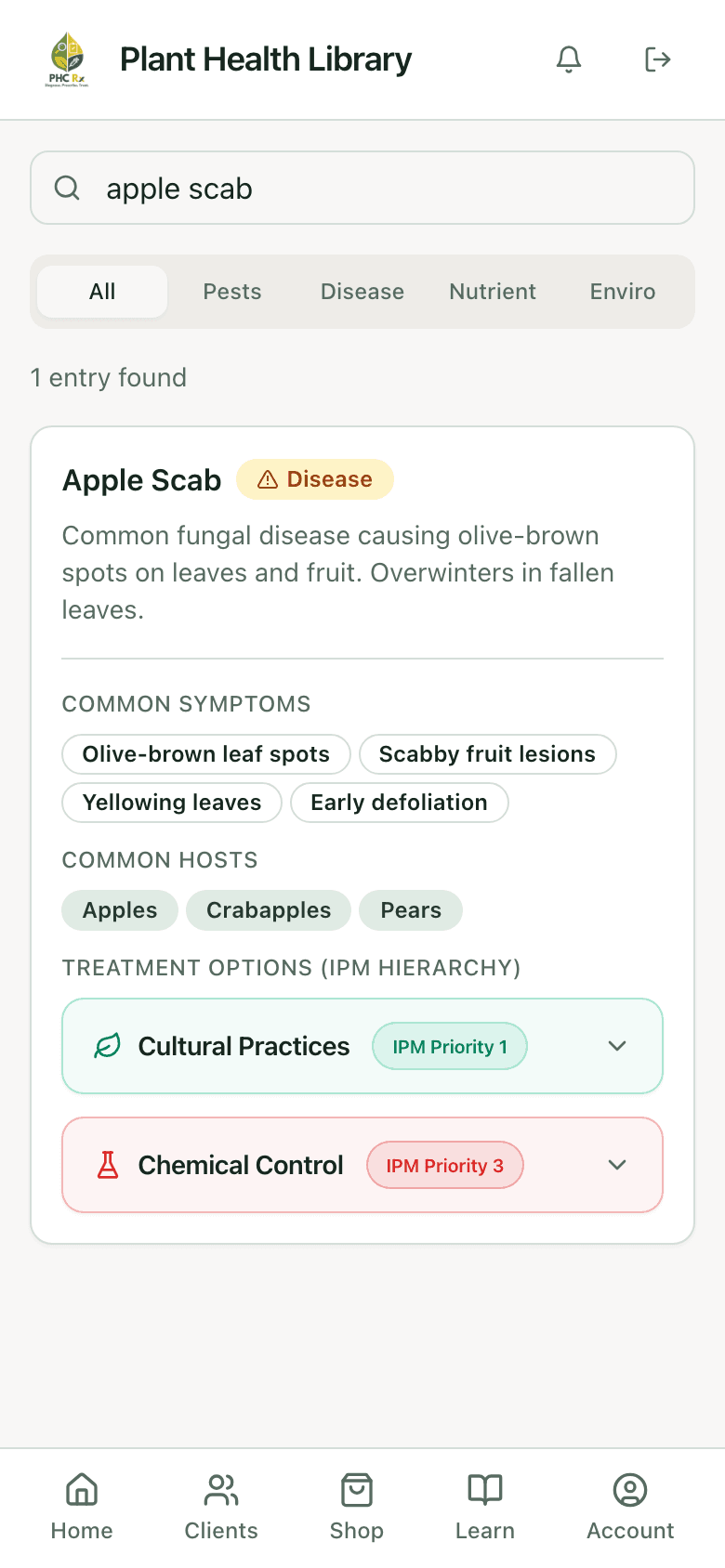
Apple scabVenturia inaequalis
A fungal leaf and fruit disease that overwinters in fallen leaves and shoots spores into the new foliage during wet weather from bud break through early summer. Primary infections in April and May produce the olive-brown spots; those spots produce a second wave of spores that keeps it going through a wet June. Heavily infected leaves yellow and drop by midsummer, and a susceptible crabapple can be half bare by August. It does not kill the tree; it makes it ugly every year and stresses it over time.
Symptoms (the tree's response)
- Olive-green to brown velvety spots on leaves, first along the veins
- Yellowing and early leaf drop, starting in June and severe by August
- Scabby, cracked lesions on fruit
- Thin crown and poor bloom the following spring after a bad year
Signs (the organism itself)
- Velvety spore masses on the leaf spots under magnification
- Fruiting bodies on last year's fallen leaves in spring, the source of the primary spores
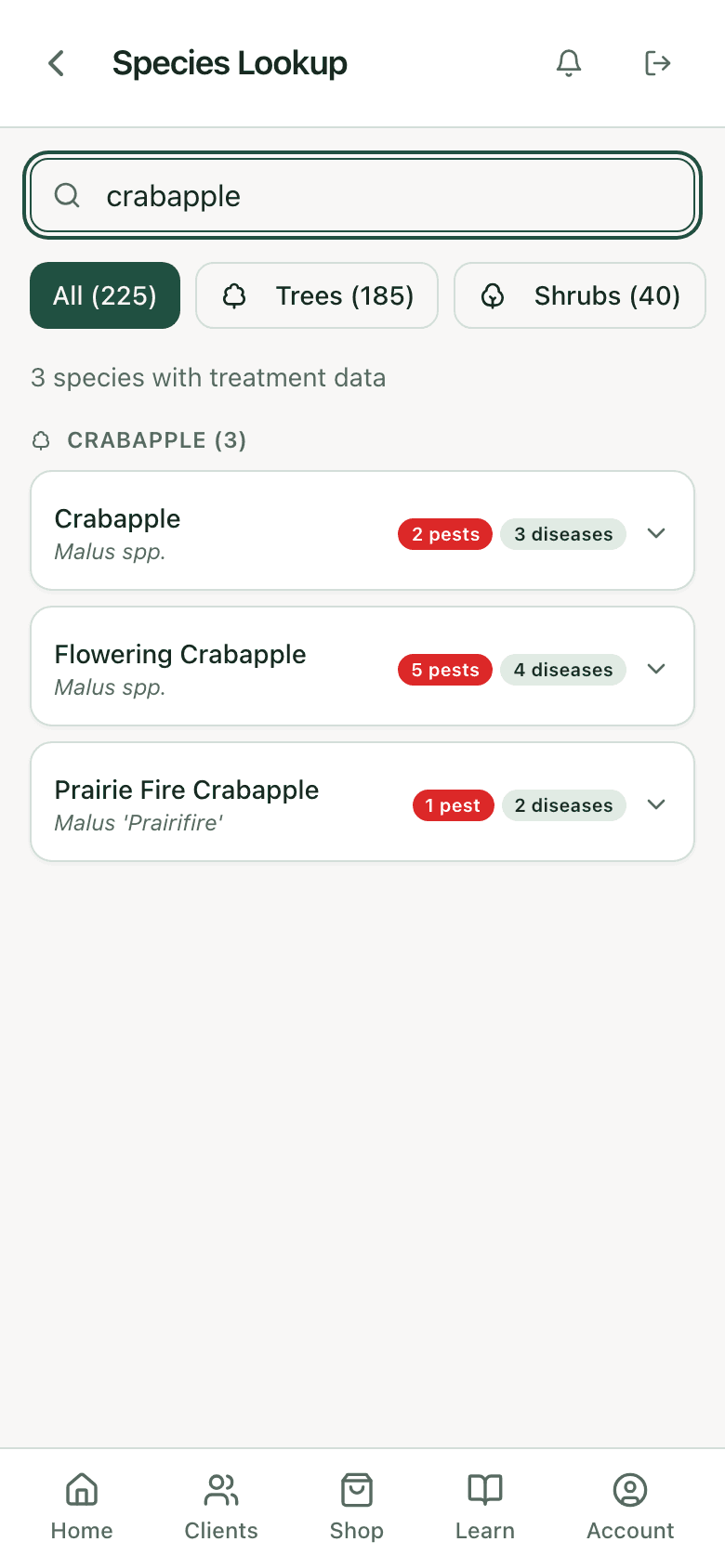
Common hosts: Flowering crabapple, most older cultivars, Apple, Pear (a related scab fungus), Hawthorn and mountain ash (related species), Prairifire and other resistant crabapples rarely need treatment
Timing window
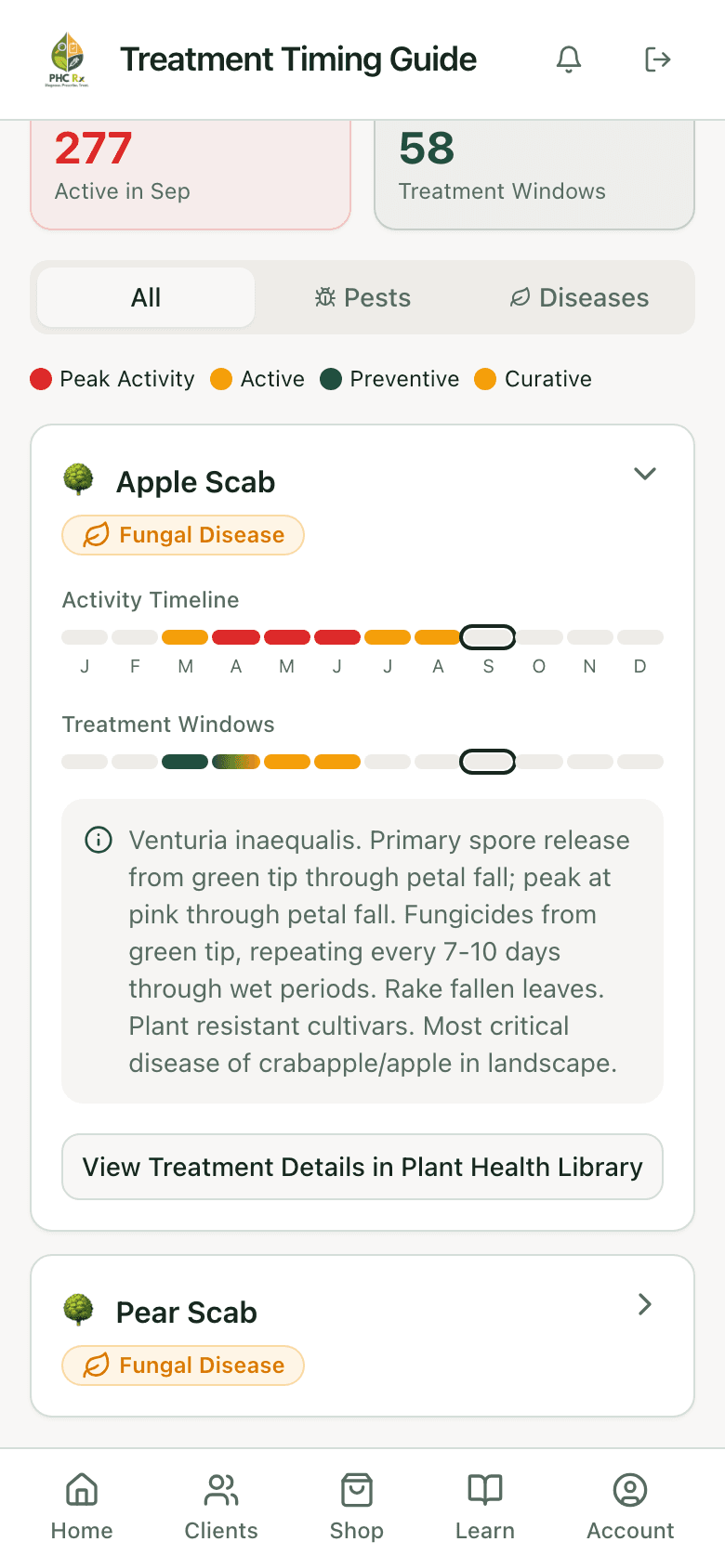
4 active monthsOrganism active
Preventive treatment
Curative treatment
Protectant sprays start at green tip, when the first leaf tissue shows, and repeat on the label interval through petal fall, extending into June if the weather stays wet. A trunk-injected systemic goes in at bud swell so it is in the leaves as they open. Leaf cleanup in fall removes the overwintering inoculum and is the cheapest control there is. Nothing applied in July changes this year.
Treatment options
Product, rate, delivery, timing
Rates below are per inch of trunk diameter at breast height unless the row says otherwise. The registered label wins over anything on this page.
Myclobutanil 20 EW (Quali-Pro)
- Active ingredient
- Myclobutanil 19.7%
- Rate
- Per label as a foliar spray, diluted
- Delivery
- Foliar spray to full coverage
- Timing
- Green tip through petal fall
- Frequency
- Every 7 to 14 days in wet weather, usually three or four applications
Propizol (Arborjet)
- Active ingredient
- Propiconazole
- Rate
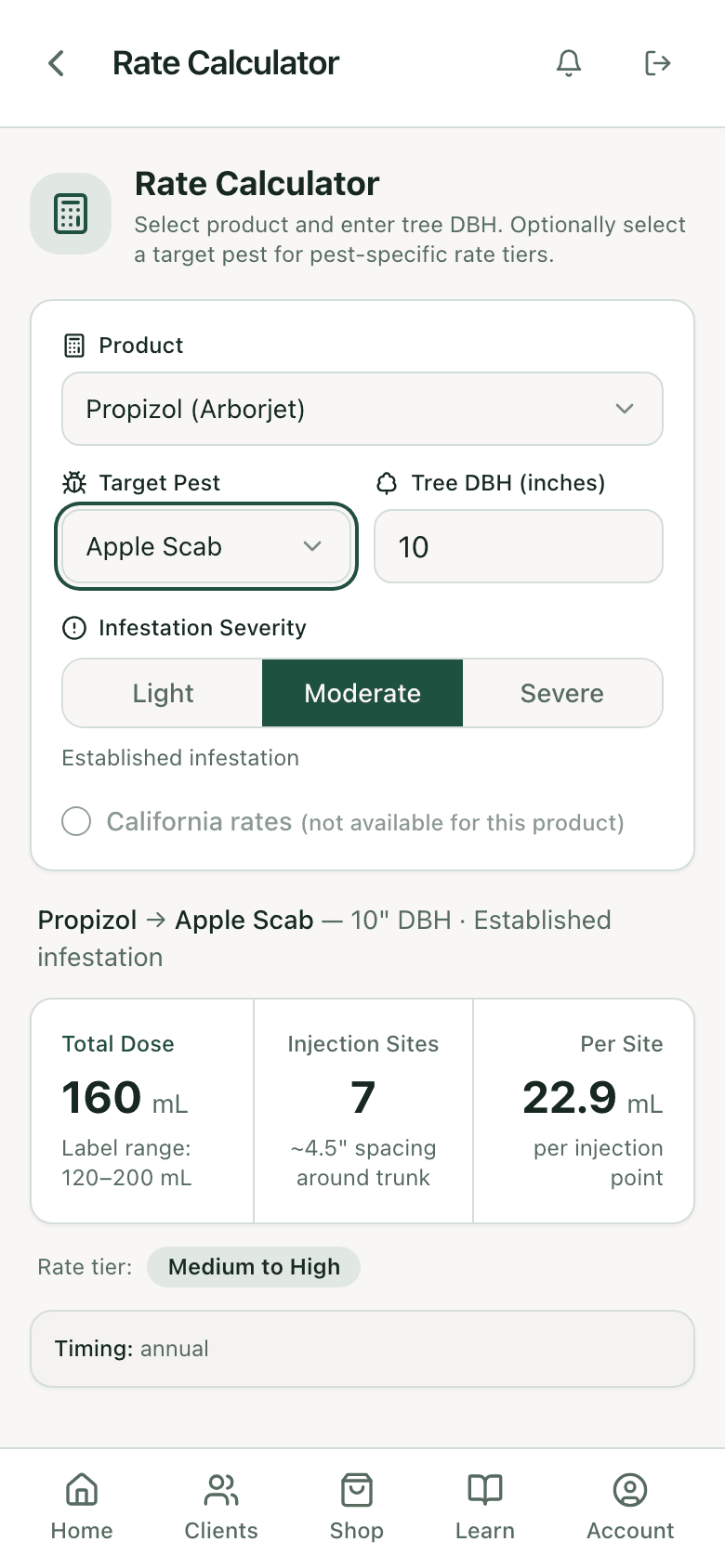
- Label table by DBH band with low and high tiers. A 10 inch crabapple is 100 to 120 mL low, 200 to 240 mL high (label band 10 to 12 in); a 14 inch tree is 130 to 150 mL low, 260 to 300 mL high (label band 13 to 15 in)
- Delivery
- Trunk injection at the flare, small ports on thin-barked crabapple
- Timing
- Early spring at bud swell
- Frequency
- Annually per label
Propiconazole 14.3 (Quali-Pro)
- Active ingredient
- Propiconazole 14.3%
- Rate
- Per label as a foliar spray, or by DBH table as a trunk injection
- Delivery
- Foliar spray or trunk injection
- Timing
- Green tip for sprays, bud swell for injection
- Frequency
- At the label interval
TM 4.5 (Quali-Pro)
- Active ingredient
- Thiophanate-methyl 46.2%
- Rate
- Per label as a foliar spray
- Delivery
- Foliar spray
- Timing
- Green tip through petal fall
- Frequency
- At the label interval, in rotation
Reliant (Quest Products)
- Active ingredient
- Phosphorous Acid 45.8%
- Rate
- Per label as a foliar spray
- Delivery
- Foliar spray
- Timing
- Post-bloom
- Frequency
- Every 14 days per the species notes
Captan, mancozeb, or sulfur (several brands)
- Active ingredient
- Captan, mancozeb, sulfur
- Rate
- Per label as a foliar spray
- Delivery
- Foliar spray to full coverage
- Timing
- Green tip through petal fall
- Frequency
- Every 7 to 10 days during infection periods
- Myclobutanil 20 EW (Quali-Pro): A triazole with some kickback if applied within a couple of days after an infection period. The standard spray on ornamental crabapples. Rotate with a protectant to manage resistance.
- Propizol (Arborjet): Propiconazole by injection, for the large or inaccessible crabapple where a spray program is impractical or the client will not have spraying near the patio. Ornamental use; check the label before treating a tree whose fruit is eaten.
- Propiconazole 14.3 (Quali-Pro): The Quali-Pro propiconazole, labeled both ways. Same active as Propizol; same rotation rule.
- TM 4.5 (Quali-Pro): Thiophanate-methyl, a different mode of action from the triazoles. The rotation partner in a spray program.
- Reliant (Quest Products): Potassium phosphite. A supplement that boosts the tree's defenses; not a stand-alone scab program.
- Captan, mancozeb, or sulfur (several brands): The multi-site protectants that anchor an orchard or crabapple spray rotation. Low resistance risk; no kickback. Not in the PHC Rx catalog as specific products; write the brand you use.
Worked examples
Dose per tree
Propizol, from the label table
10″ DBH
100 to 120 mL low, 200 to 240 mL high (label band 10 to 12 in)
Propizol, from the label table
14″ DBH
130 to 150 mL low, 260 to 300 mL high (label band 13 to 15 in)
Myclobutanil 20 EW, foliar
8″ DBH
Per label, diluted in the water volume needed to wet a tree this size to runoff, three or four times from green tip to petal fall
Want the number for the tree in front of you? Use the tree injection rate calculator.
Spray, inject, or replace
A crabapple small enough to cover gets a spray program: a triazole or a protectant at green tip and every 7 to 14 days through petal fall, more if May stays wet. That is three or four visits in a six-week window on a schedule the weather sets, which is why the calendar matters more on scab than on almost anything else. A big old crabapple over a patio gets the injection at bud swell instead, one visit, product in the leaves as they open.
The third option is the honest one for a susceptible old cultivar: replace it. Prairifire, Adirondack, Sugar Tyme, and dozens of other modern crabapples are scab-resistant and need no program. The species notes in the PHC Rx library flag Prairifire as rarely needing treatment for a reason.
Fall cleanup is a treatment
The primary spores come from last year's leaves on the ground. Raking and removing them in fall, or mulch-mowing them to shreds where removal is impractical, cuts the spring inoculum on an isolated tree substantially. It does not replace the spray program in a neighborhood full of infected crabapples, but it is the cheapest line on the prescription and the one the client can do themselves.
What the label check will catch
Apple scab is on the myclobutanil, propiconazole, thiophanate-methyl, and phosphite labels. Where the label check flags a plan is timing (a first spray scheduled after bloom, past the primary infection window), delivery (a foliar-only formulation written as an injection), and, on a fruit-bearing apple, the pre-harvest interval and the ornamental-only language on some labels. Read that section before treating a tree whose apples get eaten.
Label check
1 warningLast application was 14 days ago. Proceed with a documented override, or reschedule.
Pricing the job
Spray programs price per visit with a season package, since the count depends on the weather; three visits in a dry spring, five in a wet one. The injection prices per inch like any other; a 10 inch crabapple at $18 per inch is $180 once a year. Neither is a large ticket, which is why the replacement conversation is often the better business: one removal and planting, and a client who is not calling about brown leaves every August.
FAQ
Questions arborists ask
When should crabapples be sprayed for scab?
Starting at green tip, when the first leaf tissue shows in early spring, and repeating every 7 to 14 days through petal fall. Extend into June in a wet year. Sprays after the leaves are spotted do little for the current season.
What is the best fungicide for apple scab on crabapple?
Myclobutanil or propiconazole for a triazole with some kickback, rotated with a protectant such as captan or mancozeb, or thiophanate-methyl. All as foliar sprays to full coverage on the schedule above.
Can apple scab be treated with a trunk injection?
Yes. Propiconazole by trunk injection at bud swell gives season-long protection on a tree too big to spray. In the PHC Rx calculator a 10 inch crabapple on Propizol is 100 to 120 mL low, 200 to 240 mL high (label band 10 to 12 in). Check the label's ornamental language before injecting a tree whose fruit is eaten.
Will scab kill the tree?
No. It defoliates it early, weakens it over years, and reduces bloom. The treatment is for appearance and long-term vigor, or the answer is a resistant cultivar.
Does raking leaves help?
Yes. The primary spores come from last year's fallen leaves. Fall cleanup reduces the spring inoculum on an isolated tree and costs nothing.
Where do these rates come from?
The PHC Rx product catalog, built from the Myclobutanil 20 EW, Propizol, Propiconazole 14.3, TM 4.5, and Reliant labels, and the app's species library for hosts and timing.
Related