
Tree diagnosis software
Tree diagnosis software that shows its work.
A photo app guesses. An extension PDF describes. PHC Rx walks the five steps a good diagnostician already runs in their head, weighs each piece of evidence, and gives the finding a confidence rating you can defend to the client, the inspector, or the adjuster.
5
steps: environment, symptoms, positive ID, signs, results
138
pests, diseases, and disorders it can land on
220+
species, each with its own vulnerability list
3
evidence weights: symptom, suspected sign, confirmed sign
The gap
What comes up when you search for this
Plant-ID apps built for houseplants. A university extension PDF from 2014. A chemical company's pest page that names the product and stops. None of it is for a person who has to write a diagnosis with their license number under it.
A photo cannot see the root collar
Half of what kills a landscape tree is below grade or in the site history. Girdling roots, buried collar, a trench from last year's irrigation job. The camera never gets there.
Symptoms are not a diagnosis
Chlorosis, dieback, thin canopy. Ten different problems produce the same three symptoms. The organism itself, the D-shaped hole, the conk, the frass, is what narrows it.
Nobody records how sure they were
Two years later the client asks why the tree died after treatment. "I thought it was scale" is not an answer. A confidence rating with the evidence behind it is.
Step 1
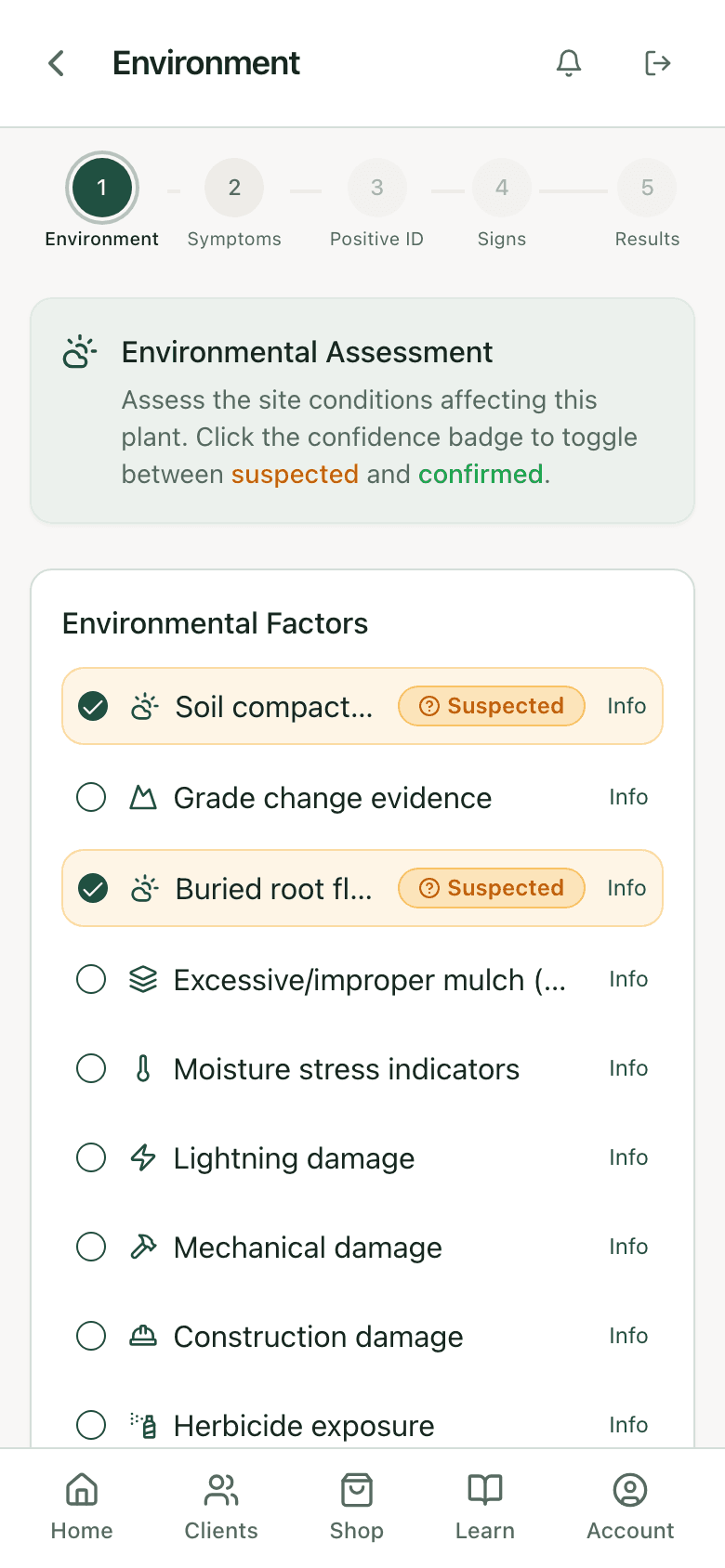
Environment: what the site is doing to the tree.
Compaction, drainage, grade change, construction, irrigation, salt, reflected heat. Site stress shows up as symptoms that look like disease and are not. Recording it first keeps you from treating a root problem with a fungicide.
Step 2
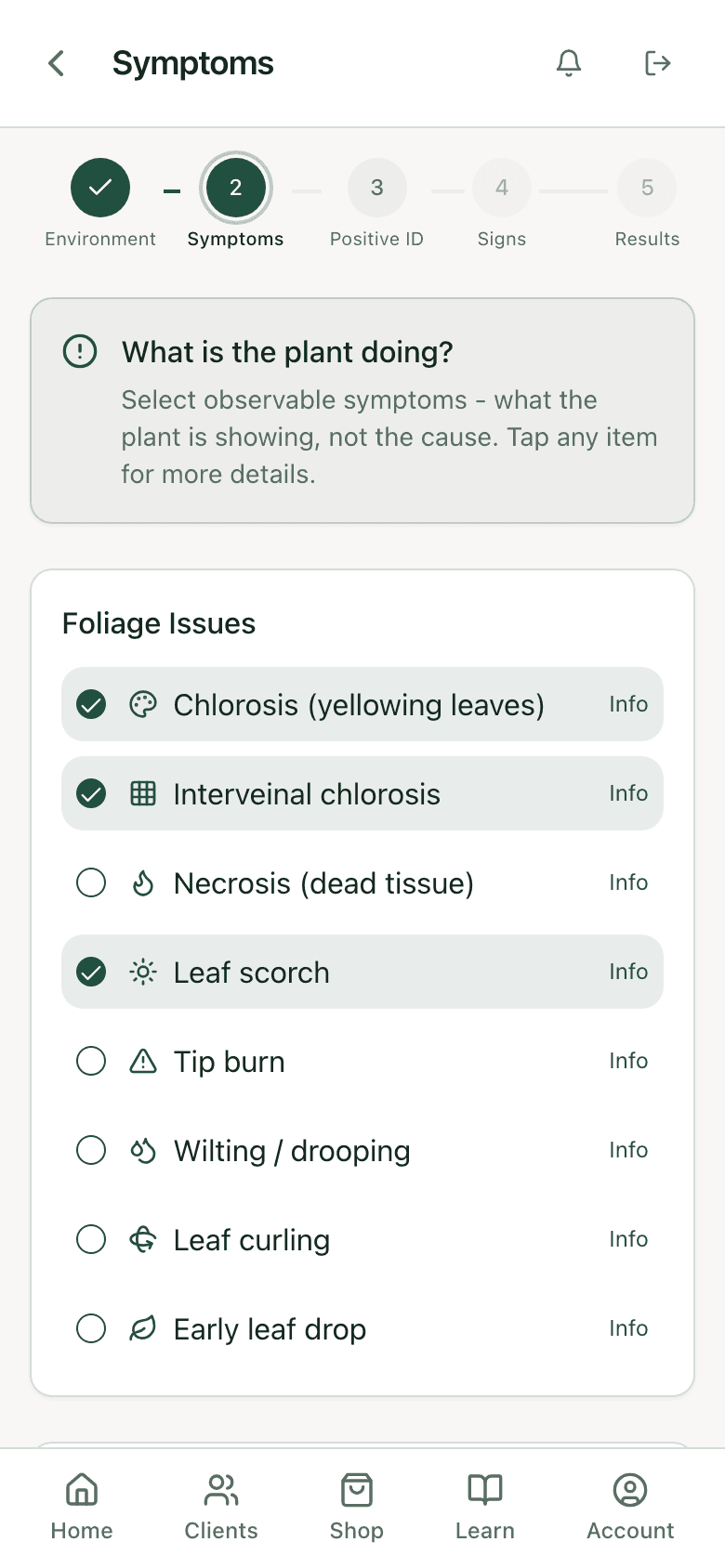
Symptoms: what the tree is showing.
Chlorosis, marginal scorch, wilting, dieback, epicormic sprouting, premature drop. Each one narrows the list a little. None of them alone gets you to a name, and the app weights them that way.
Step 3
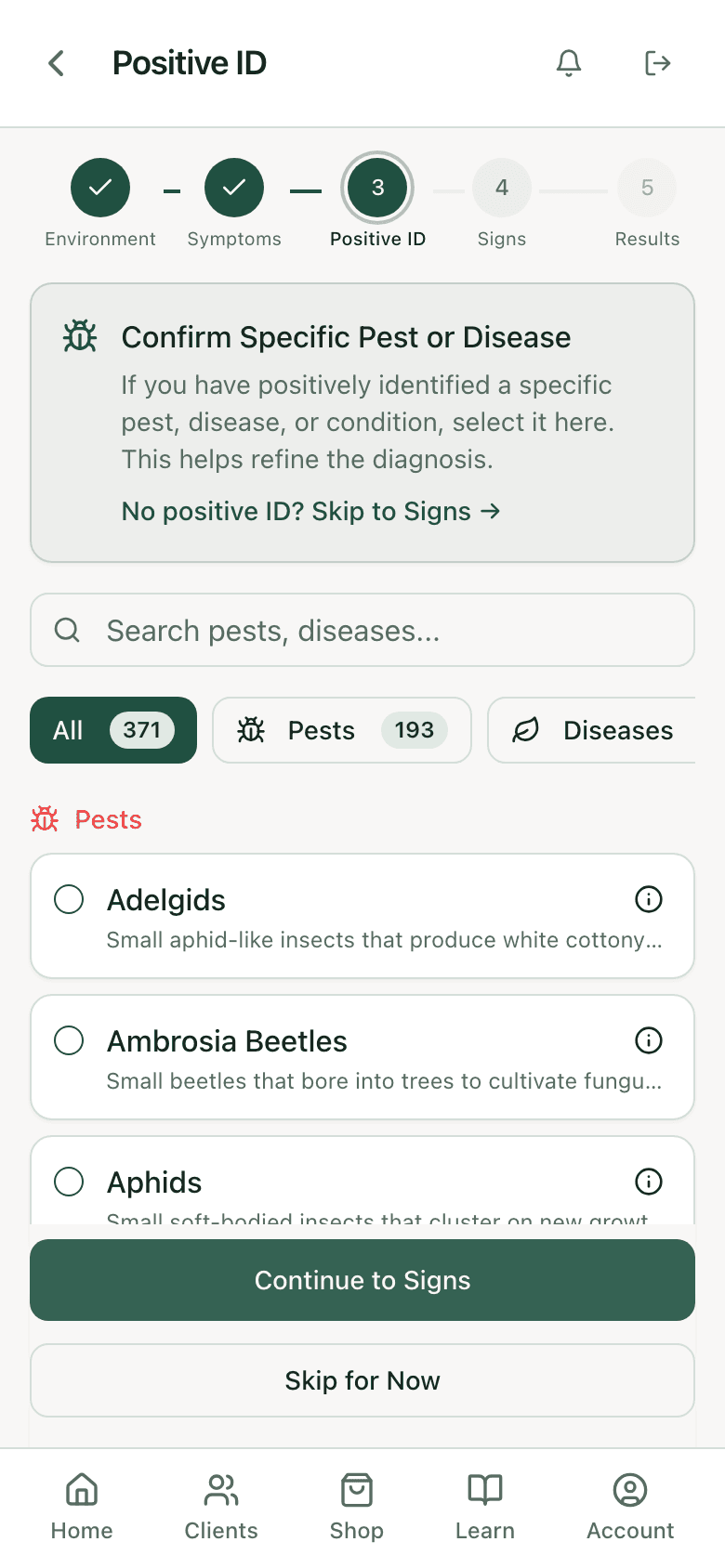
Positive ID: when you know.
A lab result, a specimen in hand, an extension agent's confirmation. A positive ID outweighs everything else on the form. If you have one, the diagnosis is built around it. If you do not, the app says so.
Step 4
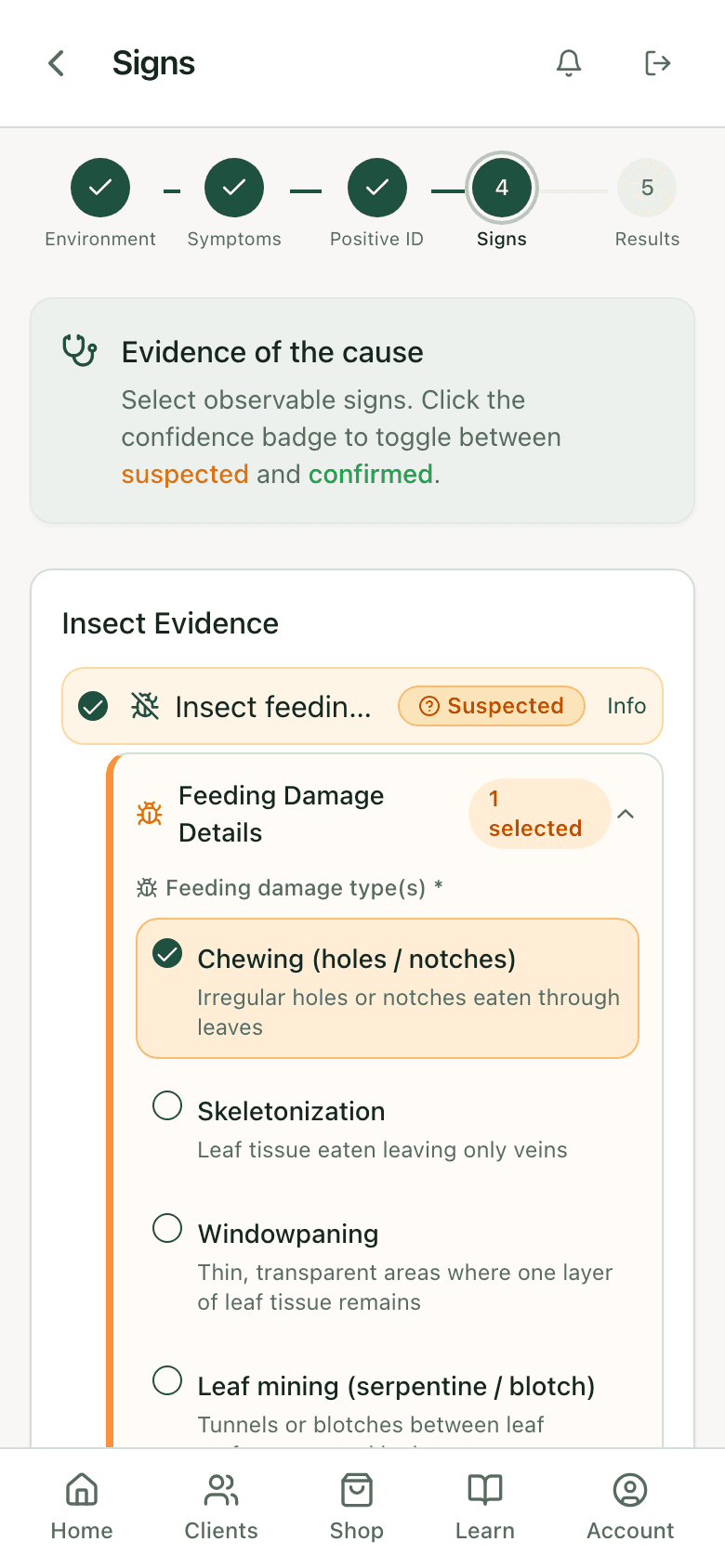
Signs: the organism itself.
Exit holes, galleries, frass, conks, mycelial fans, scale bodies, egg masses, feeding damage by type. Each sign toggles between suspected and confirmed, and confirmed counts for more. Chewing damage with holes and notches points one way; skeletonizing points another; the app knows the difference.
- Suspected or confirmed on every sign
- Feeding damage broken out by type
- Links to the library entry from the sign
Step 5
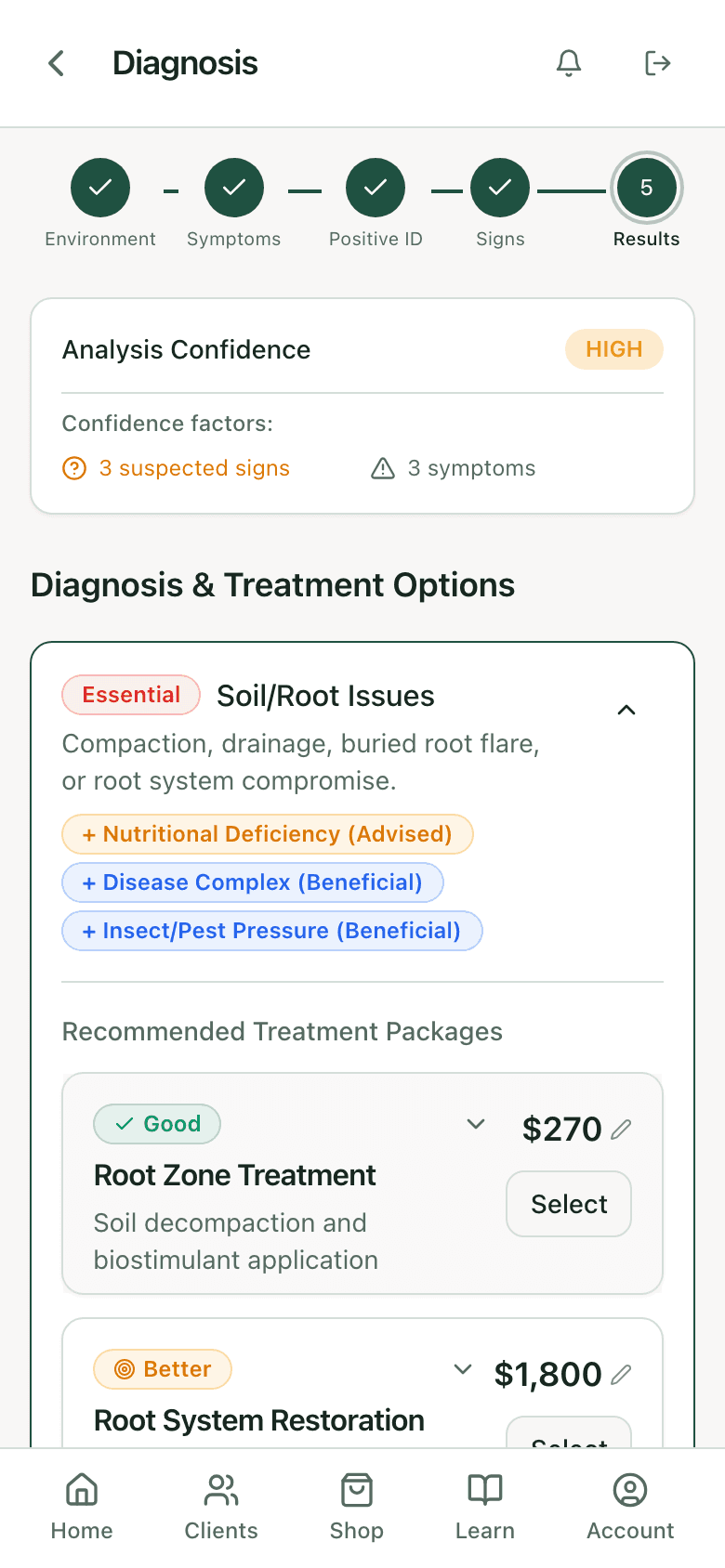
Results: a finding, a confidence rating, and the reasons.
Issues come back ranked essential, advised, or beneficial. The confidence badge sits at the top with the factors that produced it: how many confirmed signs, how many suspected, how many symptoms, whether there was a positive ID. Under each issue, the treatment packages for that species at that DBH, priced from your service list.
How the prescription gets to the client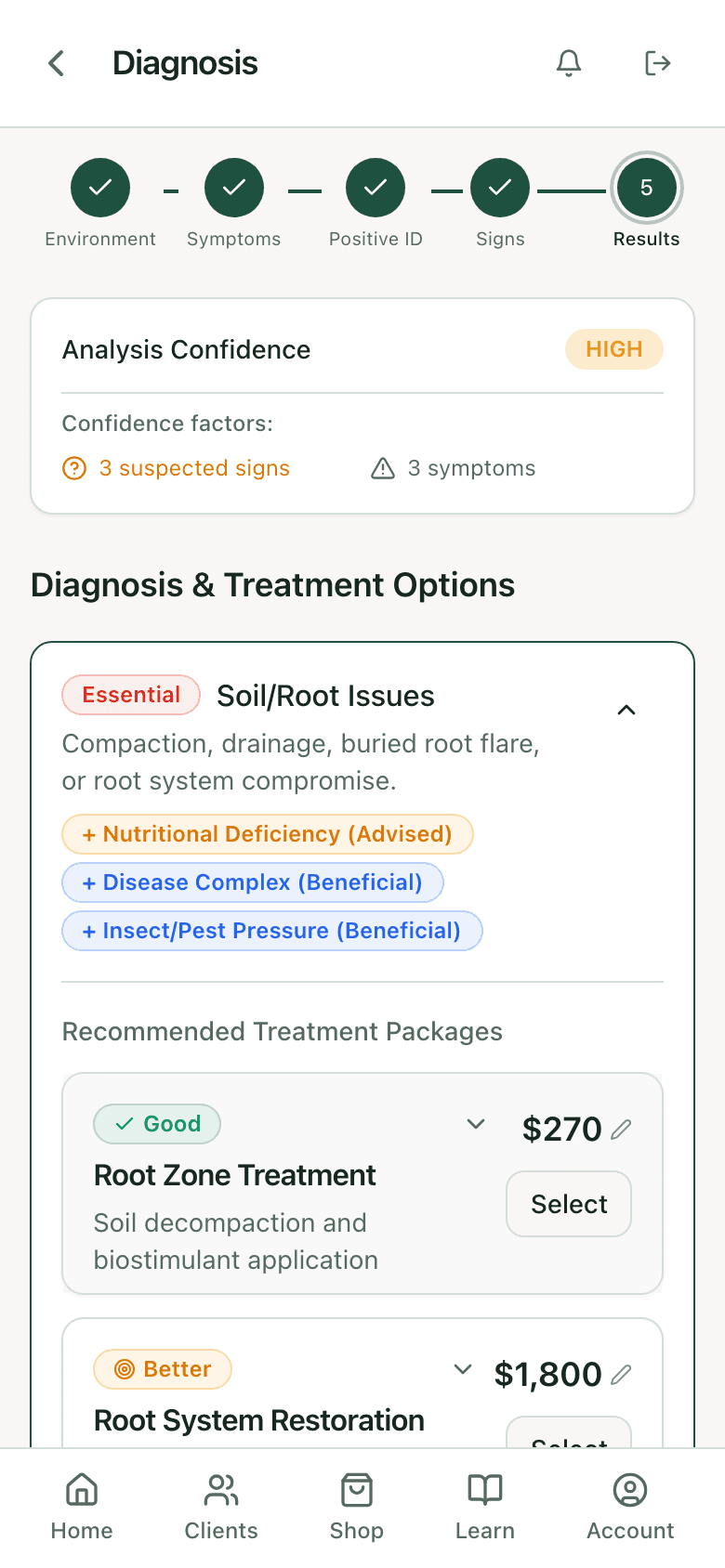
After the diagnosis
The treatment is already matched to the species.
Northern red oak with oak wilt gets propiconazole macro-infusion at the library rate per inch. Green ash with EAB gets emamectin benzoate. The label check runs before the prescription goes out, and the rate calculator turns DBH into a dose.
Diagnosis — 12 Oak Ridge Ln
Confidence 86%Add a second positive ID to raise confidence above 90%.
Straight from the app
The whole flow, on the phone.
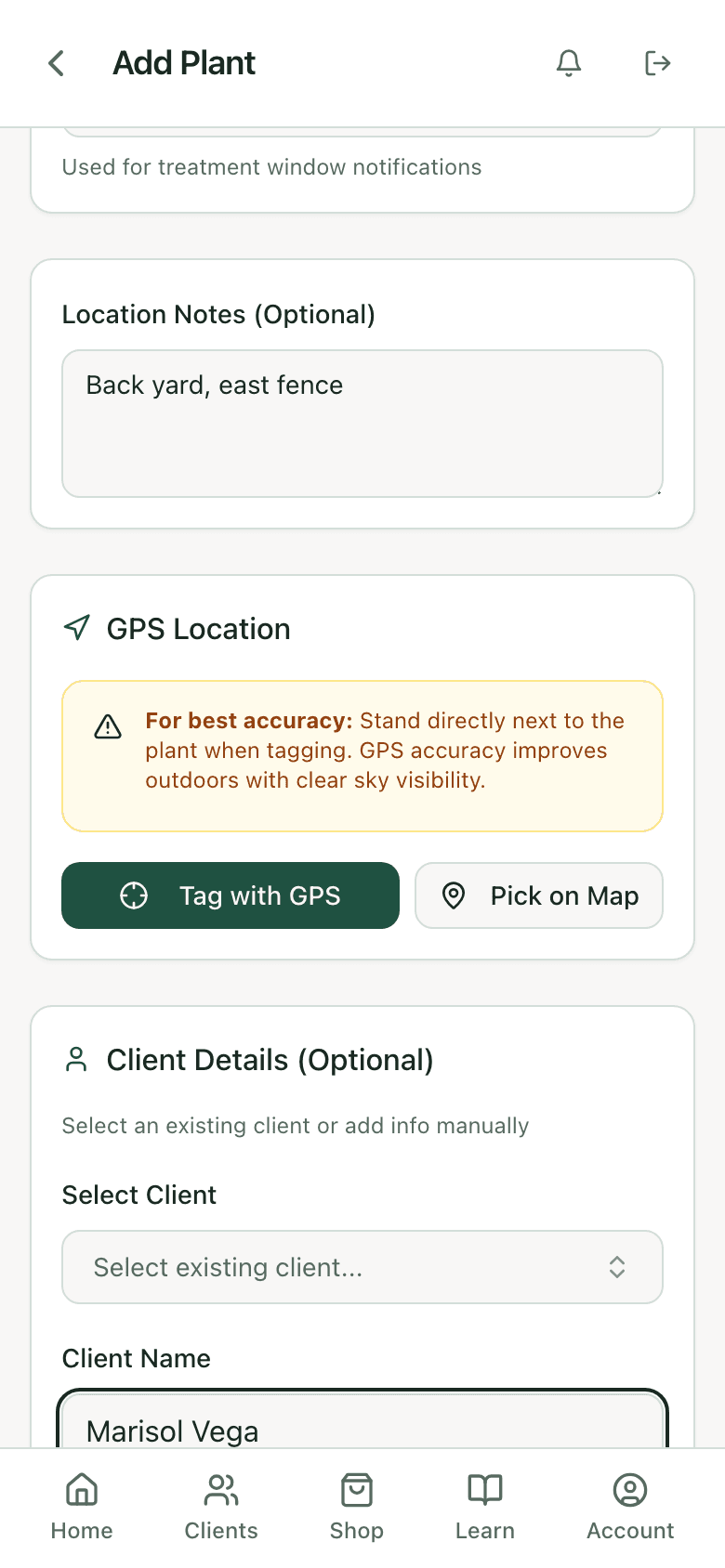
Species and DBH first
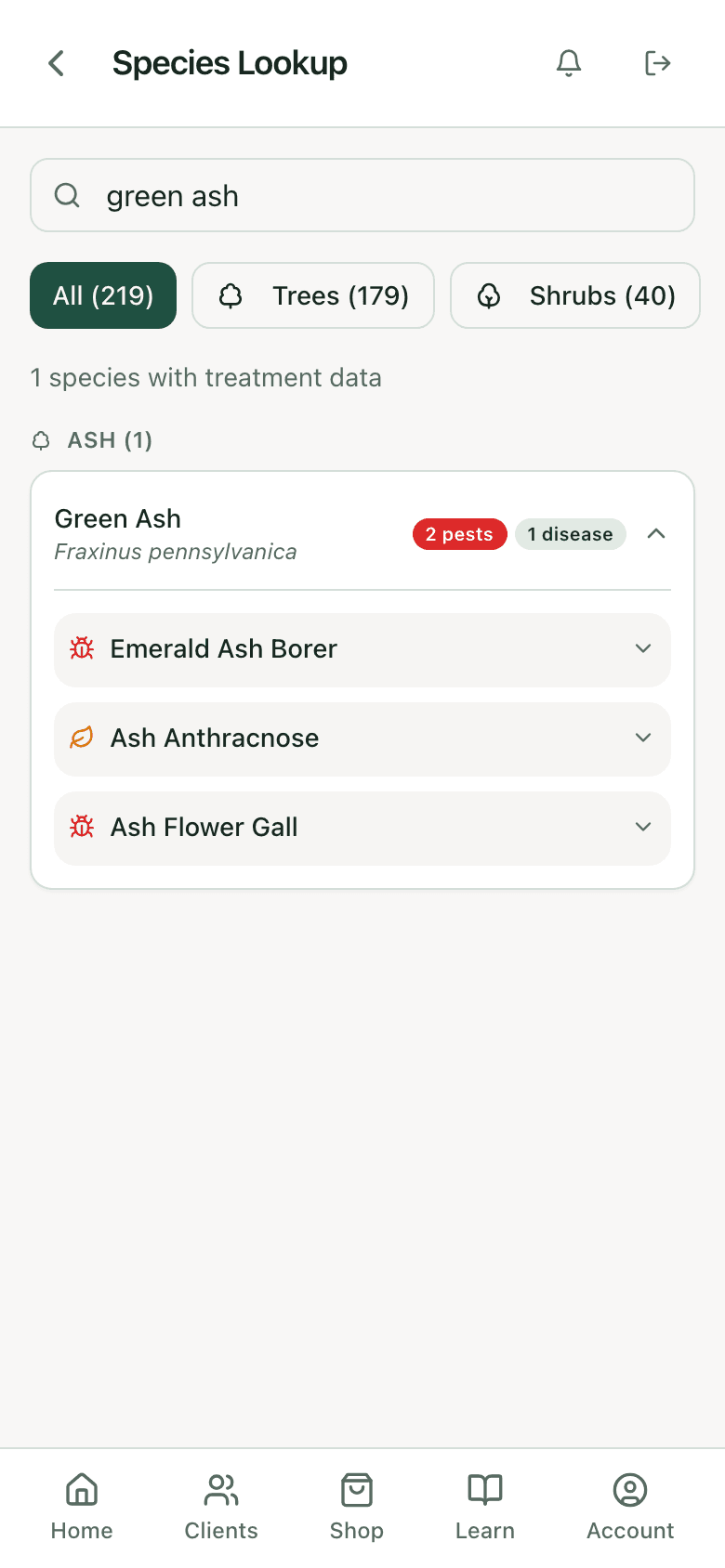
What this species gets
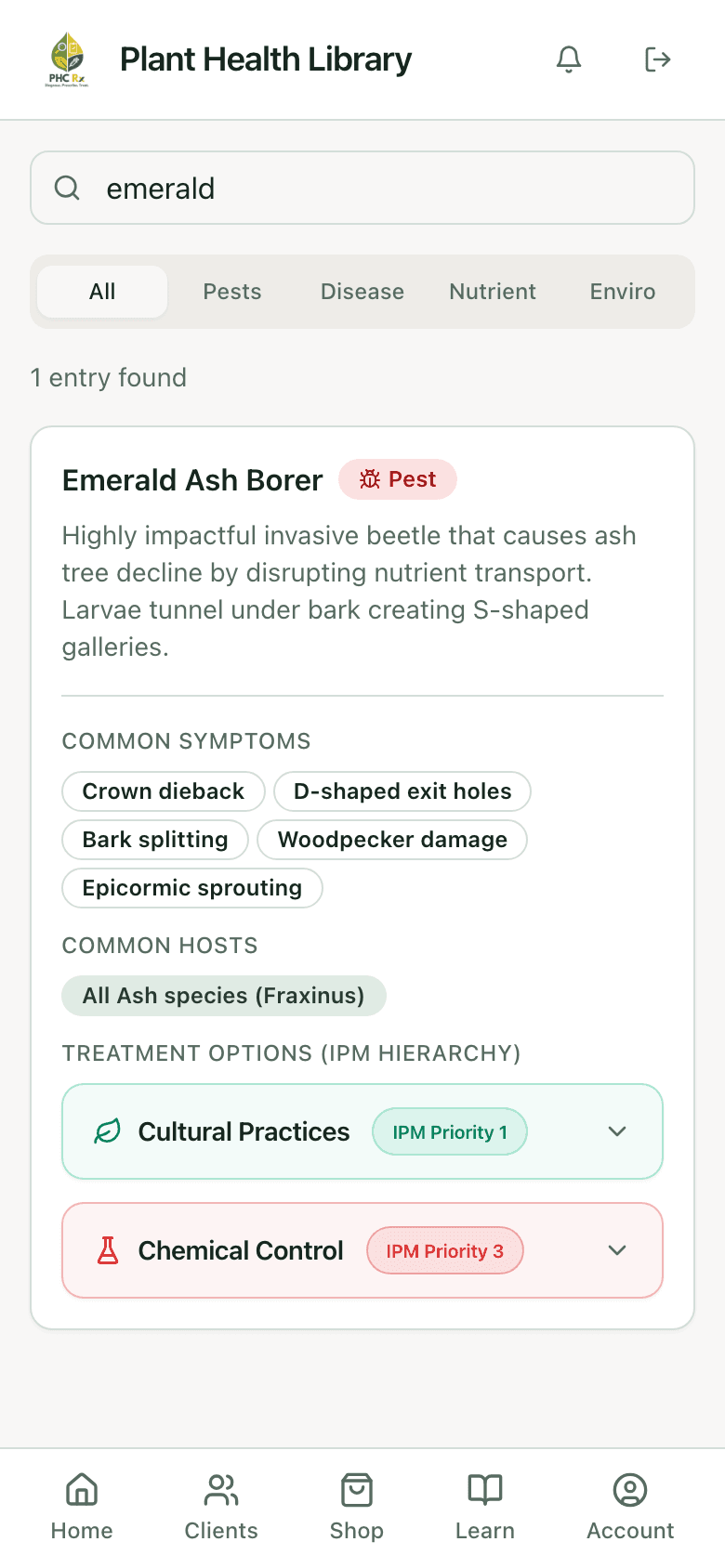
Library entry, 138 of them
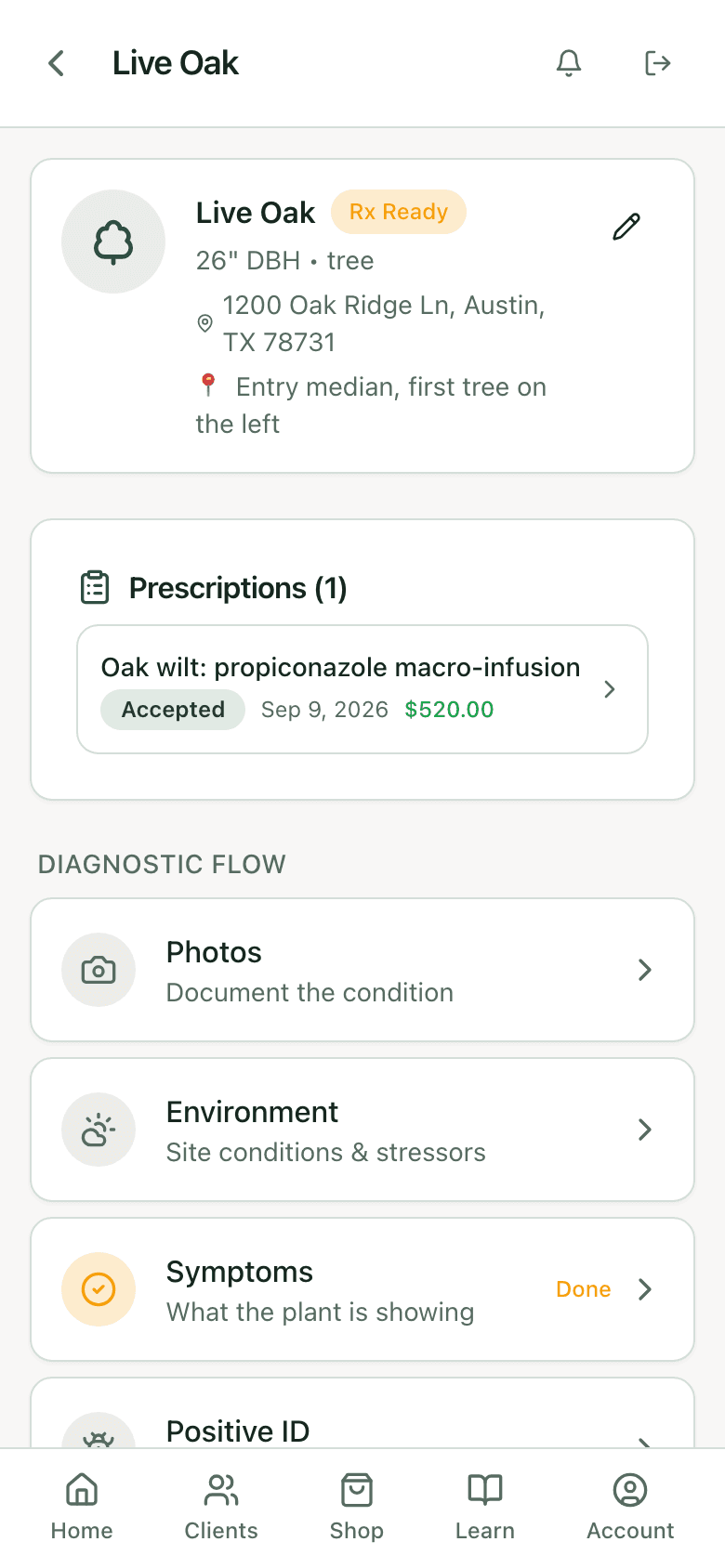
The record afterward
How the confidence rating works
Each piece of evidence carries a weight. A general symptom is worth the least, because many things cause it. A suspected sign is worth more. A confirmed sign is worth more again. A positive ID outweighs the rest. The rating on the results screen is the sum, bucketed to Low, Moderate, or High, with the factors listed so anyone reading the record can see how you got there.
There is no black box in it and no photo model. It is the reasoning a diagnostician already uses, written down every time instead of some of the time.
Who it is for
- PHC techs who need a repeatable process across a crew, so two people on the same species land on the same call.
- Consulting arborists who need the reasoning documented for a report or a deposition.
- Municipal foresters keeping a defensible file on street trees.
- Owners adding PHC to a tree service who want the diagnosis done right from the first tree. How to start a program.
What it will not do
It will not identify a tree from a photo, and it will not diagnose from a photo. You measure the tree, you look at the signs, you make the calls. The app weighs them, records them, and matches the treatment. Your license, your judgment, on the record.
FAQ
Questions arborists ask
Is this a tree disease identification app?
It is a diagnosis tool for professionals. You enter what you observed on site, in five steps, and it returns ranked findings with a confidence rating and species-matched treatments. It does not identify from photos.
How is it different from PictureThis or Planta?
Those identify plants and common problems from a photo for homeowners. PHC Rx is built around the evidence an arborist collects on site, weighs it the way a diagnostician does, and produces a written finding with treatments, rates per inch, and a label check.
What does the confidence rating mean?
How much evidence is behind the finding and how strong it is. Confirmed signs and positive IDs push it up; symptoms alone keep it low. The factors are listed on the results screen and in the report.
Can I add my own species or issues?
Yes. Custom species can be added to the library on any plan, and the glossary covers 138 pests, diseases, and disorders with more added as labels come in.
Does it work offline?
Records you have opened stay available with no signal on the iOS and Android apps, new work queues on the phone, and it syncs when you are back in range.
What does it cost?
It is part of every PHC Rx plan, from $99 a month for one seat. Plans and trial.
Related