
Free download
Tree risk assessment form, every field explained.
The Industry Standard Tree Risk Assessment Form is two pages and about ninety boxes, and the instructions are a separate PDF. This is the same field order, one line on what goes in each box and why, a printable worksheet, and the version that fills itself in on your phone and exports the report.
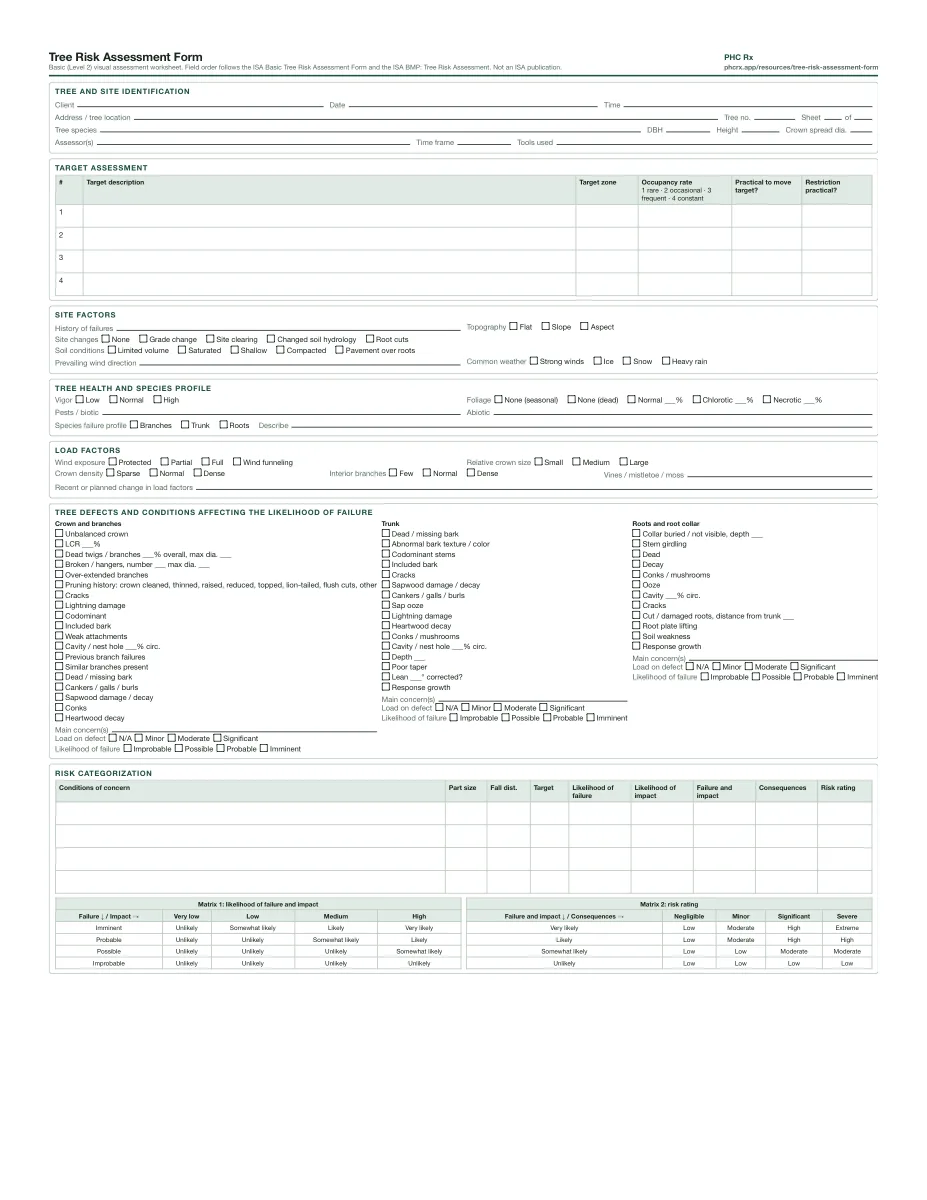
Download the blank version, or skip the paper and fill it in the app.
Field by field
What goes in each box, and why
Client, date, time, address, tree number, sheet __ of __
Who, when, where, and which tree if there is more than one on the property.
A form without a date and a tree number is not evidence of anything. If it ends up in front of a lawyer, this header is the first thing checked.
Species, DBH, height, crown spread
Botanical name if you can. DBH at 4.5 feet in inches. Height and spread estimated or measured.
Part size and fall distance in the risk table come from these. DBH also drives the dose if a treatment follows.
Assessor(s), time frame, tools used
Your name and certification/TRAQ number. The period the rating applies to, usually one year. Binoculars, mallet, probe, resistance drill.
The time frame is the single most misunderstood box. A rating is only valid for the window you write here.
Target assessment (targets 1 to 4)
Each thing that could be hit: description, target zone, occupancy rate 1 to 4 (rare, occasional, frequent, constant), whether it is practical to move it or restrict access.
Risk is the tree and the target together. A hollow oak over an empty field is Low. The same oak over a patio table is not.
Site factors
History of failures, topography, site changes (grade, clearing, hydrology, root cuts), soil conditions, prevailing wind, common weather.
Root cuts and grade changes explain a lot of failures that the crown never hinted at.
Tree health and species profile
Vigor, foliage condition and percentages, pests, abiotic damage, and how this species typically fails (branches, trunk, roots).
Species profile is where local knowledge goes: Bradford pear at the union, silver maple at the codominant stems, pecan at included bark.
Load factors
Wind exposure, relative crown size, crown density, interior branches, vines or mistletoe, and any recent or planned change in load.
A tree that just lost its windbreak neighbor is carrying load it has never seen. That belongs on the form.
Crown and branches
Checklist: dead or broken branches with count and max diameter, over-extended limbs, pruning history, cracks, codominant stems, included bark, cavities, conks, decay. Then the main concern, load on the defect, and likelihood of failure for this part.
The likelihood call (improbable, possible, probable, imminent) is made three times, once per part of the tree. The form makes you commit to each one.
Trunk
Same checklist pattern: bark, codominant stems, included bark, cracks, cankers, ooze, decay, conks, cavity depth and percent of circumference, taper, lean and whether it is corrected, response growth.
Percent of circumference and cavity depth are what let someone else check your work later.
Roots and root collar
Collar buried or visible, girdling roots, dead or decayed roots, conks, cracks, cut roots and distance from trunk, root plate lifting, soil weakness, response growth.
Most catastrophic whole-tree failures are root failures, and most of the evidence is at or below grade. Pull the mulch back.
Risk categorization table
One row per failure type: conditions of concern, part size, fall distance, target number, likelihood of failure, likelihood of impacting the target, the combined failure-and-impact from Matrix 1, consequences, and the risk rating from Matrix 2.
This is the whole method. Two lookups turn four judgments into a rating of Low, Moderate, High, or Extreme, and the same inputs give the same answer no matter who fills it in.
Mitigation options and residual risk
What you would do about each concern (prune, reduce, cable, remove, move the target) and what the risk rating becomes if that is done.
Residual risk is what the client is buying. "Reduce the east leader, risk drops from High to Moderate" is a sentence they can act on.
Overall tree risk rating, overall residual risk, work priority, inspection interval
The highest rating on the table becomes the overall. Priority 1 to 4. When to look again.
The inspection interval is the box that gets you called back, and the one that protects you if the tree fails after the interval lapsed.
Data: final or preliminary, advanced assessment needed, inspection limitations
Whether this is the finished rating. Whether a Level 3 assessment (resistance drilling, aerial inspection, root excavation) is warranted. What you could not see.
"Root collar buried, not inspected" is the limit of a Level 2 assessment, written down, and nothing more.
Notes, explanations, descriptions
Anything the checkboxes did not capture.
Write it the way you would say it to the client standing next to you.
How to complete it
Step by step
1
Walk the site before you look up
Targets first. Where do people stand, park, sleep. Occupancy rate for each. Then site history: any grading, trenching, or a neighbor tree removed in the last few years.
2
Assess the tree from the ground up
Root collar, trunk, then crown, in that order, with binoculars for the upper canopy and a mallet at the base. Check every box that applies and write the numbers: percent circumference, cavity depth, branch diameter.
3
Make the three likelihood calls
Roots, trunk, crown. For each: what is the main concern, how much load is on it, and is failure improbable, possible, probable, or imminent within the time frame.
4
Run the two matrices
Likelihood of failure against likelihood of impact gives you failure-and-impact. That against consequences gives you the risk rating. Do it per failure type; the worst one is the overall.
5
Write the mitigation and the residual
For each concern, what you recommend and what the rating becomes. Then work priority, inspection interval, and whether an advanced assessment is needed.
6
Sign it, date it, deliver it
Final or preliminary. Your name and TRA number. In PHC Rx the same nine steps produce a branded PDF the client opens from a link.
About the download
The worksheet here is a PHC Rx layout that follows the field order and terminology of the industry-standard method for tree risk assessment, so it transfers directly to the official form or into the app. It is not an official form itself, just PHC Rx's own version of the same structure, and if you carry TRA you should still have the official form and its instructions on hand.
Both matrices are printed on the sheet so you are not flipping to the instructions on a tailgate.
The same nine steps, on your phone
The PHC Rx risk wizard walks the form in the same order: tree, targets, site, health, load, defects by part, categorization, mitigation, finalize. The matrices run automatically from your likelihood and consequence picks. The report comes out with your logo, gets sent from the same link system as a prescription, and lives on the tree's record next to any treatment you do afterward.
Written and reviewed by
ISA Board Certified Master Arborist MA-5832B · ISA TRAQ · Maryland Licensed Tree Expert #2168
Alex Shy is an ISA Board Certified Master Arborist, TRAQ-qualified tree risk assessor, and Maryland Licensed Tree Expert. He holds a B.S. in Forest Resource Management from West Virginia University. Alex is the founder and president of Mobile Tree Spa LLC, founder and co-owner of the PHC Rx diagnostic app, and a member of the ATCP board, where he oversees the education committee. His work focuses on making science-based plant health care practical, profitable, and easy for tree care companies to adopt.
ISA Certified Arborist MA-7027A · VNLA Certified Horticulturist · Virginia Commercial Pesticide Applicator
Jordan Thompson is an ISA Certified Arborist, VNLA Certified Horticulturist, Virginia Commercial Pesticide Applicator, and co-owner of J.J. Mauget Co. and TIPCO. She holds an M.S. in Entomology and a B.S. in Environmental Horticulture from Virginia Tech. Her work bridges arboriculture, plant health care, and applied research, with a particular focus on tree injection, invasive species, tree disease management, and translating university research into practical tools for professional arborists.
FAQ
Questions arborists ask
Is this the same as the official industry-standard tree risk assessment form?
This is PHC Rx's own digital version of the same industry-standard structure, not an official form issued by any one certifying body. It is a worksheet in the same field order with the same terminology, so it maps one-to-one, and if you hold TRA you should still have the official form and instruction booklet on hand.
What is the difference between Level 1, 2, and 3?
Level 1 is a limited visual assessment, usually a drive-by or walk-by of many trees. Level 2 is the basic assessment this form covers: a 360-degree ground inspection of one tree with simple tools. Level 3 is advanced: resistance drilling, sonic tomography, aerial inspection, root excavation. The form has a box to flag when Level 3 is needed.
Do I need TRA to use the form?
No, but the rating carries a lot more weight with a TRA credential behind it, and some municipalities and insurers require it. The ISA course is two days plus an exam.
How long is a risk rating valid?
For the time frame written on the form, usually one year. After that, or after a storm, a grade change, or new construction nearby, it needs to be redone.
What goes in the report the client sees?
The rating, the reasoning, the mitigation options with residual risk, and the inspection interval. The report in PHC Rx pulls all of that from the form fields so nothing gets retyped.
Related