
Treatment guide
Boxwood blight treatment: protectant sprays, sanitation, replacement
There is no fungicide that cures boxwood blight. There are fungicides that keep spores from infecting clean leaves if they are on the plant before the rain. So the program is: confirm it is blight and not Volutella, decide what to remove, protect what is left through the wet months, and stop carrying it on your tools and your pants to the next property.
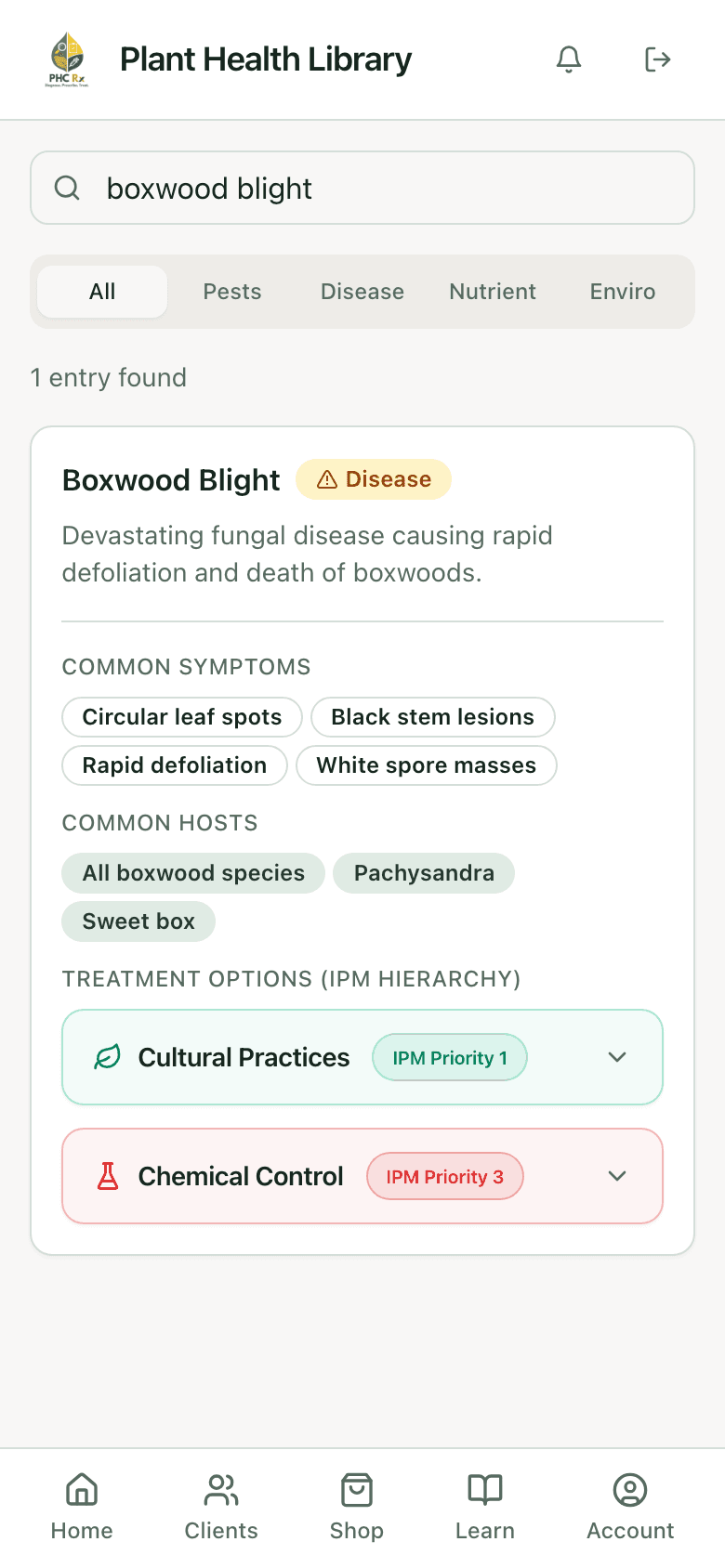
disease
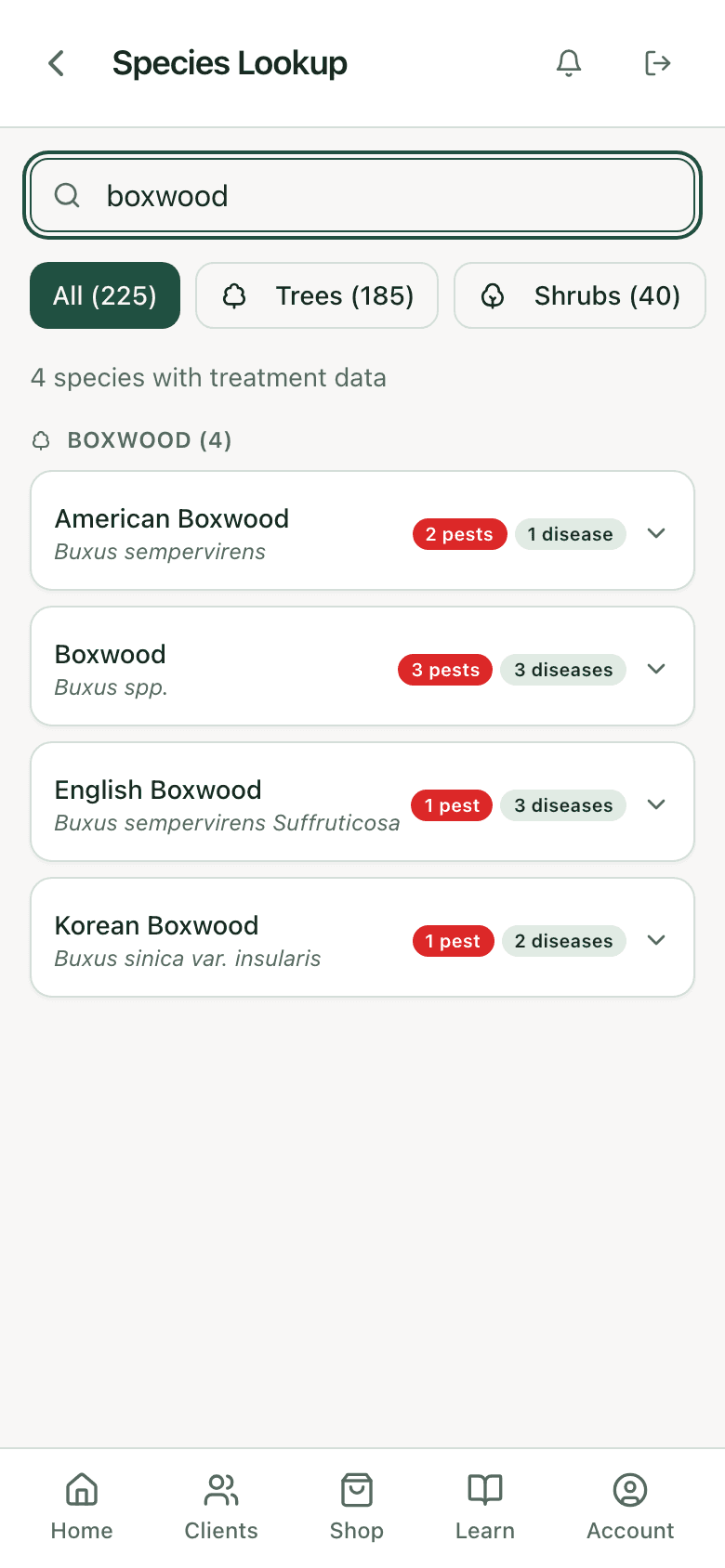
Boxwood blightCalonectria pseudonaviculata
A fungal leaf and stem disease that arrived in the United States in 2011 and moves on infected nursery stock, on pruning tools, and on clothing. Spores are sticky and spread in splashing water. In a warm, wet week it takes a hedge from green to bare. Infected leaves fall and the fungus survives in them on the ground for years. The plant does not die from one defoliation, but repeated cycles kill it and the hedge next to it.
Symptoms (the tree's response)
- Circular light-brown leaf spots with a dark border, often with a yellow halo
- Rapid defoliation, starting low in the plant
- Bare stems with the foliage still green at the top
- Whole-hedge collapse within weeks in wet weather
Signs (the organism itself)
- Black streaks and lesions on green stems, which Volutella does not produce
- White spore masses on the undersides of leaves in humid conditions
- Lab confirmation, which any plant clinic can give from a stem sample
Common hosts: English boxwood (highly susceptible), American boxwood, Korean and Japanese boxwood (some tolerance), Pachysandra, Sweet box (Sarcococca)
Timing window
7 active monthsOrganism active
Preventive treatment
Curative treatment
The fungus needs leaf wetness and temperatures roughly between 60 and 80 F, so spring and fall are the infection seasons and summer heat slows it. Protectant sprays go on before the wet periods and are repeated on the label interval while the weather holds. Nothing is curative. Prune and remove in dry weather only.
Treatment options
Product, rate, delivery, timing
Rates below are per inch of trunk diameter at breast height unless the row says otherwise. The registered label wins over anything on this page.
Propiconazole 14.3 (Quali-Pro)
- Active ingredient
- Propiconazole 14.3%
- Rate
- Per label as a foliar spray, diluted, applied to full coverage
- Delivery
- Foliar spray to the point of runoff, inside and out
- Timing
- Before wet periods in spring and fall
- Frequency
- Repeated at the label interval while conditions favor infection
Myclobutanil 20 EW (Quali-Pro)
- Active ingredient
- Myclobutanil 19.7%
- Rate
- Per label as a foliar spray
- Delivery
- Foliar spray to full coverage
- Timing
- Ahead of wet weather in the infection seasons
- Frequency
- At the label interval, in rotation
TM 4.5 (Quali-Pro)
- Active ingredient
- Thiophanate-methyl 46.2%
- Rate
- Per label as a foliar spray
- Delivery
- Foliar spray
- Timing
- Ahead of wet periods
- Frequency
- At the label interval, in rotation
Chlorothalonil (several brands)
- Active ingredient
- Chlorothalonil
- Rate
- Per label as a foliar spray
- Delivery
- Foliar spray to full coverage
- Timing
- Before wet periods, repeated on the label interval
- Frequency
- Every 7 to 14 days while conditions favor infection
- Propiconazole 14.3 (Quali-Pro): A triazole with boxwood blight on the label as a protectant. Rotate with a different mode of action; blight populations shift under single-product programs.
- Myclobutanil 20 EW (Quali-Pro): Another triazole. Same mode of action as propiconazole, so it is not the rotation partner for it; rotate both against a chlorothalonil or a strobilurin.
- TM 4.5 (Quali-Pro): Thiophanate-methyl, a different mode of action from the triazoles. Useful as the rotation partner.
- Chlorothalonil (several brands): The protectant most extension programs list first for blight. Multi-site contact fungicide with low resistance risk, so it anchors the rotation. Not in the PHC Rx catalog as a specific product; write the brand you use.
Is it blight or is it Volutella
Volutella blight is the common boxwood disease, and it looks similar from the truck: browning, thinning, dead patches. The difference is on the stems. Boxwood blight puts black streaks and lesions on green stems; Volutella does not, and Volutella produces salmon-pink spore masses rather than white. Boxwood blight also drops its leaves fast and clean, leaving bare green stems, where Volutella leaves the dead leaves hanging. When it matters, and with blight it always matters, send a stem to a plant clinic. The diagnosis record in PHC Rx has a positive ID step for exactly this.
A blight diagnosis changes the whole job. Volutella is a pruning and vigor problem. Blight is a quarantine problem: every tool, tarp, boot, and truck bed that touched the hedge is now a way to move it.
Remove, protect, or replace
A lightly infected hedge in a client who wants to keep it: remove the worst plants and every fallen leaf, bag it, and get it off the property. Protect the rest with a fungicide rotation through spring and fall for at least two seasons, and accept that the fungus is in the soil and the program does not end. A heavily infected English boxwood hedge: take it out, leaves and top inch of mulch included, and do not plant boxwood back into it for several years.
Replacement is where the conversation usually lands. The more tolerant Korean and Japanese cultivars and the new blight-resistant introductions hold up under moderate pressure; English boxwood does not. Some clients are done with boxwood altogether, and there are hollies and other broadleaf evergreens that give the same line without the disease.
Sanitation on the crew
- Blight properties last on the route or on their own day. Never before a clean boxwood property.
- Tools dipped in 70 percent alcohol or a disinfectant between plants, not just between properties.
- Debris bagged on site, not chipped, not composted. The fungus survives in fallen leaves for years.
- Coveralls or a change of clothes and boots after a blight job. Spores travel on fabric.
- Prune only in dry weather. Wet foliage and a pruner is how it spreads down the hedge.
What the label check will catch
Boxwood blight is on the propiconazole, myclobutanil, and thiophanate-methyl labels in the PHC Rx catalog, and the delivery method is foliar. Where the label check flags a plan is a trunk-injection formulation written for a boxwood, or a spray interval shorter than the label allows because the weather stayed wet. Both show before the client sees the prescription.
Label check
1 warningLast application was 14 days ago. Proceed with a documented override, or reschedule.
Pricing the job
Protectant spray programs on boxwood are priced per visit by hedge length, and the visits are frequent in a wet spring. Removal is priced as a removal, with disposal. Be clear with the client that the spray program is a holding action with no end date, and put that in the prescription description so it is on the record when they ask in year three.
FAQ
Questions arborists ask
Can boxwood blight be cured?
No. Fungicides protect uninfected leaves if applied before infection periods; they do not clear an infected plant. Control is removal, sanitation, protectant sprays through the wet seasons, and tolerant replacements.
What fungicide works on boxwood blight?
Chlorothalonil as the protectant anchor, rotated with a triazole (propiconazole or myclobutanil) or thiophanate-methyl. All are foliar sprays to full coverage, repeated on the label interval during wet spring and fall weather.
How do I tell boxwood blight from Volutella?
Black streaks on green stems and clean, fast leaf drop are blight. Salmon-pink spore masses and dead leaves that stay attached are Volutella. Confirm blight with a lab; it changes how you run the job.
Should the whole hedge come out?
English boxwood with a heavy infection, usually yes, with the fallen leaves and top mulch. Lightly infected hedges of more tolerant types can be managed with removal of the worst plants and a spray program, if the client understands it is ongoing.
Can I replant boxwood in the same spot?
The fungus survives in leaf debris in the soil for several years. Replant with a resistant cultivar after thorough debris removal, or choose a different genus.
Where does this come from?
The PHC Rx species library and product catalog, built from the Propiconazole 14.3, Myclobutanil 20 EW, and TM 4.5 labels, plus the extension guidance on sanitation that every state with blight has published.
Related