
Treatment guide
Sycamore anthracnose treatment: injection rates and the bud-break window
A cool wet April and the sycamores drop their first leaves in May. Anthracnose does not kill a mature sycamore, but it kills the client's patience, and on a street tree that is 30 inches through, a foliar spray is not happening. A systemic fungicide by trunk injection before bud break is the job. Rates per inch, timing, and which trees it is worth doing on.
disease
Sycamore anthracnoseApiognomonia veneta
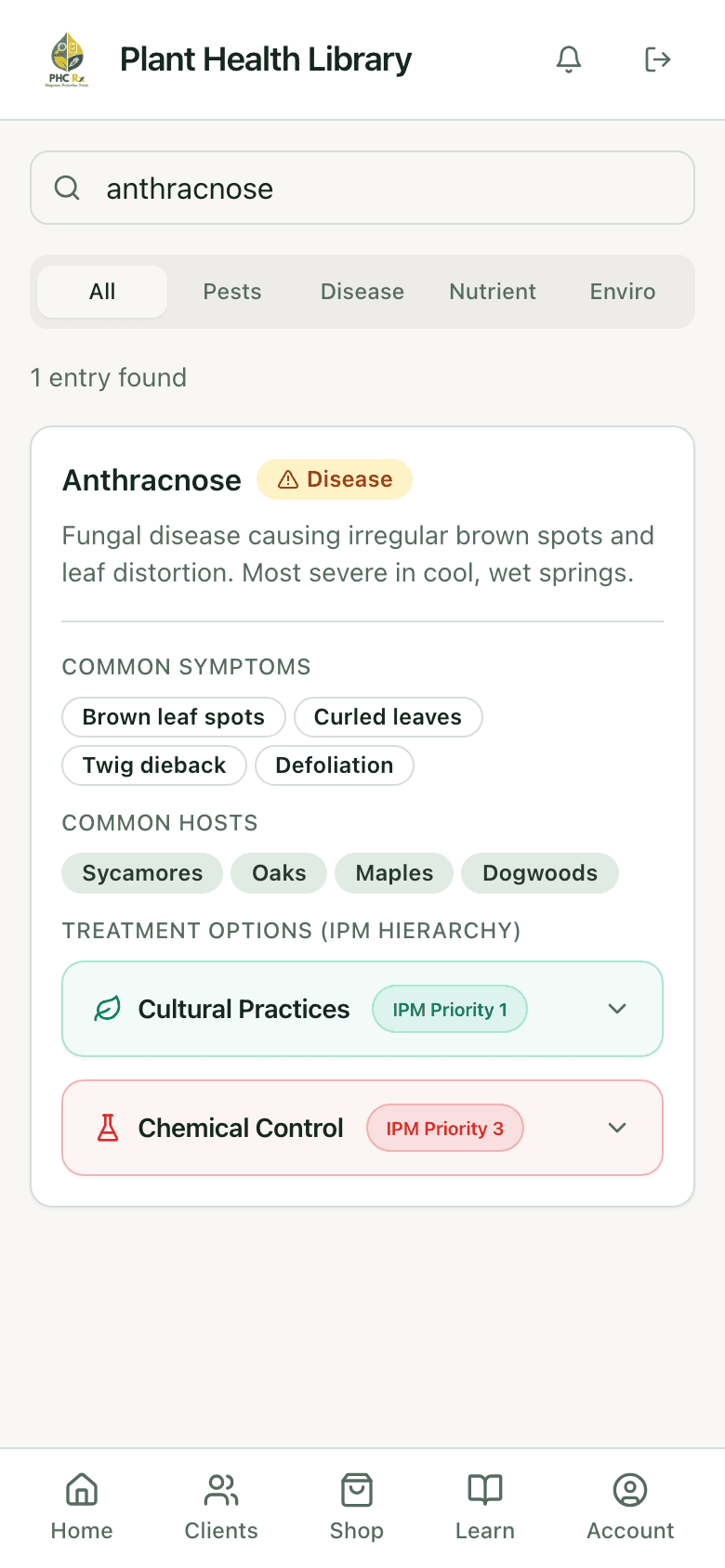
A fungal disease of new leaves and shoots that overwinters in twig cankers and infects in cool, wet spring weather. Symptoms track the weather: a warm dry spring and there is almost none, a cool wet one and the tree defoliates by late May and refoliates in June from the second flush. Years of it produce the witches' brooms and crooked twig growth that sycamores are known for. It rarely kills, but repeated defoliation stresses the tree and the twig cankers keep the inoculum on site.
Symptoms (the tree's response)
- Brown dead areas along the leaf veins, spreading across the blade
- Young leaves shriveling and dropping in May, looking like frost damage
- Shoot blight and dieback of new twigs
- Sudden defoliation in late spring followed by a second flush
Signs (the organism itself)
- Sunken cankers on one-year twigs, with the fungus fruiting on them
- Crooked, zigzag twig growth and witches' brooms from years of tip kill
- Fruiting bodies on the dead leaf tissue along the veins under magnification
Common hosts: American sycamore (Platanus occidentalis), the most susceptible, London planetree (Platanus x acerifolia), more tolerant, Other anthracnose fungi hit oak, maple, ash, dogwood, walnut, hickory, and linden with the same pattern
Timing window
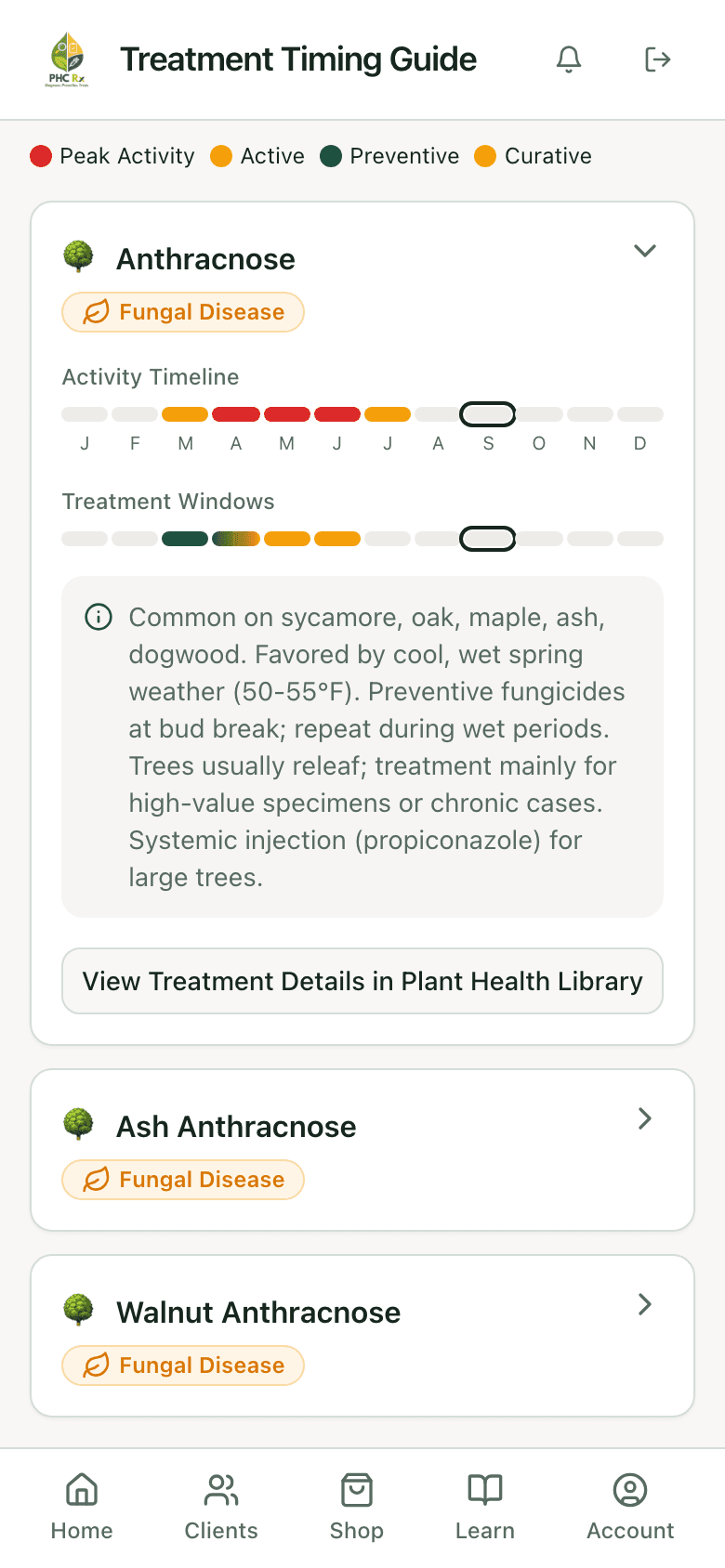
3 active monthsOrganism active
Preventive treatment
Curative treatment
The infection window is bud break through leaf expansion, April into May, when the weather is cool and wet. A trunk-injected fungicide goes in before bud break, March into early April, so it is in the new leaves as they open. Foliar sprays go on at bud swell and repeat through leaf expansion in wet years. Nothing done in June helps this year; the tree is already refoliating.
Treatment options
Product, rate, delivery, timing
Rates below are per inch of trunk diameter at breast height unless the row says otherwise. The registered label wins over anything on this page.
Propizol (Arborjet)
- Active ingredient
- Propiconazole
- Rate
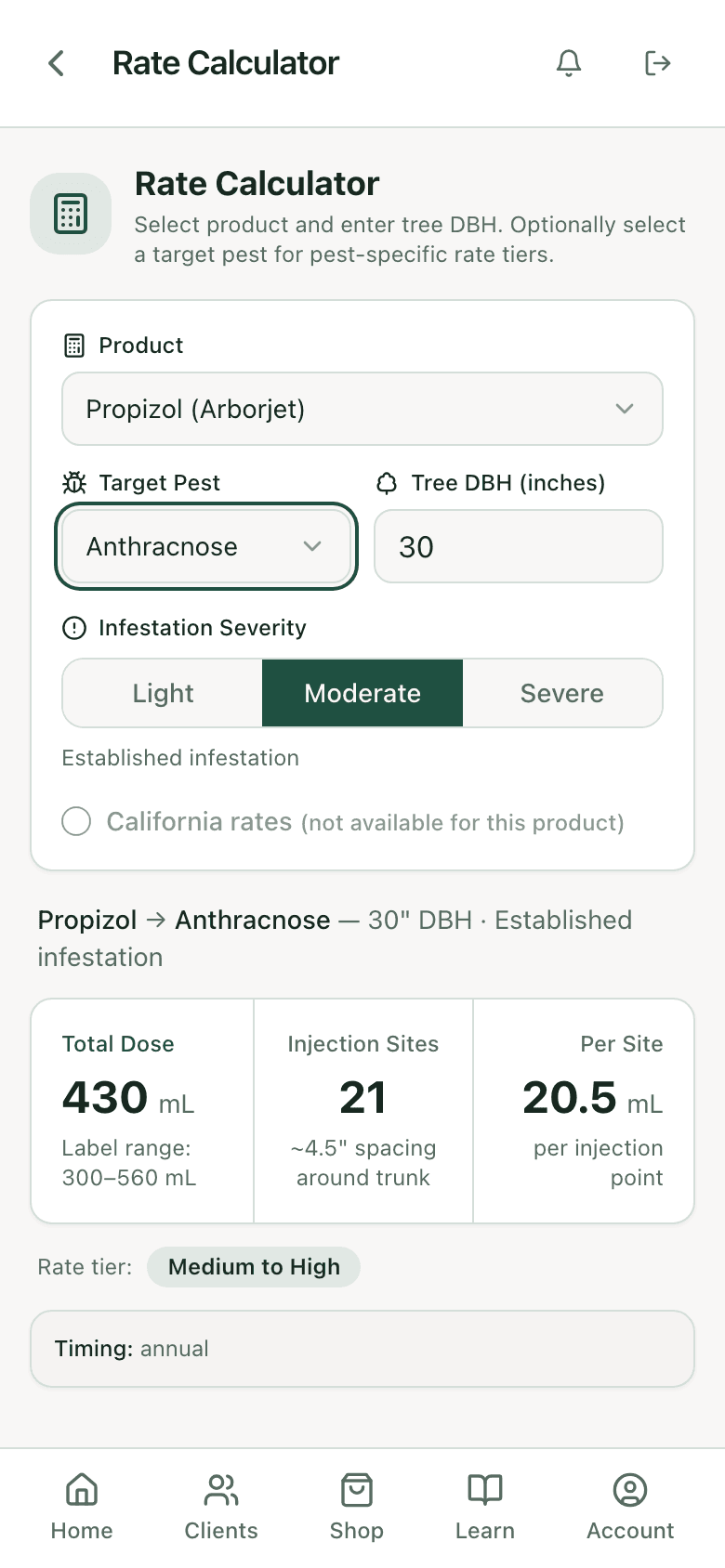
- Label table by DBH band with low and high tiers. A 30 inch sycamore is 280 to 300 mL low, 560 to 600 mL high (label band 28 to 30 in); a 20 inch tree is 190 to 210 mL low, 380 to 420 mL high (label band 19 to 21 in)
- Delivery
- Trunk injection at the flare, ports at DBH divided by 2; sycamore bark is thin and the flare is often irregular, so place ports where the wood is sound
- Timing
- Early spring before bud break
- Frequency
- Annually per label
Tebuject 16 (Mauget)
- Active ingredient
- Tebuconazole
- Rate
- Capsule micro-injection by DBH band; a 24 inch sycamore is 60 to 72 mL low, 60 to 72 mL high (label band 20 to 24 in)
- Delivery
- Mauget capsule micro-injection
- Timing
- Early spring at bud break
- Frequency
- Annually
Phospho-jet (Arborjet)
- Active ingredient
- Phosphorous acid
- Rate
- Label table by DBH band; a 20 inch tree is 63 to 70 mL low, 85 to 100 mL medium, 119 to 140 mL high (label band 17 to 20 in)
- Delivery
- Trunk injection; the label also allows foliar, drench, and bark spray
- Timing
- Spring
- Frequency
- Annually
Myclobutanil 20 EW (Quali-Pro)
- Active ingredient
- Myclobutanil 19.7%
- Rate
- Per label as a foliar spray
- Delivery
- Foliar spray to full coverage
- Timing
- At bud break, repeated at 10 to 14 days through leaf expansion in wet weather
- Frequency
- Two to three applications a season
Copper hydroxide plus mancozeb (several brands)
- Active ingredient
- Copper hydroxide, mancozeb
- Rate
- Per label as a foliar spray
- Delivery
- Foliar spray to full coverage
- Timing
- Begin at bud swell and continue through leaf expansion if wet weather persists
- Frequency
- Every 7 to 14 days in wet conditions
- Propizol (Arborjet): Propiconazole with anthracnose on the label. The choice on a big specimen or a street tree where spraying is impractical or prohibited.
- Tebuject 16 (Mauget): Tebuconazole. The capsule route for anthracnose on sycamore, maple, and the other listed hosts.
- Phospho-jet (Arborjet): Potassium phosphite. Boosts the tree's own defenses rather than killing the fungus; useful as a second injection in a rotation and on trees where a triazole was used last year.
- Myclobutanil 20 EW (Quali-Pro): A triazole spray for trees small enough to cover. Rotate with a copper or chlorothalonil product.
- Copper hydroxide plus mancozeb (several brands): The protectant program on young sycamores, dogwoods, and other small hosts. Multi-site, low resistance risk. Not in the PHC Rx catalog as a specific product; write the brand you use.
Worked examples
Dose per tree
Propizol, from the label table
30″ DBH
280 to 300 mL low, 560 to 600 mL high (label band 28 to 30 in)
Propizol, from the label table
20″ DBH
190 to 210 mL low, 380 to 420 mL high (label band 19 to 21 in)
Tebuject 16, capsule micro-injection
24″ DBH
60 to 72 mL low, 60 to 72 mL high (label band 20 to 24 in)
Phospho-jet, from the label table
20″ DBH
63 to 70 mL low, 85 to 100 mL medium, 119 to 140 mL high (label band 17 to 20 in)
Want the number for the tree in front of you? Use the tree injection rate calculator.
Which sycamores are worth treating
Anthracnose is a cosmetic and stress disease on a mature sycamore. The tree refoliates every June and lives. The case for treating is a specimen tree the client looks at every day, a street or campus tree where the May leaf drop is a maintenance problem, or a tree that has been defoliated several years running and is showing dieback from the accumulated stress. A woodlot sycamore does not need it, and the diagnosis record should say that rather than the prescription.
London planetree gets the same fungus and shrugs it off; the hybrids were selected partly for that. If the client is replacing a sycamore, this is where to point them.
Injection on thin bark
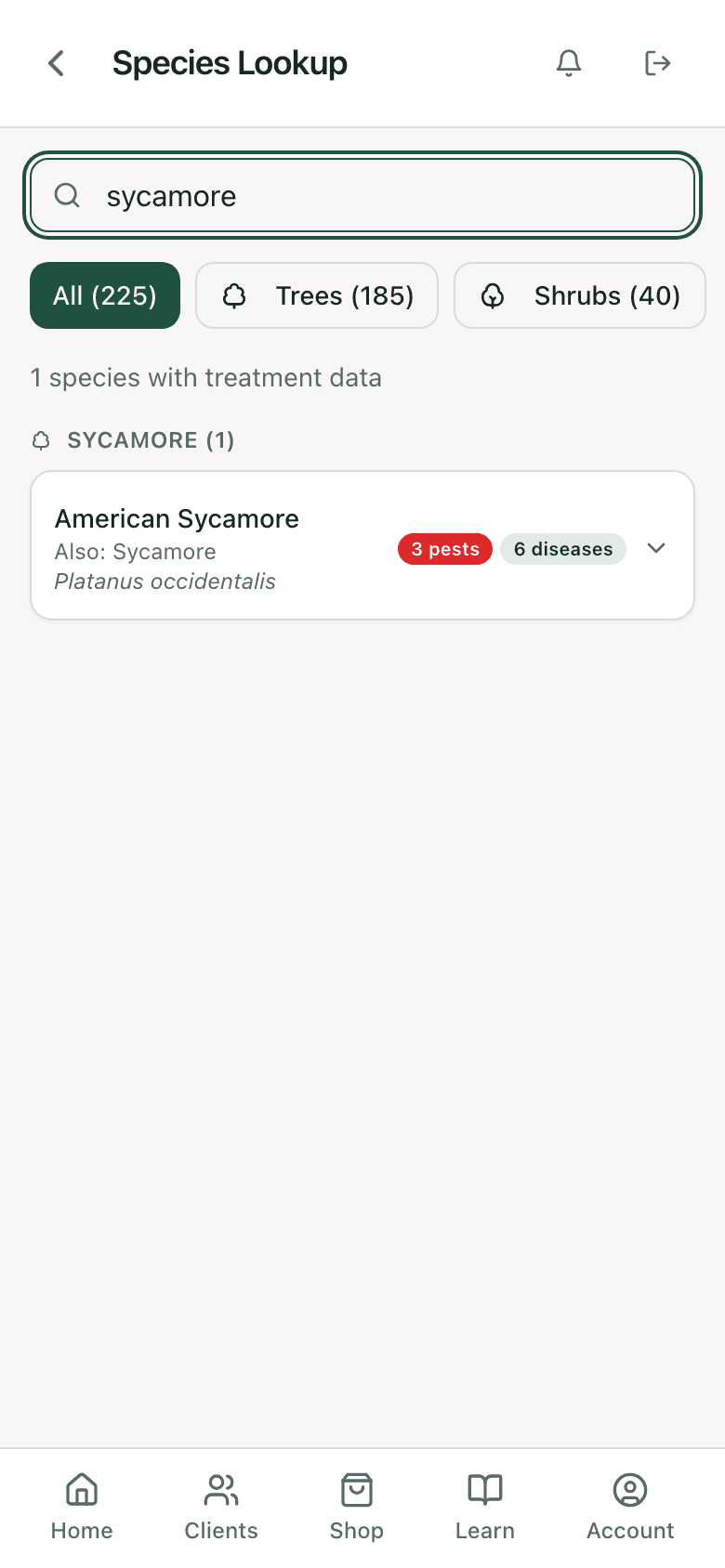
Sycamore bark is thin and sloughs; the flare is often buttressed and irregular. Port placement matters more than on an oak. Use the smallest port the system allows, put it in sound wood on the flare, avoid old wounds and the cankered areas, and do not inject a tree in drought. The species notes in the PHC Rx library carry the thin-bark caution on the Propizol line for a reason.
What the label check will catch
Anthracnose is on the propiconazole, tebuconazole, phosphite, and myclobutanil labels. Where the app flags a plan is timing: an injection scheduled for May after the leaves have opened, which is the most common way this treatment gets wasted. The label check shows it before the client sees the prescription.
Label check
1 warningLast application was 14 days ago. Proceed with a documented override, or reschedule.
Pricing the job
A 30 inch sycamore is a big injection. At $15 to $20 per inch it is a $450 to $600 visit, once a year, on a tree the client can see from the kitchen. Product cost at the low tier is a fraction of that. Pair it with a dormant-season pruning of the cankered twigs on the trees you can reach, which reduces the inoculum and is a second line on the prescription.
FAQ
Questions arborists ask
What is the propiconazole injection rate for sycamore anthracnose?
A label table by DBH band with a low and a high tier. In the PHC Rx calculator a 30 inch sycamore on Propizol is 280 to 300 mL low, 560 to 600 mL high (label band 28 to 30 in); a 20 inch tree is 190 to 210 mL low, 380 to 420 mL high (label band 19 to 21 in). The label in hand is the reference.
When should a sycamore be injected for anthracnose?
Before bud break, March into early April, so the fungicide is in the new leaves when the cool wet infection weather arrives. An injection after the leaves have opened does little for the current year.
Will anthracnose kill my sycamore?
Rarely. The tree refoliates in June. Years of repeated defoliation add stress and produce the crooked twig growth and witches' brooms, and dieback can follow on an already stressed tree. Treatment is for appearance, for maintenance on street trees, and for trees showing that accumulated stress.
Can it be sprayed instead of injected?
On a tree small enough to cover, yes: a copper or triazole protectant at bud swell, repeated through leaf expansion in wet weather. On a mature sycamore the injection is the practical route.
Does the same treatment work on oak, maple, or dogwood anthracnose?
The products overlap and the timing logic is the same: protect the new leaves before the wet weather. The PHC Rx species library lists the anthracnose treatments per host, and dogwood anthracnose in particular is a more serious disease that gets its own plan.
Where do these rates come from?
The PHC Rx product catalog, built from the Propizol, Tebuject 16, Phospho-jet, and Myclobutanil 20 EW labels, and the app's species library for hosts and timing.
Related