
Treatment guide
Diplodia tip blight treatment: bud swell, candle, and the cones that keep it going
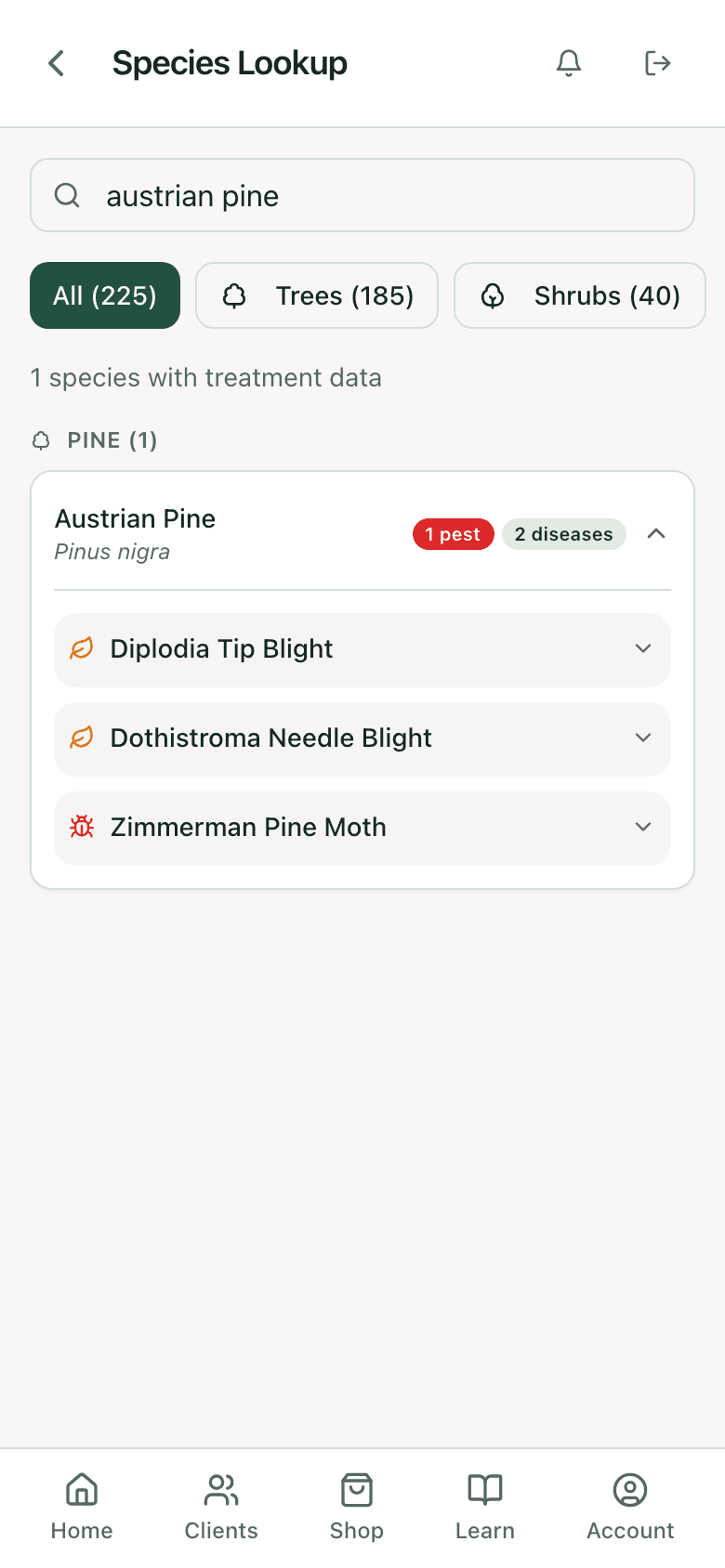
The Austrian pine with brown stubby candles all over the lower half has Diplodia, and the cones on the ground under it are where next spring's spores come from. Two protectant sprays timed to bud swell and candle elongation, or a fungicide injection at bud break, plus a cleanup that gets the cones off the property. Rates, the window, and when the tree is past saving.
disease
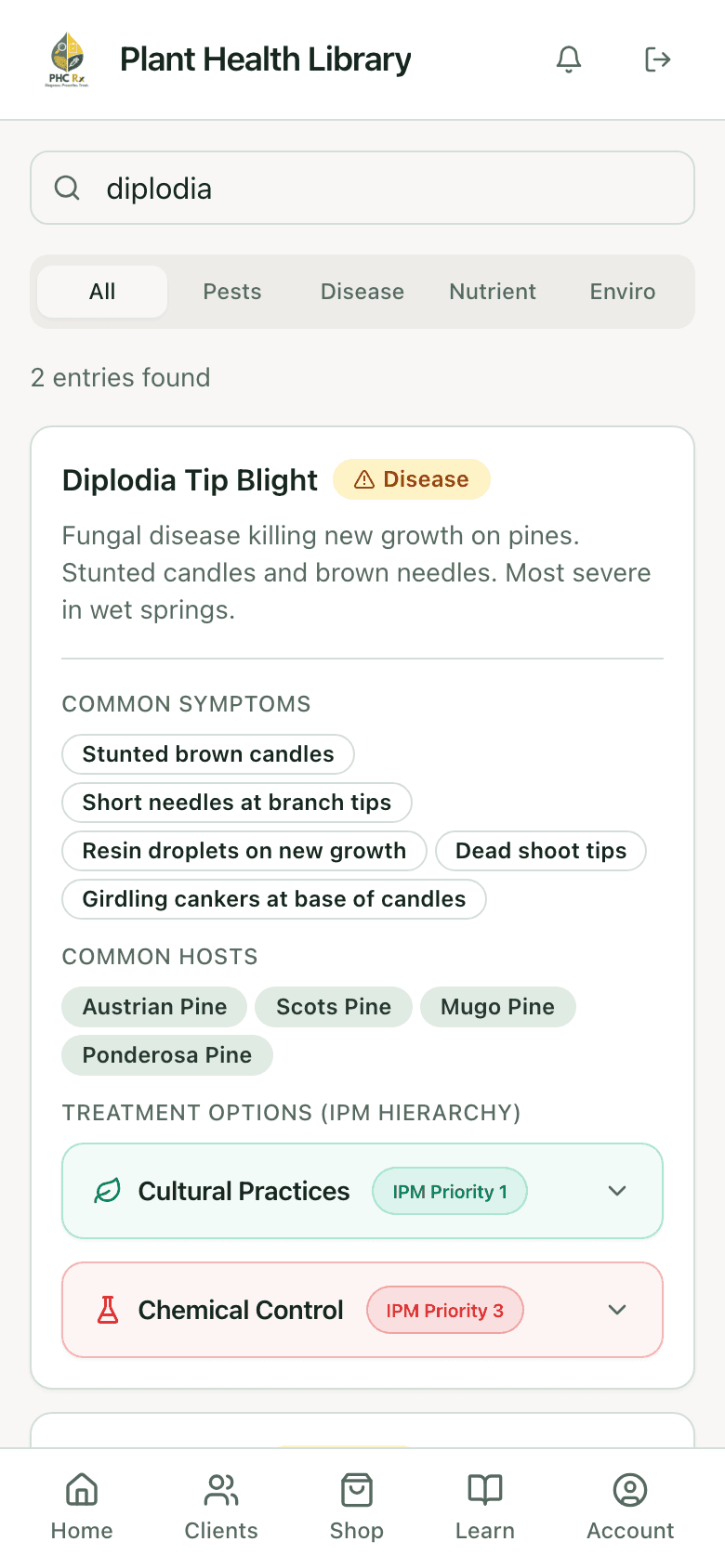
Diplodia tip blightDiplodia sapinea (formerly Sphaeropsis sapinea)
A fungus that infects the new shoots of two- and three-needle pines as the candles expand in spring. The candle stops growing, the needles on it stay short and turn straw-brown, and resin beads up at the base. It starts on the lower branches, where the spores splash up from infected cones on the ground and in the tree, and works its way up over years until the tree is a dead skeleton with a green top. The fungus also invades wounds and stressed wood, causing cankers that kill whole branches. Mature trees under drought stress are the ones that go.
Symptoms (the tree's response)
- Stunted, brown candles with short needles at the branch tips, lower canopy first
- Dead shoot tips that stay on the tree, giving it a flagged look
- Branch dieback from cankers on stressed trees
- Progressive thinning from the bottom up over several years
Signs (the organism itself)
- Black fruiting bodies at the base of the dead needles and on the scales of second-year cones, visible with a hand lens
- Resin droplets on the dead candles
- Infected cones on the tree and on the ground under it
- Dead tips on the same branches every year
Common hosts: Austrian pine, the worst hit, Scots pine and red pine, Mugo pine, Ponderosa pine, Occasionally white pine, spruce, and fir
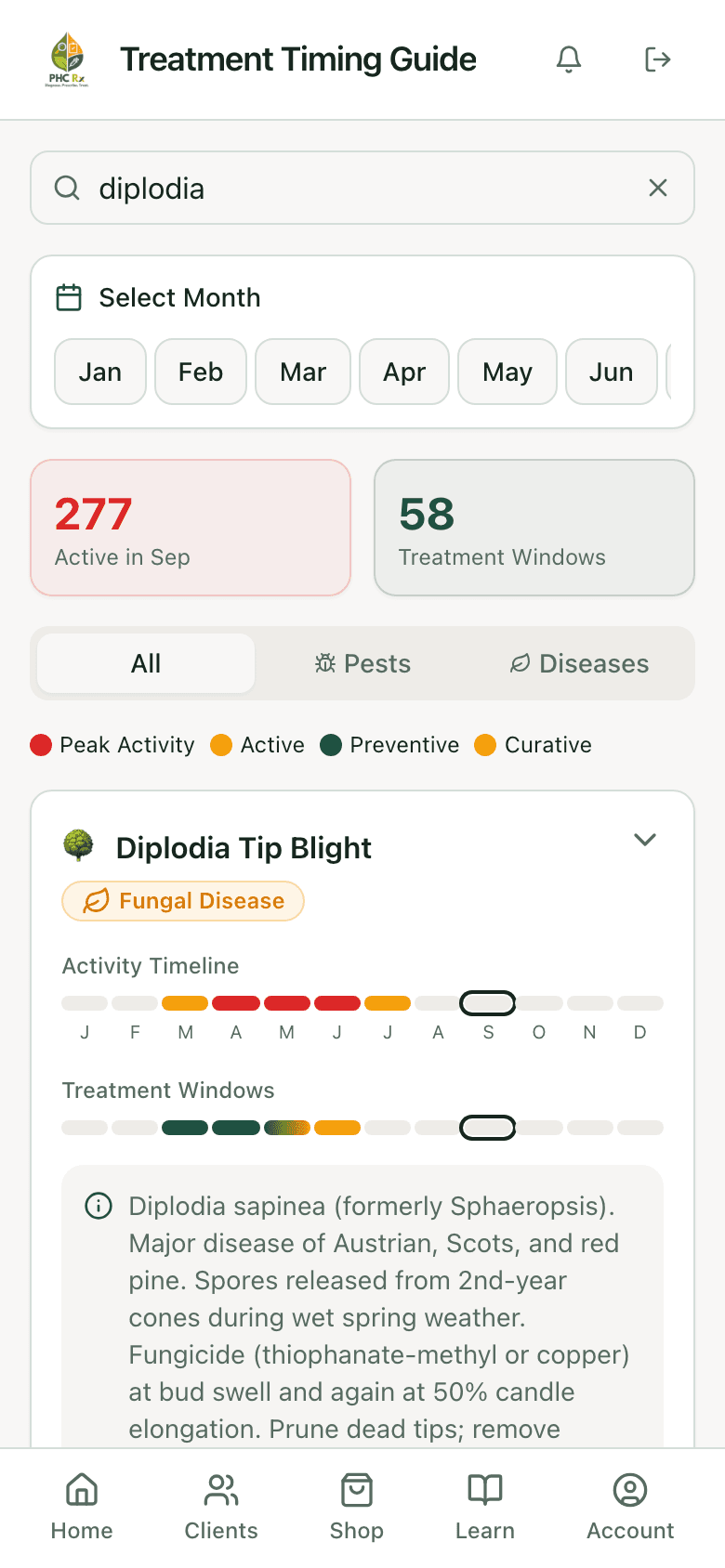
Timing window
5 active monthsOrganism active
Preventive treatment
Curative treatment
Spores release from second-year cones in wet spring weather as the buds swell. Spray at bud swell, again when the candles are about half elongated, and a third time at full elongation in a wet spring. A trunk injection goes in at bud break. Prune out dead tips in dry weather in late summer or winter, and rake and remove cones. Water deeply during drought; Diplodia kills the stressed tree and leaves the watered one alone.
Treatment options
Product, rate, delivery, timing
Rates below are per inch of trunk diameter at breast height unless the row says otherwise. The registered label wins over anything on this page.
FUNGISOL® (Mauget)
- Active ingredient
- Debacarb, Carbendazim
- Rate
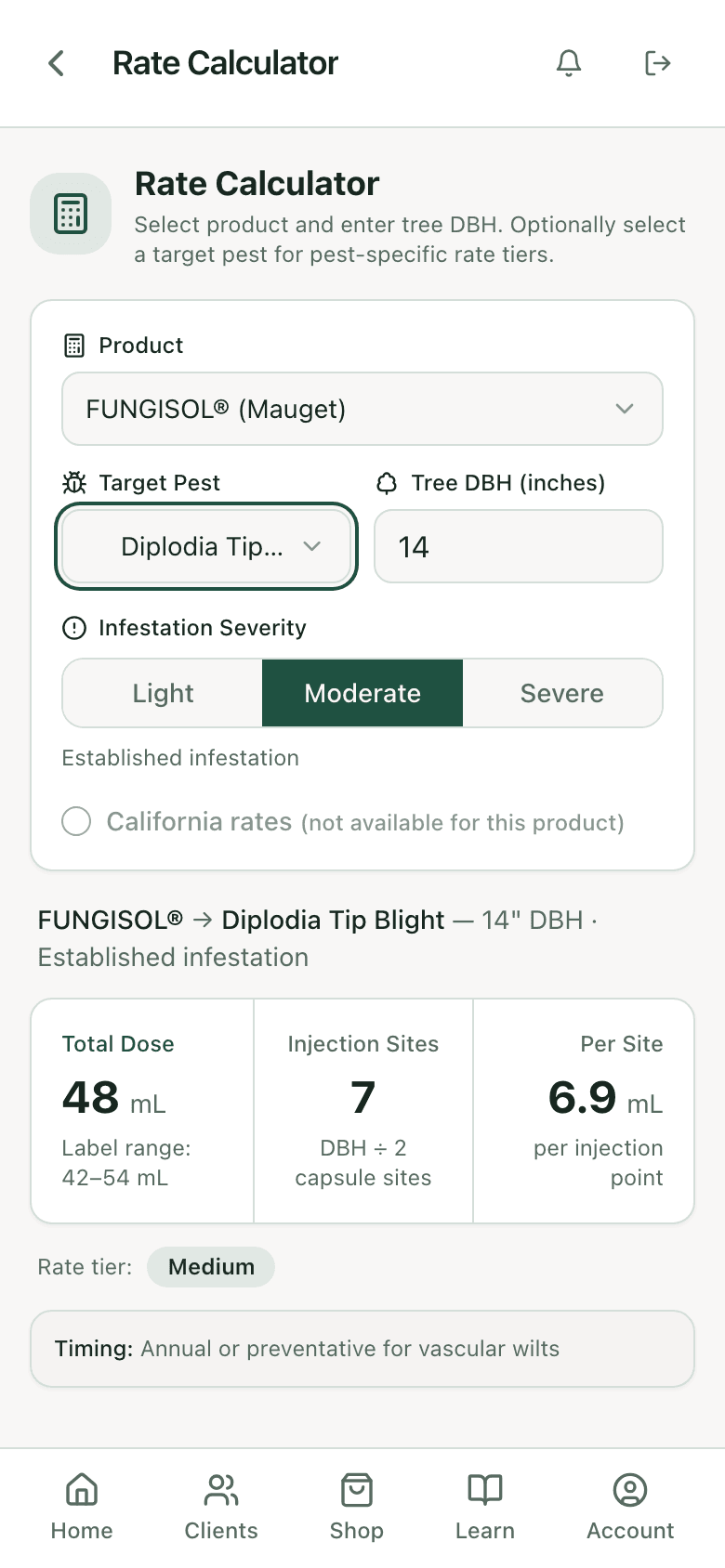
- Capsule micro-injection by DBH band. A 14 inch Austrian pine is 42 to 54 mL low, 42 to 54 mL medium, 42 to 54 mL high (label band 14 to 19 in); a 20 inch pine is 60 to 72 mL low, 60 to 72 mL medium, 60 to 72 mL high (label band 20 to 24 in)
- Delivery
- Mauget capsule micro-injection at the root flare
- Timing
- Bud break, ahead of candle elongation
- Frequency
- Annual or preventative for vascular wilts
Tebuject 16 (Mauget)
- Active ingredient
- Tebuconazole
- Rate
- Capsule micro-injection by DBH band; a 16 inch tree is 42 to 54 mL low, 42 to 54 mL high (label band 14 to 19 in)
- Delivery
- Mauget capsule micro-injection
- Timing
- Bud break
- Frequency
- Annual application or as needed during the growing season.
Propizol (Arborjet)
- Active ingredient
- Propiconazole
- Rate
- Label table by DBH band; a 16 inch tree is 160 to 180 mL low, 320 to 360 mL high (label band 16 to 18 in)
- Delivery
- Trunk injection
- Timing
- Bud break
- Frequency
- annual
TM 4.5 (Quali-Pro)
- Active ingredient
- Thiophanate-methyl 46.2%
- Rate
- Per label, diluted, sprayed to wet all new candles from the bottom of the tree up
- Delivery
- Foliar spray
- Timing
- Bud swell, half candle, and full candle in a wet year
- Frequency
- Two to three applications per spring
Copper fungicide (several brands)
- Active ingredient
- copper
- Rate
- Per label, sprayed to wet all new growth
- Delivery
- Foliar spray
- Timing
- Bud swell and half candle
- Frequency
- Two applications per spring
- FUNGISOL® (Mauget): Debacarb and carbendazim, systemic, one visit for the season. The choice on a tall pine that a sprayer cannot cover, or where the spray would drift across a property line.
- Tebuject 16 (Mauget): Tebuconazole. Rotation partner for FUNGISOL on a pine that gets injected every spring for years.
- Propizol (Arborjet): Propiconazole for crews on an Arborjet rig. Same window, same job.
- TM 4.5 (Quali-Pro): Thiophanate-methyl, the labeled protectant. The lower branches are where the infection starts, so a spray that covers the bottom third well matters more than one that reaches the top.
- Copper fungicide (several brands): The rotation partner for thiophanate-methyl and the option on a property that wants a lower-toxicity material. Not in the PHC Rx catalog as a specific product; write the brand you use and its rate.
Worked examples
Dose per tree
FUNGISOL, capsule micro-injection
14″ DBH
42 to 54 mL low, 42 to 54 mL medium, 42 to 54 mL high (label band 14 to 19 in)
FUNGISOL, capsule micro-injection
20″ DBH
60 to 72 mL low, 60 to 72 mL medium, 60 to 72 mL high (label band 20 to 24 in)
Tebuject 16, capsule micro-injection
16″ DBH
42 to 54 mL low, 42 to 54 mL high (label band 14 to 19 in)
Propizol, from the label table
16″ DBH
160 to 180 mL low, 320 to 360 mL high (label band 16 to 18 in)
Want the number for the tree in front of you? Use the tree injection rate calculator.
The cones are the reservoir
Second-year cones carry the fruiting bodies, on the tree and on the ground. A fungicide program on a pine with three years of cones under it is fighting a losing battle against its own mulch. Rake and bag the cones in fall, prune the dead tips in dry weather, and get the debris off the property. It is unglamorous, billed hourly, and does more than the third spray. Write it on the prescription as a service line so it gets done.
Then look at the water. Diplodia is a stress disease on mature trees. The Austrian pine in the parking lot island with no irrigation is the one dying; the same species in a watered lawn 50 feet away is fine. Deep watering through drought is part of the treatment, and on the island tree it may be the only part that matters.
Spray, inject, or remove
A screen of 20-foot Austrian pines gets a spray program, two or three passes a spring, aimed at the lower two-thirds. A single 50-foot specimen gets injected at bud break. A pine that has lost more than half its canopy to cankers and tip blight, on a site with no water, gets a removal quote and an honest word; fungicide on that tree is a bill, not a treatment. The diagnosis and a photo of the canopy go on the plan so the client sees why.
What the label check will catch
Tip blight is on the debacarb, tebuconazole, propiconazole, and thiophanate-methyl labels the app carries, so the disease check passes. The label check flags a spray scheduled after the candles have hardened, a repeat inside the label interval, the same triazole three springs in a row, and a DBH below the table on a young mugo that should be sprayed. It also flags a fungicide-only plan on a tree the diagnosis marked as drought stressed, which is a reminder more than a rule.
Label check
1 warningLast application was 14 days ago. Proceed with a documented override, or reschedule.
Pricing the job
Sprays are per tree per visit with a property minimum. Injection is per inch of DBH: a 14 inch pine at $18 per inch is $252 a season, a 20 inch pine is $360. Cone and tip cleanup is hourly and pairs with the fall visit. All of it goes on the calendar with the product and rate on each event, and next year's bud-swell spray is scheduled before this year's cleanup is invoiced.
FAQ
Questions arborists ask
How do you treat diplodia tip blight on Austrian pine?
Protectant fungicide sprays at bud swell, half candle, and full candle in a wet spring, with thiophanate-methyl rotated with copper, aimed at the lower two-thirds of the tree. Or a fungicide trunk injection at bud break on a tall tree. Rake and remove cones, prune dead tips in dry weather, and water through drought.
Can a pine recover from tip blight?
A tree that has lost a third or less of its canopy and has water will hold and fill in over a few seasons with a program. A tree with cankers through the main branches and half the canopy gone, on a dry site, is not coming back; quote the removal.
When should you spray pines for tip blight?
At bud swell, usually April, when the candles are about half extended in May, and again at full extension in a wet year. Sprays after the needles harden in summer do nothing until next spring.
Does trunk injection work for diplodia?
Yes, at bud break, as the season's protection on a tree too big to spray. A 14 inch Austrian pine takes 42 to 54 mL low, 42 to 54 mL medium, 42 to 54 mL high (label band 14 to 19 in) from the FUNGISOL rate table.
Why does it keep coming back?
The spores come from the cones, on the tree and on the ground, and from the dead tips left on the branches. Cleanup is half the treatment. The other reason is stress; a pine with no water in July stays susceptible no matter what is sprayed on it.
Where do these rates come from?
The PHC Rx product catalog, built from the FUNGISOL, Tebuject 16, Propizol, and TM 4.5 labels, and the app's timing guide for the spray windows.
Related