
Treatment guide
Spotted lanternfly treatment: systemics that hold through fall
The adults show up on the trunk in August, the honeydew starts in September, and the client calls when the patio turns black. A dinotefuran or imidacloprid trunk injection in a maple, walnut, or willow kills what feeds on that tree for weeks. Rates per inch, the window, and the egg-mass step that sets up next year.
pest
Spotted lanternflyLycorma delicatula
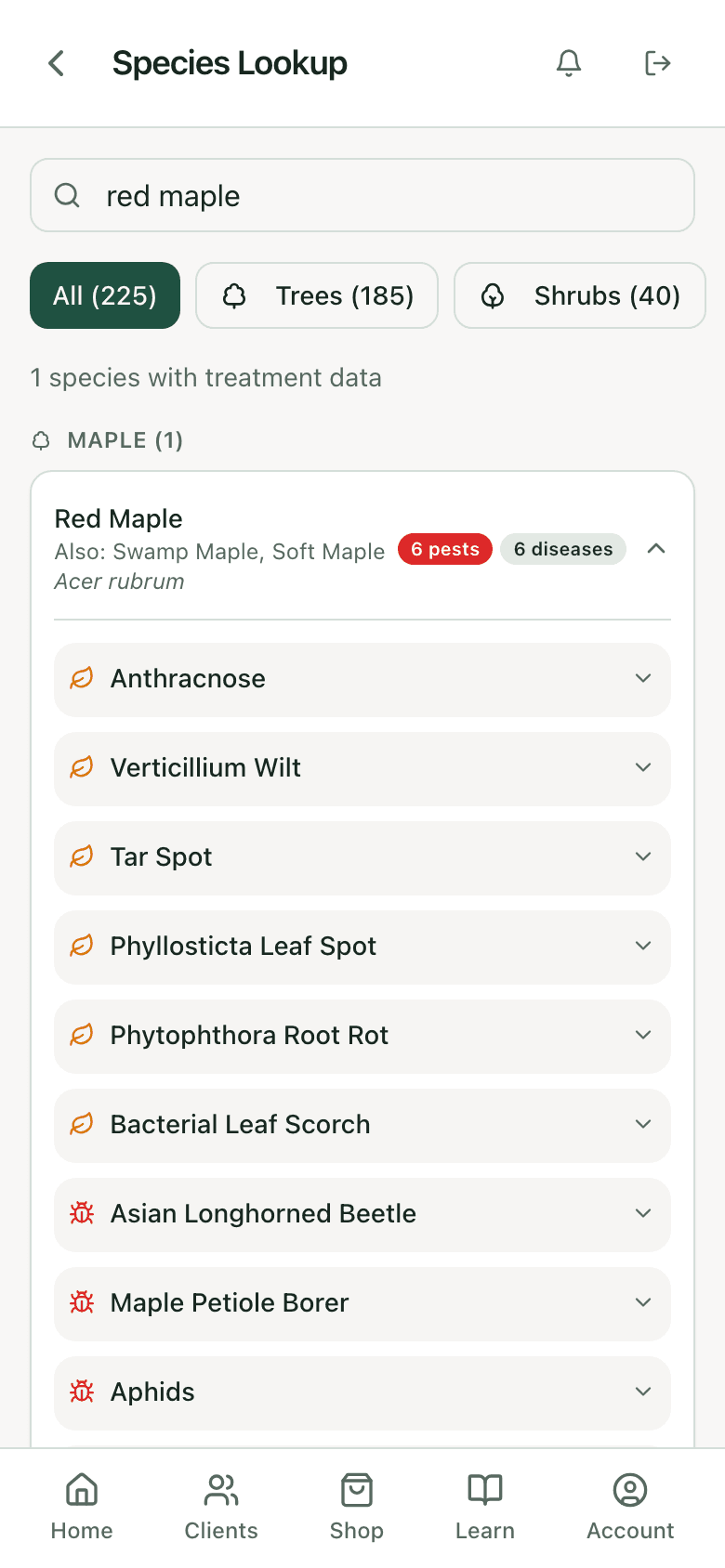
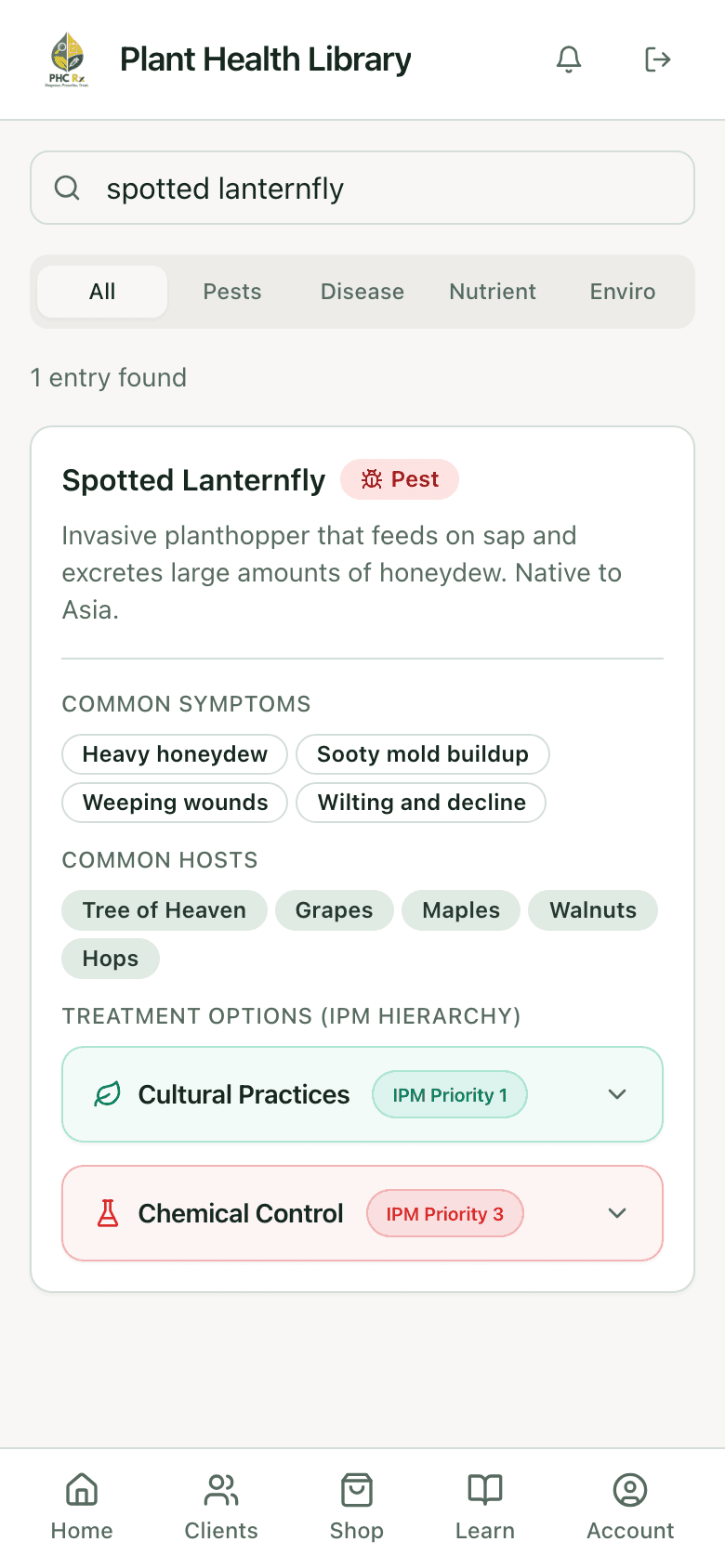
An invasive planthopper, not a fly and not a caterpillar. Nymphs hatch from egg masses in May and feed on soft growth; the fourth-instar red nymphs and the winged adults feed on trunks and limbs from July into November. They pierce the phloem and pump out honeydew, which drips on everything below and grows sooty mold. Heavy feeding on a maple or walnut weakens the tree over a few seasons; on a residential lot the complaint is the mess long before it is the tree.
Symptoms (the tree's response)
- Honeydew dripping from the canopy, wet patios and cars under the tree
- Sooty mold on bark, leaves, and everything underneath
- Weeping wounds and sap flow on the trunk where adults cluster
- Wilting, branch dieback, and thin canopy after repeated heavy years
Signs (the organism itself)
- Adults with gray spotted forewings and red underwings on the trunk, August through frost
- Red and black nymphs with white spots on new growth in June and July
- Egg masses that look like a smear of gray mud on smooth bark, September through April
- Wasps, ants, and bees working the honeydew
Common hosts: Tree of heaven, the preferred host, Red, silver, and sugar maple, Black walnut, Willow, River birch, Grape and hops on the agricultural side, Over 70 woody species when the population is high
Timing window
8 active monthsOrganism active
Preventive treatment
Curative treatment
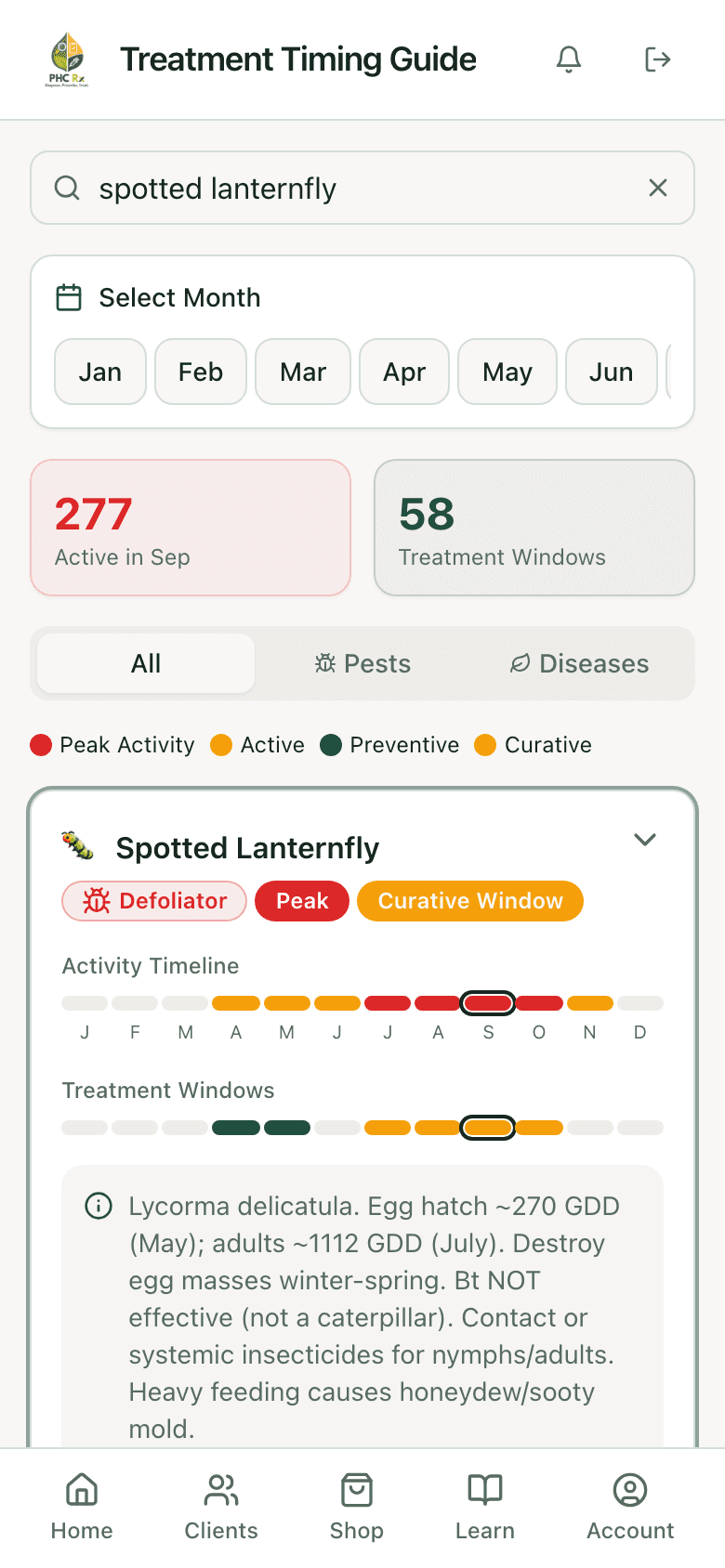
Hatch is around 270 growing degree days, usually May. Adults appear at about 1,100 GDD, July into August, and feed on trunks until frost. A systemic injected in late spring is in the tree before the nymphs move up; a systemic injected in August still kills adults for the rest of the season, and that is when most of the calls come. Scrape and destroy egg masses from October through April. Bt does nothing to a planthopper.
Treatment options
Product, rate, delivery, timing
Rates below are per inch of trunk diameter at breast height unless the row says otherwise. The registered label wins over anything on this page.
Dinocide (Mauget)
- Active ingredient
- Dinotefuran
- Rate
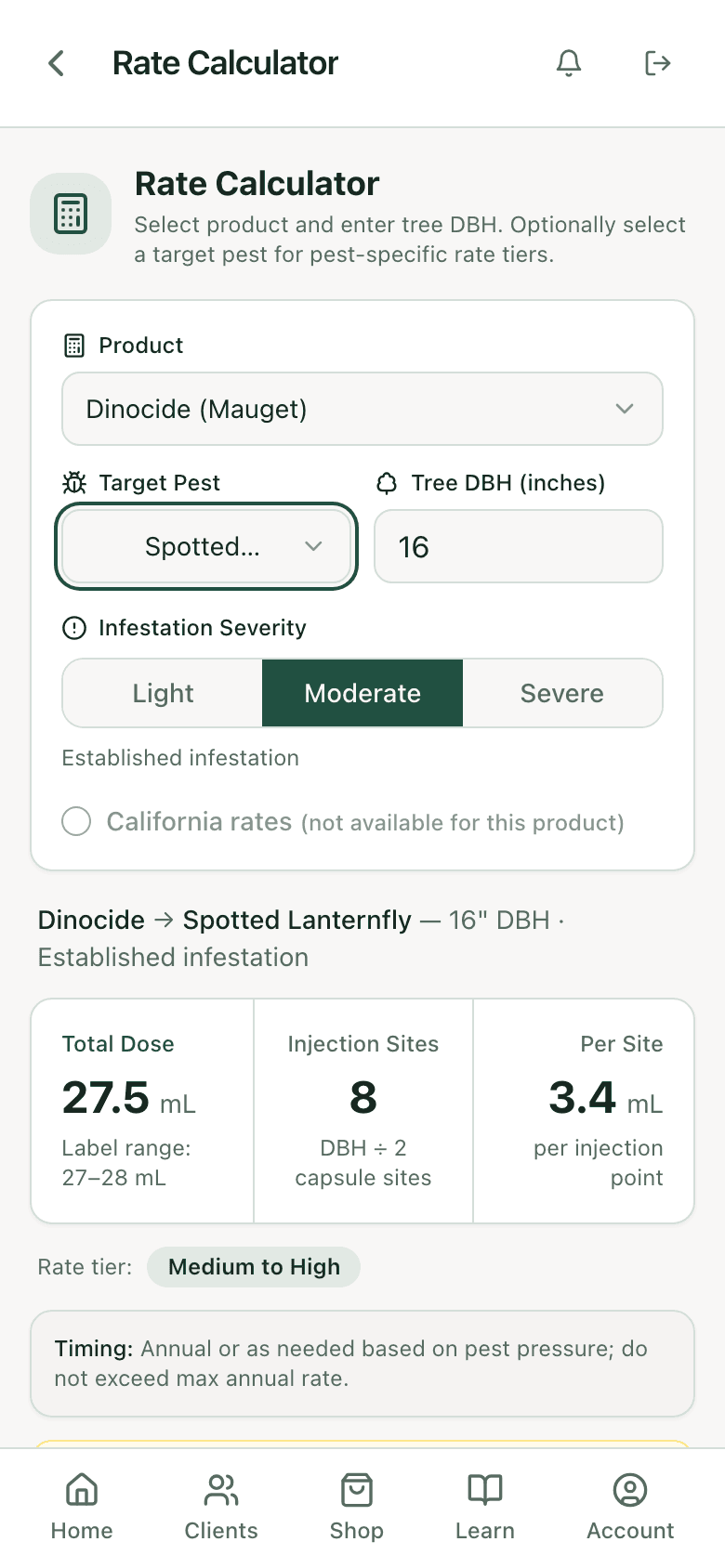
- Capsule micro-injection by DBH band. A 16 inch maple is 21 to 27 mL low, 28 to 36 mL high (label band 14 to 19 in); a 24 inch walnut is 33 to 42 mL low, 44 to 56 mL high (label band 23 to 28 in)
- Delivery
- Mauget capsule micro-injection at the root flare, one capsule per site around the trunk
- Timing
- June for the nymphs, or August when the adults arrive; moves into the canopy in days
- Frequency
- Annual or as needed based on pest pressure; do not exceed max annual rate.
Imicide (Mauget)
- Active ingredient
- Imidacloprid 10%
- Rate
- Capsule micro-injection by DBH band; a 16 inch tree is 21 to 27 mL low, 28 to 36 mL high (label band 14 to 19 in)
- Delivery
- Mauget capsule micro-injection at the root flare
- Timing
- April into June, ahead of the nymphs, on a tree that gets hit every year
- Frequency
- Annual
IMA-jet (Arborjet)
- Active ingredient
- Imidacloprid 5%
- Rate
- Label table by DBH band; a 16 inch tree is 32 to 72 mL low, 51 to 108 mL medium, 64 to 144 mL high (label band 16 to 18 in)
- Delivery
- Trunk injection with an injection rig, plugs at the flare
- Timing
- Spring, before the nymphs move onto the tree
- Frequency
- Annual
ACE-jet (Arborjet)
- Active ingredient
- Acephate 97.4%
- Rate
- Label table by DBH band; a 20 inch tree is 99 mL low, 150 mL medium, 175 mL high (label band 20 to 22 in)
- Delivery
- Trunk injection
- Timing
- When adults are on the trunk and the client wants them gone this week
- Frequency
- Per label
Bifen I/T (Control Solutions)
- Active ingredient
- Bifenthrin 7.9%
- Rate
- Per label, diluted, applied to the lower trunk and limbs where adults congregate
- Delivery
- Bark spray or foliar spray
- Timing
- August through October, repeated as adults keep arriving
- Frequency
- Per label
- Dinocide (Mauget): Dinotefuran, the fastest of the systemics on this pest. Adults feeding on the trunk pick it up within a week and drop. Protection runs into fall on a spring or summer application, so one visit covers the season on most residential trees.
- Imicide (Mauget): Imidacloprid. Slower to move than dinotefuran and longer lasting, so it is the preventive choice on the maple by the deck that has been the neighborhood lanternfly tree for three summers. Follow the label on flowering hosts and pollinator restrictions.
- IMA-jet (Arborjet): Imidacloprid for crews already running an Arborjet system. Same season-long protection; the rig is faster on large trunks than capsules.
- ACE-jet (Arborjet): Acephate. Fast knockdown, short residual, one season. The right call when the tree was not treated in spring and the population on it is heavy in September.
- Bifen I/T (Control Solutions): Bifenthrin, a contact pyrethroid. Kills what it touches, and adults keep flying in from the neighbor's tree of heaven, so it is a repeat job. Best on small hosts, fence lines, and the trunk band on trees too small to inject. Hard on beneficials.
Worked examples
Dose per tree
Dinocide, capsule micro-injection
16″ DBH
21 to 27 mL low, 28 to 36 mL high (label band 14 to 19 in)
Dinocide, capsule micro-injection
24″ DBH
33 to 42 mL low, 44 to 56 mL high (label band 23 to 28 in)
Imicide, capsule micro-injection
16″ DBH
21 to 27 mL low, 28 to 36 mL high (label band 14 to 19 in)
ACE-jet, from the label table
20″ DBH
99 mL low, 150 mL medium, 175 mL high (label band 20 to 22 in)
Want the number for the tree in front of you? Use the tree injection rate calculator.
Inject the host, not the neighborhood
Spotted lanternfly does not stay on one tree, so the goal of a treatment is a clean tree and a clean patio, not eradication. Pick the trees that matter: the maple over the deck, the walnut over the driveway, the willow by the pool. Inject those with a systemic and the adults that land on them die. Trees on the back fence get left alone or get a bark spray if the client is paying for it.
Tree of heaven is the one exception. If there is an Ailanthus on the property, it is the magnet, and the decision is remove it or treat it as a trap tree with a systemic so it kills what it attracts. Removal without treating the stump brings back a thicket of suckers, which are worse.
The egg-mass visit
Every egg mass on the property in winter is 30 to 50 nymphs in May. They are on smooth bark, the underside of limbs, fence rails, patio furniture, the RV. A scrape-and-bag visit from October through April, billed hourly and paired with dormant pruning, takes down next spring's population on that lot. It does not stop the neighbor's from flying in, so the injection still goes on the calendar. Put both on the prescription as separate lines and let the client see why.
What the label check will catch
Spotted lanternfly is on the dinotefuran, imidacloprid, acephate, and bifenthrin labels the app carries, so the pest check passes. What the label check flags is the maximum annual rate on a tree that was already injected in spring, a neonicotinoid on a linden or other pollinator-heavy host during bloom, and DBH under the label minimum on a young maple. The flag shows on the plan before the client does.
Label check
1 warningLast application was 14 days ago. Proceed with a documented override, or reschedule.
Pricing the job
Injections are priced per inch of DBH like any other. A 16 inch maple at $18 per inch is $288 for the season; a 24 inch walnut is $432. A bark spray on three small hosts is priced per visit with a minimum and sold as a series, because the adults come back. Scraping is hourly. All of it lands on the calendar with the product and rate on the event, so the September call from the same client next year starts with a record instead of a guess.
FAQ
Questions arborists ask
What is the best treatment for spotted lanternfly on trees?
A systemic trunk injection with dinotefuran or imidacloprid on the trees the client cares about. Dinotefuran works within days and carries through fall; imidacloprid applied in spring lasts the season. Contact sprays on the trunk band work for a week and have to be repeated.
When should you treat for spotted lanternfly?
Late spring, so the systemic is in the tree before the nymphs move onto it, or August when the adults arrive on the trunk. A dinotefuran injection in August still gives full control for the rest of the season. Scrape egg masses from October through April.
Does tree injection work on spotted lanternfly?
Yes. Adults and nymphs feed on phloem, which is exactly where an injected systemic ends up. A 16 inch maple takes 21 to 27 mL low, 28 to 36 mL high (label band 14 to 19 in) from the Dinocide rate table.
Should I cut down a tree of heaven to control lanternfly?
Remove it if you can treat the stump and follow up on suckers, otherwise treat it as a trap tree with a systemic. Cutting it and walking away produces a stand of suckers that hosts more lanternfly than the original tree.
Will spotted lanternfly kill my maple?
Rarely on its own. Repeated heavy feeding thins the canopy and stresses the tree, and the honeydew and sooty mold are the visible damage. The treatment decision is usually about the mess and the tree's long-term vigor, not imminent death.
Where do these rates come from?
The PHC Rx product catalog, built from the Dinocide, Imicide, IMA-jet, ACE-jet, and Bifen I/T labels, and the app's timing guide for the activity windows.
Related