
Guide
Plant health care pricing: per inch, per tree, or flat.
Most PHC work is priced by trunk diameter, because the product, the ports, and the time all scale with it. Sprays price by tree size or by property. Here is how the numbers get set, the eleven service types most companies start with and what they default to, where the minimum goes, and how to keep the product cost from eating the margin.
Key takeaways
- Injections and soil applications price per inch of DBH with a per-visit minimum. The working range is $10 to $25 per inch; the PHC Rx defaults sit at $25 for trunk injections and $15 for soil injections.
- Sprays price per tree by size class or per property. Trying to price a foliar spray per inch makes small trees free and big trees absurd.
- The minimum is the most important number on the sheet. It covers the drive, the setup, and the paperwork on a tree too small to pay for itself per inch.
- Product cost on a trunk injection is usually under a fifth of the price. Labor and the return visit are the real costs.
- Write the price on the prescription, from the DBH on the plant record, and never from memory at the truck.
Why per inch of DBH
Every label for a systemic doses by trunk diameter. The product in the tree, the number of injection ports, the time the uptake takes, and the size of the crown you are protecting all go up with DBH. Pricing the same way keeps the quote honest on both ends: a 10 inch crabapple is not a $500 job and a 40 inch elm is not a $200 one. The client can also check it with a tape, which builds trust in a way a flat number does not.
The exception is anything you apply to foliage. Spray volume depends on canopy size, not trunk size, and a spray on a 30 foot tree takes roughly the same time whether its trunk is 12 inches or 18. Those services price per tree by height or canopy class, or per property for a hedge or a bed.
The eleven default service types
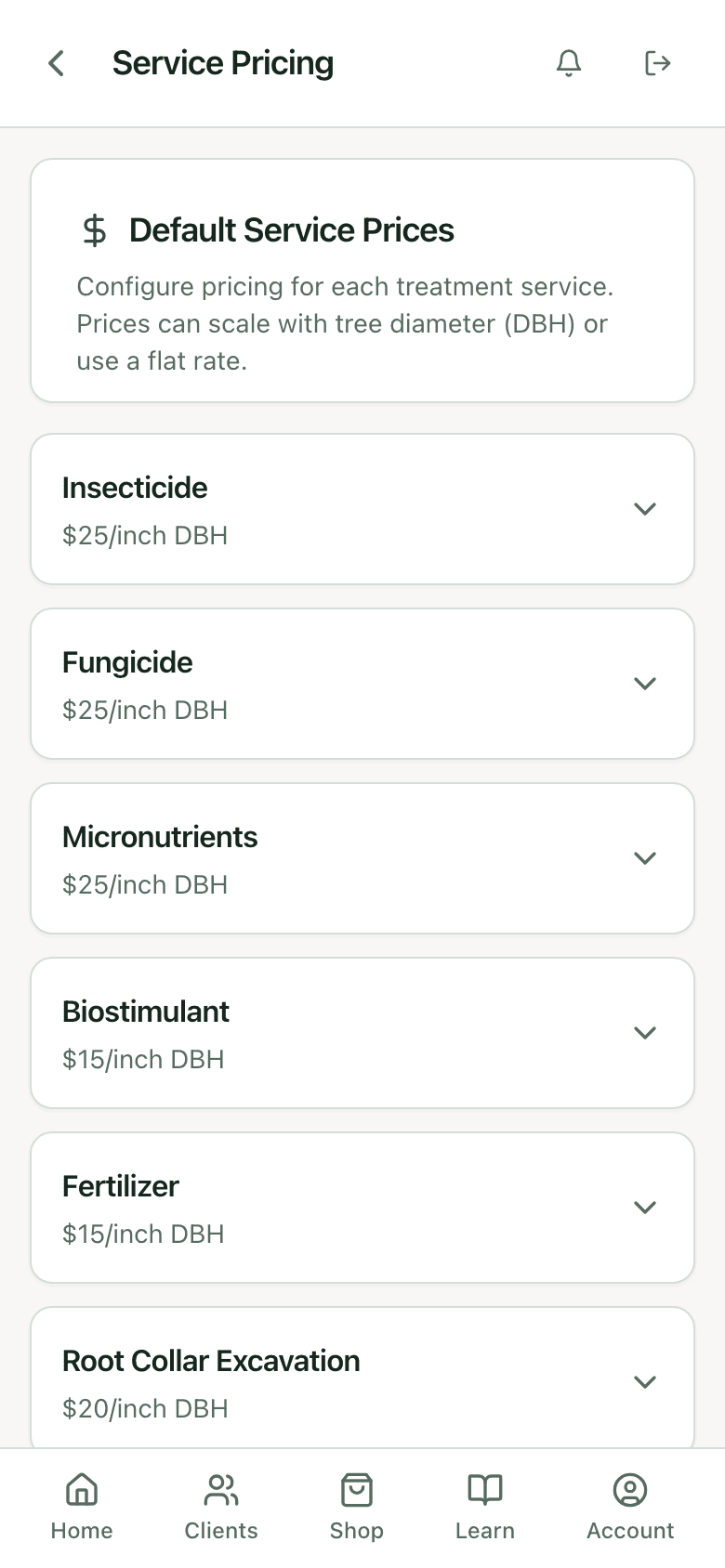
PHC Rx ships with eleven service types, each with a default rate per inch you can change, a minimum, and a flat-rate option for services that do not scale. The defaults are a starting point from real programs, not a recommendation for your market.
PHC Rx default service pricing (per inch of DBH, editable per company)
Insecticide (trunk injection)
- Default rate
- $25 per inch
- Typical delivery
- Emamectin benzoate, imidacloprid, dinotefuran, abamectin
Fungicide (trunk injection)
- Default rate
- $25 per inch
- Typical delivery
- Propiconazole, tebuconazole, thiabendazole
Micronutrients (trunk injection)
- Default rate
- $25 per inch
- Typical delivery
- Iron, manganese for chlorosis
Antibiotic (trunk injection)
- Default rate
- $25 per inch
- Typical delivery
- Oxytetracycline for bacterial leaf scorch
Growth regulator
- Default rate
- $18 per inch
- Typical delivery
- Paclobutrazol soil application
Root collar excavation
- Default rate
- $20 per inch
- Typical delivery
- Air spade, girdling root correction
Biostimulant (soil injection)
- Default rate
- $15 per inch
- Typical delivery
- Mycorrhizae, humates, seaweed
Fertilizer (soil injection)
- Default rate
- $15 per inch
- Typical delivery
- Slow-release N, deep root feeding
Bark spray
- Default rate
- $12.50 per inch
- Typical delivery
- Basal bark dinotefuran, borer bark sprays
Soil amendment
- Default rate
- $12 per inch
- Typical delivery
- Compost, biochar, pH correction
Foliar spray
- Default rate
- $10 per inch
- Typical delivery
- Better priced per tree; the per-inch default is a floor
How the price is computed
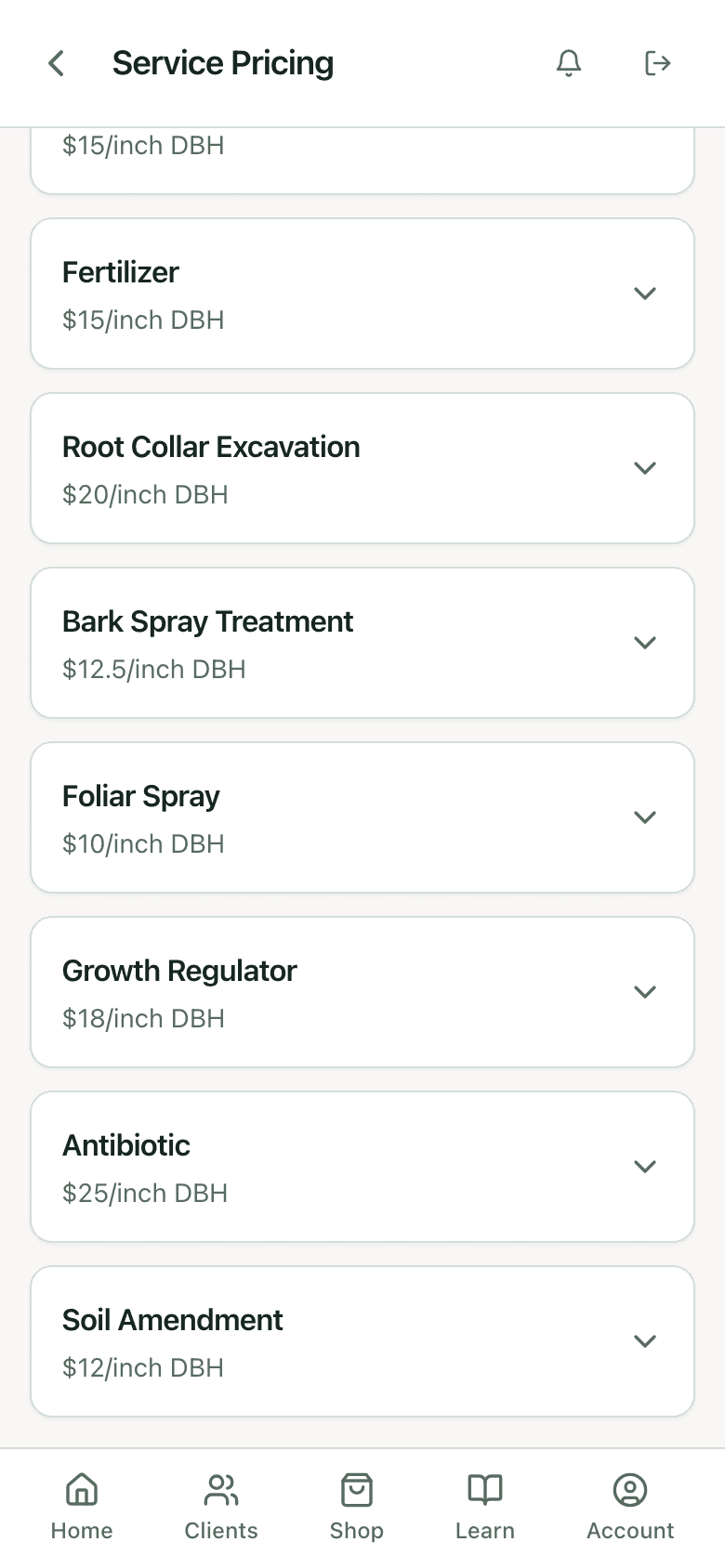
For a per-inch service, the app multiplies the rate by the DBH on the plant record and compares it to the minimum; the client pays the larger. For a flat-rate service, the base price applies regardless of DBH, and the minimum still acts as a floor. If the DBH is missing on a per-inch service, the minimum applies rather than a guess. That logic lives in one place so a tech quoting from the truck and the owner quoting from the office get the same number.
Worked examples at the default rates with a $150 minimum
22 inch ash, EAB
- Service
- Insecticide injection
- Per inch
- 22 x $25 = $550
- Minimum
- $150
- Price
- $550
5 inch crabapple, scab
- Service
- Fungicide injection
- Per inch
- 5 x $25 = $125
- Minimum
- $150
- Price
- $150
14 inch hemlock, HWA
- Service
- Insecticide injection
- Per inch
- 14 x $25 = $350
- Minimum
- $150
- Price
- $350
30 inch oak, decline
- Service
- Biostimulant soil injection
- Per inch
- 30 x $15 = $450
- Minimum
- $150
- Price
- $450
Boxwood hedge, blight
- Service
- Foliar spray, flat
- Per inch
- n/a
- Minimum
- $150
- Price
- Base price, say $185
Setting the minimum
The minimum covers the visit: drive time, setup, the label check, the record, the invoice. Most PHC operations land between $125 and $250 per visit and adjust by market. A minimum that is too low turns small-tree jobs into losses; one that is too high loses the crabapple that would have become a program client. Set it once, write it on every quote, and revisit it in January.
Multi-tree visits are where the minimum earns its keep in the other direction. Three 8 inch trees at one address is $600 at $25 per inch and one drive, and the client gets a per-property number that feels fair.
Product cost and margin
Trunk injection is the highest-margin service most tree companies run. The product in a 22 inch ash on emamectin benzoate at the label's medium rate is roughly $50 out of a $550 price at the default rate. Labor is 45 minutes to an hour with setup and uptake. The tree injection pricing guide works the whole job. Soil applications carry cheaper product and more time; sprays carry cheap product, more time, and weather risk.
Where programs lose margin is the return visit that was never priced: the follow-up inspection, the efficacy check, the retreatment reminder call. Price the program, not the visit, or put the follow-ups on the calendar as billable events.
Programs and annual agreements
The pricing sheet is per service. The business runs on programs: a property with its trees on a plan, priced annually, billed in installments or per visit. A program price is the sum of the per-inch services on the schedule plus the sprays by tree count, with a small discount for the commitment and the certainty. The starter guide covers how the first thirty programs get sold; the pricing sheet is what they are built from.
What goes on the prescription
The service, the per-inch rate or the flat price, the DBH it was computed from, the minimum if it applied, and the total. The client sees the total and the DBH; the internal notes carry the product cost if you track it. In PHC Rx the total cost field fills from service pricing and the DBH on the plant record, and it is on the record when the client accepts.
Written and reviewed by
ISA Board Certified Master Arborist MA-5832B · ISA TRAQ · Maryland Licensed Tree Expert #2168
Alex Shy is an ISA Board Certified Master Arborist, TRAQ-qualified tree risk assessor, and Maryland Licensed Tree Expert. He holds a B.S. in Forest Resource Management from West Virginia University. Alex is the founder and president of Mobile Tree Spa LLC, founder and co-owner of the PHC Rx diagnostic app, and a member of the ATCP board, where he oversees the education committee. His work focuses on making science-based plant health care practical, profitable, and easy for tree care companies to adopt.
ISA Certified Arborist MA-7027A · VNLA Certified Horticulturist · Virginia Commercial Pesticide Applicator
Jordan Thompson is an ISA Certified Arborist, VNLA Certified Horticulturist, Virginia Commercial Pesticide Applicator, and co-owner of J.J. Mauget Co. and TIPCO. She holds an M.S. in Entomology and a B.S. in Environmental Horticulture from Virginia Tech. Her work bridges arboriculture, plant health care, and applied research, with a particular focus on tree injection, invasive species, tree disease management, and translating university research into practical tools for professional arborists.
FAQ
Questions arborists ask
How much should I charge for plant health care?
Per inch of DBH for injections and soil applications, $10 to $25 per inch depending on product and market, with a per-visit minimum of $125 to $250. Per tree by size class for sprays. The PHC Rx defaults are $25 per inch for trunk injections, $15 for soil injections, and $10 to $20 for the rest.
Should I price per inch or flat?
Per inch for anything dosed by trunk diameter, because the product and the time scale with it. Flat or per tree for sprays and for property-level services like a hedge treatment. The app supports both per service.
What minimum should I set?
Enough to cover the visit: drive, setup, label check, record, invoice. Most operations land between $125 and $250 and adjust by market.
How much is the product cost on an injection?
Usually under a fifth of the price. A 22 inch ash on emamectin benzoate at the medium rate is about $50 of product against a $550 price at the default rate. See the injection pricing guide.
How do I price a multi-stem tree?
Dose and price each stem large enough to inject, or use the combined DBH the label method gives you. Say which on the prescription. The DBH guide covers the multi-stem rules.
Can I change the default rates?
Yes. Every service has an editable per-inch rate, a minimum, and a flat-rate toggle, set per company in the app.
Related