
Free download
Tree inspection report template, one row per tree.
An HOA with 80 trees, a campus after a storm, a property manager who wants to know what is going to fall on a car. The job is a condition rating per tree, the observations behind it, and a recommendation with a priority, on a sheet someone can sort. This template is that log, a rating key, a summary line, and a detail sheet for anything rated poor or worse.
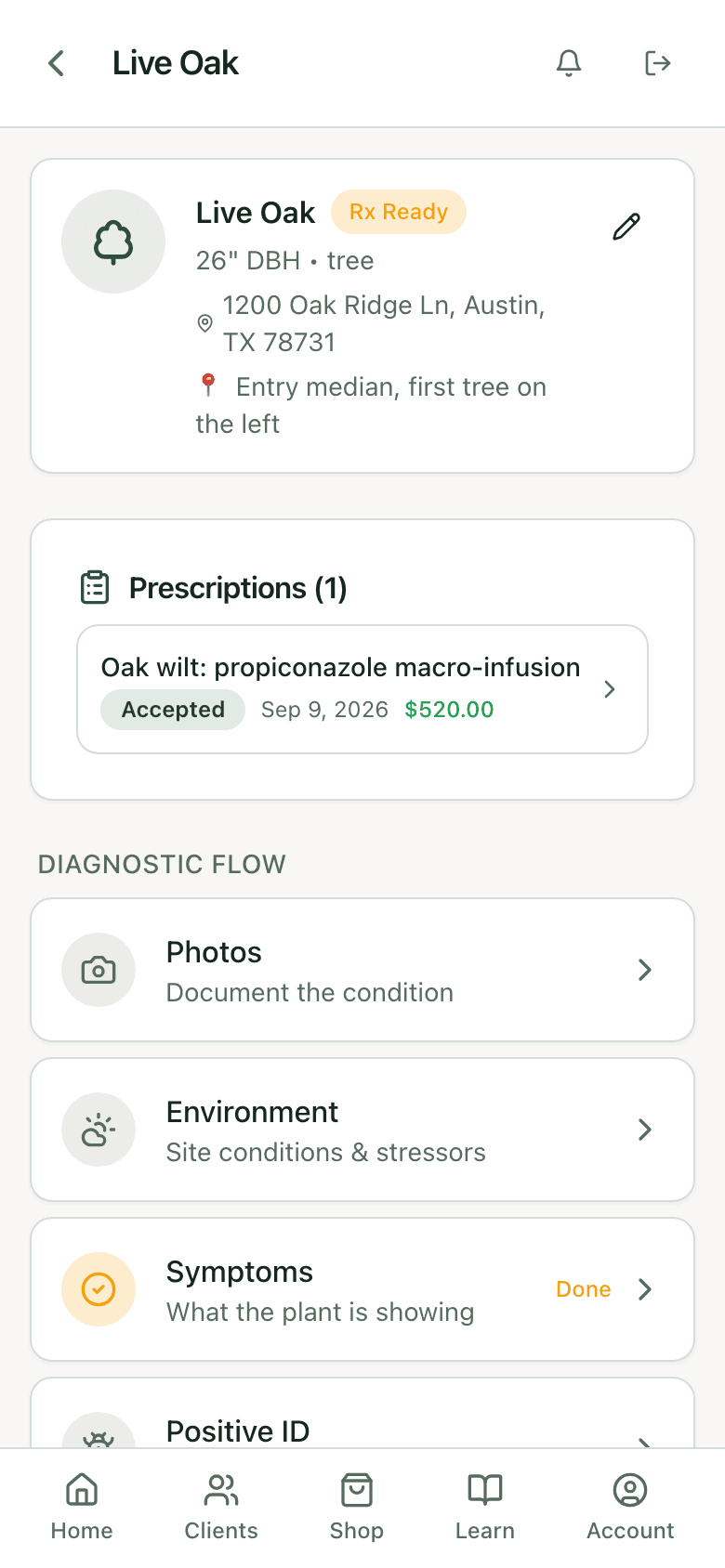
Download the blank version, or skip the paper and fill it in the app.
Field by field
What goes in each box, and why
Property and inspection
Client, address, inspection date, inspector and credential number, weather, sheet number, scope (all trees, trees over a DBH, trees near targets, listed trees, post-storm), count of trees inspected.
Scope is what the client bought. "All trees over 6 inches within 50 feet of a structure" is a different job from "every tree on the property," and the price and the liability follow the sentence.
Condition rating key
Good: full crown, normal vigor, no significant defects. Fair: minor dieback or defects, no immediate action. Poor: significant dieback, decay, or structural defect; action needed. Critical: imminent failure or dead; immediate action.
Four ratings, printed on the sheet, so every inspector on the crew rates the same tree the same way and the client can sort by it.
Inspection log
Tree number, species, DBH, height, condition rating, observations (defects, pests, disease, site), target present, recommendation, priority, photo number. Fourteen rows per sheet.
This is the deliverable. A property manager wants a table they can sort by priority and hand to a budget meeting, not a narrative.
Summary
Counts by rating. Removals recommended, treatments recommended, Level 2 risk assessments needed. Three lines of narrative.
The summary is what gets read first and quoted in the board meeting. "Sixty-two trees inspected, four critical, nine poor, three removals, six treatments, two need a full risk assessment."
Detail sheet
One per tree rated poor or critical: tree number, species, DBH, location, roots and collar, trunk, crown, suspected pest or disease with a diagnosis confidence, recommendation, treatment product and rate, timing window, cost, follow-up (Level 2, Level 3, treatment scheduled, removal quoted, re-inspect interval).
A one-line log entry cannot hold what a critical tree needs. The detail sheet is where the inspection becomes a diagnosis or a risk assessment, and where the recommendation gets a price.
Signature
Inspector signature, credential number, date.
The inspection is a document once it is signed. Until then it is notes.
How to complete it
Step by step
1
Tag or map the trees first
Numbered tags, or GPS in the app, or a sketch with numbers. An inspection log with no way to find tree 37 again is a list of adjectives. In PHC Rx every tree on the property gets a record with species, DBH, GPS, and photos before any inspection starts.
2
Walk the property in one direction
Front to back, left to right, so the numbers run in an order the next inspector can follow. Rate every tree as you pass it; do not skip the good ones, because "good on this date" is the baseline for next year.
3
Log the observations, not the conclusion
The observations column is what you saw: dead limbs over 4 inches, conks at the base, chlorotic foliage, girdling root, sidewalk lift. The rating and the recommendation follow from it. A reviewer can check an observation; they cannot check "looks bad."
4
Detail sheet for poor and critical
Every tree at poor or critical gets the second page: roots, trunk, crown, a suspected cause with a confidence, a recommendation with a product and rate if it is a treatment, and a follow-up box. Run the diagnosis or the risk wizard in the app for these.
5
Summarize and sign
Counts by rating, the removals, the treatments, the trees that need a Level 2 assessment. Three lines the client can read aloud. Sign it, date it, and deliver it as a link or a PDF.
About the download
Two pages: the property header, rating key, fourteen-row inspection log, and summary on page one; two detail sheets on page two, to be printed as many times as there are poor or critical trees. It is a PHC Rx layout, not a municipal form; where a city or an HOA has its own inspection form, the columns here map onto it. The arborist report template is the single-tree version, and the tree risk assessment form is what a Level 2 assessment on a critical tree produces.
The same inspection, on the tree record
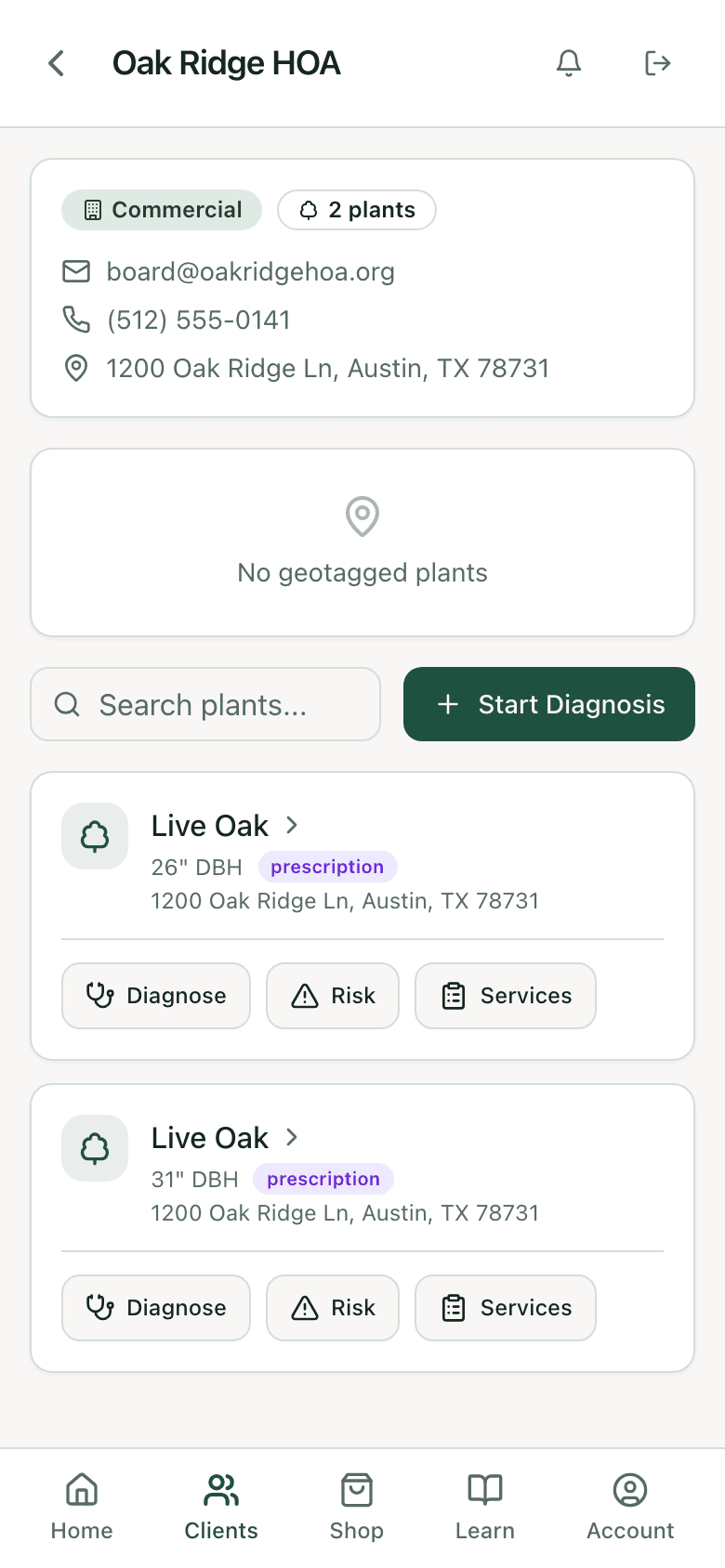
In PHC Rx every tree on the property is a record with species, DBH, GPS, photos, a diagnostic state, and every treatment ever applied. An inspection is a visit that updates the state and the photos; a poor tree gets a diagnosis or a risk assessment on the same record, and the report generates from it with the company branding. Next year's inspection starts from this year's ratings instead of a blank sheet.
FAQ
Questions arborists ask
What is a tree inspection report?
A condition survey of the trees on a property: each tree identified, rated on a fixed scale, its observations logged, and a recommendation with a priority. It is broader and shallower than a risk assessment, which goes deep on one tree, and it is usually the step that decides which trees get one.
How is this different from a tree risk assessment?
An inspection rates condition across many trees quickly. A Level 2 risk assessment rates the likelihood and consequences of failure on one tree with the two matrices. The inspection log flags which trees need the assessment; the detail sheet and the risk form are where it happens.
How often should trees be inspected?
Annually on most managed properties, after any major storm, and before construction near the root zone. Trees rated poor get a re-inspection interval on the detail sheet, usually six to twelve months.
Who can do a tree inspection?
Anyone can walk a property and rate trees; the report carries weight with a certified arborist's credential number on it, and a risk rating on a critical tree should come from someone with a tree risk assessment credential.
What does the client do with it?
Sort by priority, budget the removals and treatments, and keep it as the baseline for next year. In the app the inspection is on the tree records, so the client's next report shows what changed.
Related